Jocelyn Curry

Art & Joie de Vivre

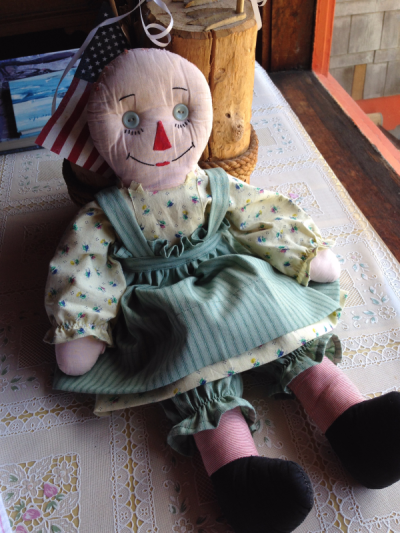
  • A very few toys from my childhood have survived the 6+ decades of my life. One of these is the Raggedy Ann made for me and my sister by our loving and skilled seamstress mother in the early 1950's. Yes, there was also a Raggedy Andy but none of us know what happened to him. I always loved peeking under Raggedy Ann's dress to see the heart embroidered with "I Love You." What child doesn't need to be reminded of this, often?

    About 18 months ago Rick and I were helping my mother prepare to move out of her house when I came across our old Raggedy Ann. She was completely bald, her rusty orange hair having been shorn by moths, I assumed. Her soft blue button eyes were as wistful as ever, but her original bloomers, calico frock and crisp white apron were no longer on her faded pink body. Replacing them were a different dress and a wilted apron. Right then and there I decided to restore her. Before I did, I took this photo of her:


    IMG_2679

    Smiling, even in her naked state, Raggedy Ann rests against Mom's antique French clock in Berkeley, CA, July, 2016. I took her down there with me from Seattle so I could cut out new clothes for her while keeping Mom company in her new apartment at my sister's house.
    IMG_2768

    Raggedy Ann went on another trip in August of this year. Here is Ann in her new outfit which I completed while vacationing in Seaside, OR.


    IMG_2990

    Today, September 28, I completed Raggedy Ann's new acrylic yarn hair while waiting for my car to be serviced. I plunked her down on the desk and got the impression that she rather liked her updated appearance! She's been the ideal portable handwork project.


  • There's a first time for everything, and this first-time project was fun. 

    IMG_2868

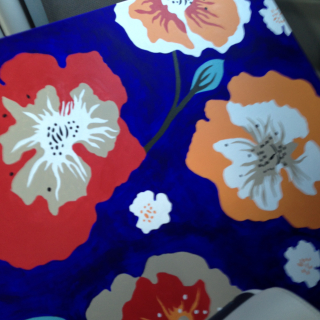
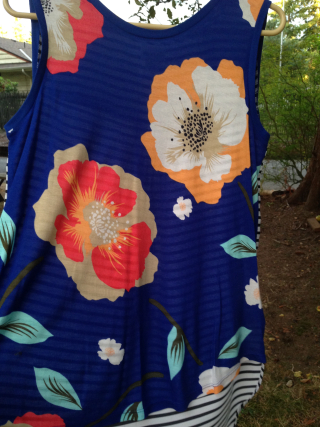
    Here's my blouse and this is how this project got started: I wore this to go visit my sister-in-law at her new home in Fircrest, WA. She loved my blouse, and said so! The reason for our visit was to help select light fixtures for her new place. While we were all pondering the possibilities, she offhandedly said that for one big white wall in her kitchen she thought she would buy a large, bright fabric panel. Remember Marimekko panels that we baby boomers bought for our rental apartments, back when? (Think bold colors and Scandinavian design). I tucked this wish of hers away in my mind. From her house we went to the lighting fixture store where my sister-in-law was drawn to the blown glass pendant lights that were mixed primary colors, just like in my blouse. I took that image away with me that day, too.

    IMG_2880

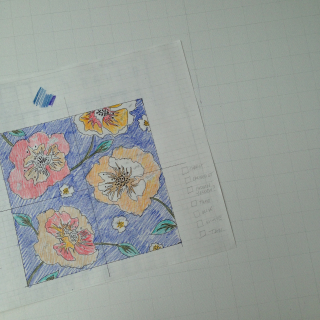
    Then, the following week I was thinking about my sweet sister-in-law, the blouse, the Marimekko idea, and the glass fixture she loved. That's when the idea popped into my head: make a painting on canvas with acrylic that would perk up that wall, the kitchen, and serve as something to enhance that pendant shade should she decide to buy it. Voilà! A great idea! I texted her to see if she liked the it, too. YES. So, I bought a 30" x 30" canvas the next day. Mind you, I'm no real painter in acrylic, but I have some big tubes of acrylic sitting around needing to be used. I got right to it. Above is my scale drawing based on the flowers in my blouse. The color guide is pencilled to the right. 

    IMG_2882

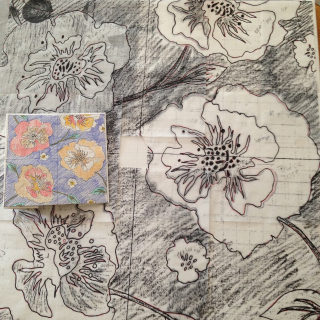
    Originally I was going to enlarge the design via a proportional grid process. I soon bagged the grid approach of enlarging because it was taking a tediously long time. The "work smarter not harder" motto kicked in. Time to enlarge my sketch with my trusty old copy machine onto tracing paper. I traced over these with graphite transfer paper. I was then ready to mix paint colors to match the blouse colors.

    IMG_2883

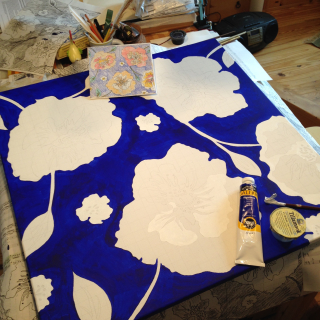
    Here's my first pass with ultramarine blue applied to the background. The white was then added. It was paint-by-number time. 

    IMG_2886

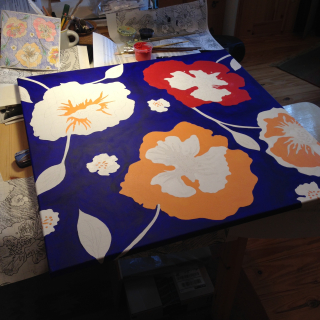
    Then came the yellow, then the red.

    IMG_2888

    I proceeded to mixing and painting each color systematically. The day we were to deliver the painting, I worked nonstop. After getting all the painting done I turned a wall heater on and parked the canvas nearby to dry before it was put in the back seat for the ride to Fircrest. Gotta love acrylic paint. A photo finish. Here is a rather blurry, partial picture of the painting hastily taken from the front seat where I was sitting!

    IMG_2889
    And here is the, well, unoriginal original in its intended place. It's looking pretty good as blouse-inspired paintings go! My sis-in-law is happy.


  • Before meeting a new group of map drawing students, I spend several days preparing teaching materials for them. There are no prerequisites for the class. Therefore, basic instruction in many different drafting and drawing skills related to drawing maps is necessary. The students never fail to impress me as they devotedly toil over every phase of their map designs. The results are so inspiring that I often take their ideas and suggestions and incorporate them in the next workshop I offer. The photos below were taken early on day 3, before the final push to finish them so what you see are not the finished products. This class was offered through the outstanding North Cascades Institute and was held June 24-26 at their beautiful Environmental Learning Center up on Diablo Lake. I have program director Katie Roloson to thank for including this class in the curriculum. Here are several examples of the participants' hard work:

    IMG_2645

    IMG_2646


    IMG_2639

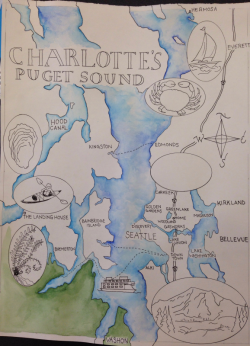
    Mary and Charlotte Minor, one of two mother-daughter pairs in this class, smile in the midst of creating their personalized maps of Puget Sound, shown above their photo. A lot of hours go into making a map so being able to smile is helpful!
    IMG_2647

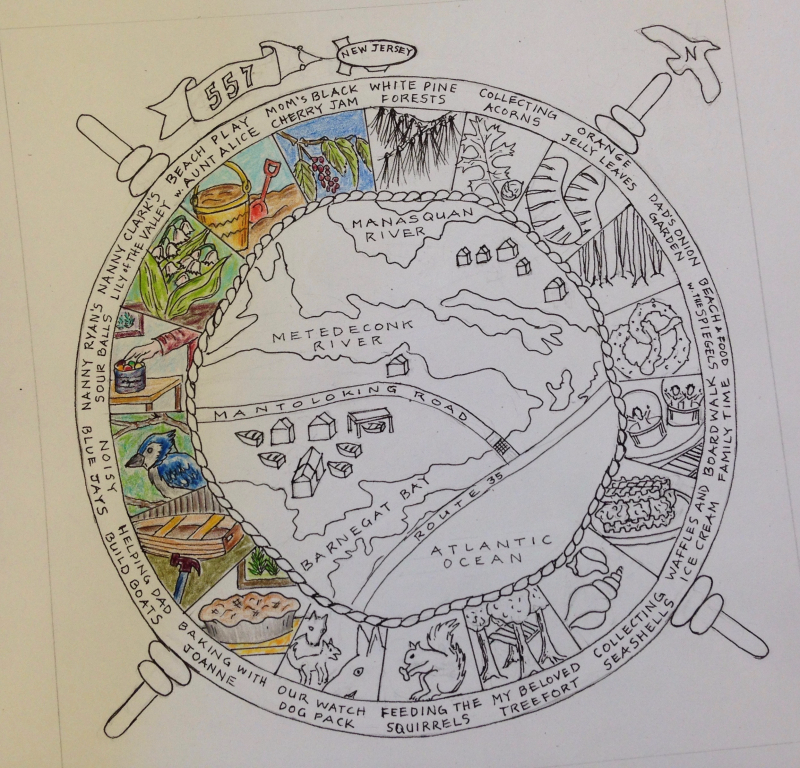
    Alice Hibberd designed a ship's wheel "mandala" format for her map of memories of her childhood home life. She did complete this map over the course of the last day. 
    IMG_2652

    Not far from our classroom is the Deer Creek Trail, a tranquil walk in the forest. Two of the students in this group did maps of this verdant place.
    IMG_2642

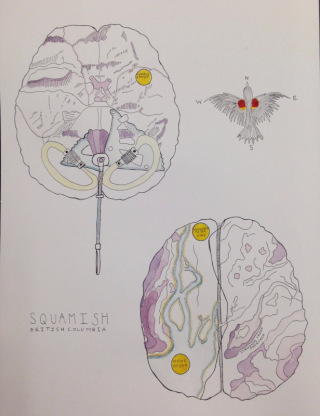
    Aly Gourd, our NCI assistant for the weekend, designed a cerebrally-inspired pair of maps based on a hike she took with a friend.
    IMG_2641

    To map one's own home property is particularly satisfying as well as thought-provoking. What matters most? How can certain features be best rendered? This map by Sue Adams was further colored after I took this photo.

     A note to the students: please send photos of your finished maps whether yours is shown in this group or not! I'll add the images as I receive them. It was such a pleasure to work with you all.

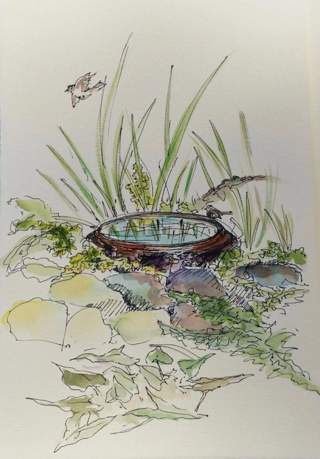
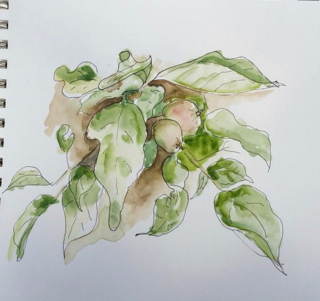
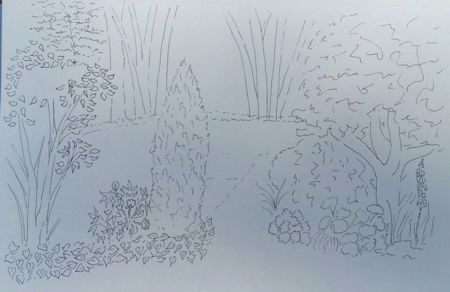
  • On Tuesday morning, our little drawing group settled in the garden of one of our members. It's spectacular there what with the many verdant areas featuring a wide variety of plants, trees, water features and clipped lawn paths. We picked our chosen spots in this wonderland, and met up 40 or so minutes later to compare sketches. I love how different the three are! They represent such different aspects of this beautiful place. Please take a look:

    20160531_111613_resized

    Here is "the bird bowl" which attracted a flurry of visiting black-capped chickadees as I sketched. One reason I am happy with my drawing (pen, ink and watercolor) is that by some small miracle the water actually looks like water!


    20160531_111511_resized

    Two infant apples emerge from the fresh foliage. This member's goal: to keep it loose.


    20160531_111550_resized

    A newly transplanted Golden Cypress, seen left of center, makes an architectural statement in this landscape sketch. To capture so many forms and textures in 40 short minutes is an admirable achievement! Color will be added.
  • In my recent life, much of 2016 has been focused on family activities and caretaking, and teaching. Aside from a little sketching and a little map drawing, doing personal artwork hasn't played a part in the past few months. One way to assure that I pull out my seldom-used oil paints is to get together with my friend Claire for a day of painting together. Last week, we set up in my greenhouse and surrounded by ecstatically blooming geraniums and our happy spirits, we painted. I with my oils, and Claire with her watercolors. 

    I set up a still life, and Claire brought a spectacular bouquet to paint. In retrospect, in terms of my own still life choices, I probably would have preferred to paint less fussy items. Or, perhaps because my personal bent is often toward rendering detail (something that oil painting usually liberates me from), I ended up spending too much time on this painting…but no matter; it was very absorbing and satisfying to paint. And a couple of days ago, after doing more work on it since we had our painting day, I declared it done. Below you will see the temporary painting "studio" with Claire in her spot. Following that is my finished painting. 

    IMG_2462

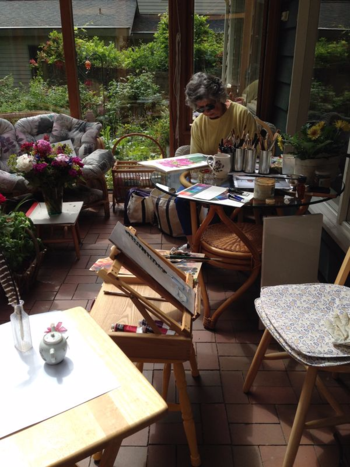
    Claire tackles a large floral bouquet with watercolors, and in the foreground you can see my hastily assembled still life with a tiny, child's teapot, an antique bottle, a feather, and a columbine.


    IMG_2481

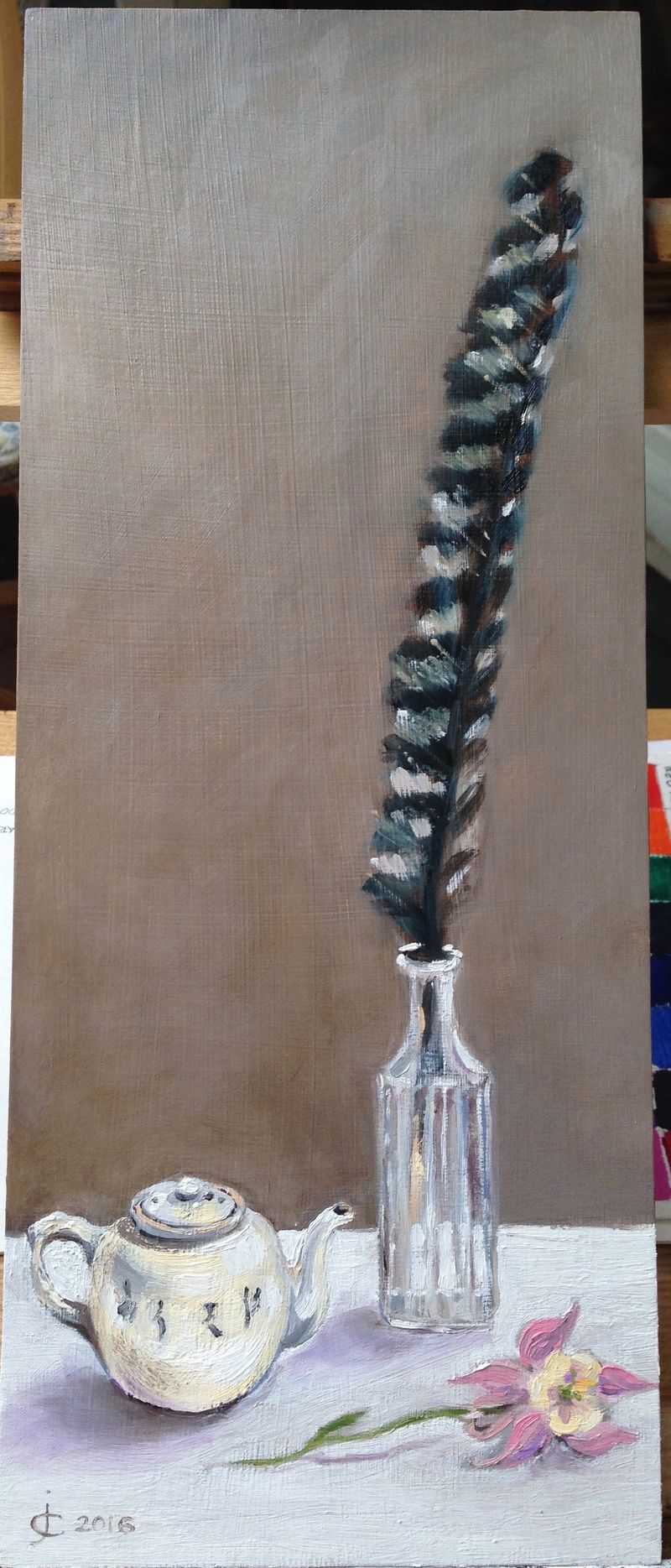
    "Keepsakes with Columbine" 6" x 14" panel

    Notes on the items in the still life: Rick and I were on a small boat on the River Li in China, in 2007, when a Chinese woman from one of the villages along the shore was allowed to board. She made her living selling things to passengers. In her basket was an assortment of small items wrapped individually in pieces of patterned cloth. One of these items was this tiny, chipped and stained teapot. It is common for vendors to approach tourists to sell their wares to them, but most items are new, mass-produced trinkets. We bought very few keepsakes in China, but the little teapot was something I did buy. On the opposite side is a scratchy decal of 3 traditionally clothed children. Hand-painted Chinese characters decorate the side you see here, and some tiny ones are on the top.

    The bottle came from a sidewalk garage sale in Walla Walla, Washington. I was there about 15 years ago with a group of friends, and spotted this old medicine bottle for $1. It has held many an individual blossom or a few sweet peas in the years since I brought it home. The feather is my granddaughter Ada's. It's future is to become a writing quill. The columbine, selected for its soft colors and contrasting form, is from the garden outside my greenhouse.

  • Hand drawn maps have the potential for telling colorful stories. The participants in my classes bring personal histories to their work stations and proceed to illustrate these in marvelous ways. Often surprising themselves with their newfound ability to draw personal maps, they draw me into their worlds during the course of the workshop.

    This process was especially evident in the group of ten who spent two days in our bright, Sidney BC "studio" which was also one end of the local Community Art Centre of the Saanich Peninsula (Also called the Tulista Arts Centre). Organized by Sherley Gordon Edey, a fine art photographer, my workshop "The Hand Drawn Map" was held in conjunction with an exhibit by local artists: Know Your Place. Sherley did a magnificent job curating and publicizing the exhibit as well as the workshop. Thank you, Sherley! I loved being an active, imported part of your brainchild.

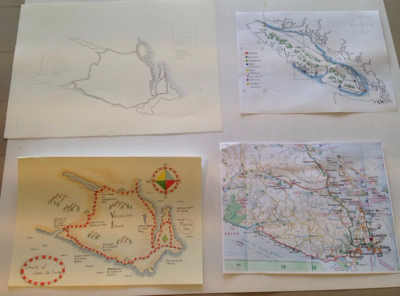
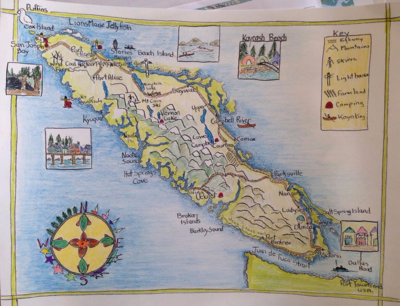
    For this workshop I created a template map of Vancouver Island. Why? Because the actual classroom time was relatively short so I wanted to reduce the amount of time spent on a starting place. Most of the students did use the starter outline map which was printed in faint blue on Arches hot press watercolor paper. Because each template map was filled in uniquely, there was a lot of delightful individuality. Here are several of the maps shown at various stages of completion. 


    IMG_2378

    Beautiful even before she adds color, Charlotte G. Riemann drew a memoir map of four adventures, or "MsAdventures" she had with her friends. Charlotte designed pull-out medallions to feature places and mishaps. Her illustrated title cartouche, stippling in the bodies of water and the compass add drawn texture and information.
     

    IMG_2382

    Jean Weller did several map studies during the course of the two days. The map on the lower left shows a road trip route she once took on the south section of the island.
     
       
    IMG_2372

    Gretchen Frith illustrated her map with places, animal species, geographical elements, a key, and a colorful, themed compass rose.
     

    IMG_2377

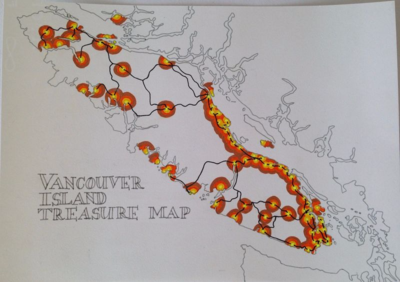
    Inspired to make a more abstract map, Megan Van Campen chose a design approach featuring the island's cities as hot points connnected by a network of lines. The luminous towns and cities are represented as the island's treasures.


    IMG_2380

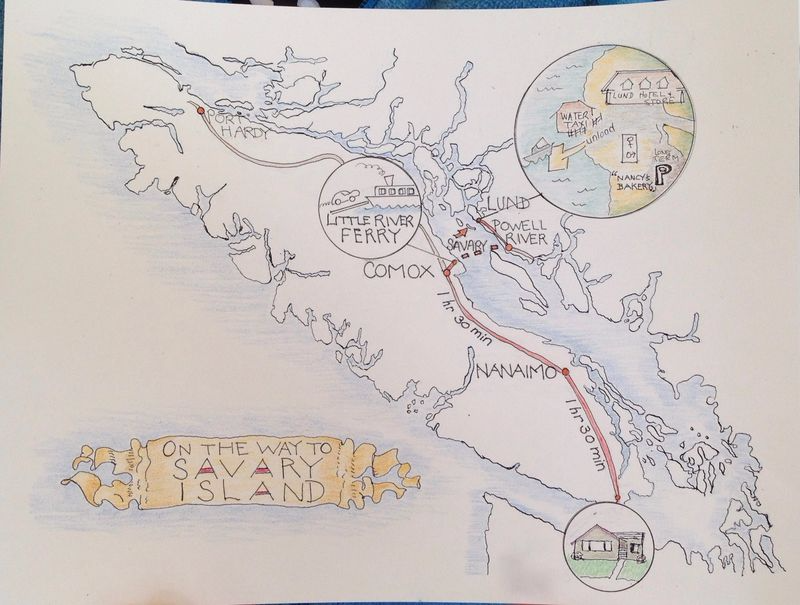
    Drawn with delicate color and careful labeling, Danica Gleave's map shows her family's favorite features as they traveled to Savary Island. Danica's use of varied sizes of circular pullouts is effective. A vintage-style cartouche lends a bit of fantasy to this map.
       

    IMG_2381

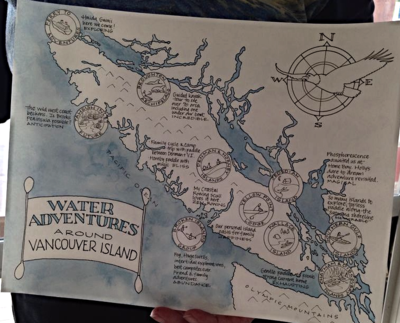
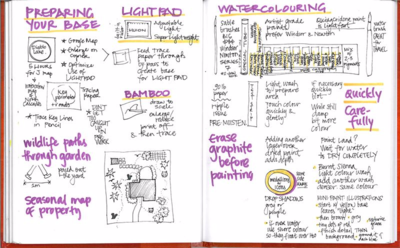
    Deborah LeFrank rendered multiple medallions (she coined this name for the circular pull-outs) with small illustrations and place names. She also included journal notes at key locations. Her lettering and compass rose reveal her skill with drawing and lettering. When Deborah finishes the watercoloring of her map I will post a photo of it here. Please scroll down to see a page from Deborah's detailed journal notes from the workshop.


    Jocelyn Curry Workshop April 2016 Sketchnotes-3

    Not only did Deborah keep this illustrated notebook of our workshop, but she sent the pdf of all the pages to every member of the group. What teacher wouldn't be over-the-moon to receive such a document! Thank you, Deborah.


    At the end of the weekend, I was given a card with personal messages from each participant. I saved the reading of this card for when I was on the ferry returning to the U.S. the following day. The sentiments meant so much to me (thank you, all). At the beginning of this post I mentioned the stories that maps can tell. Here is one of the messages I received:

    The weekend felt like one wonderfully engaging meditation. Thank you so much for your interest in and encouragement of our stories…

    This group was exceptional. Not all of their maps are shown here but all the work done was executed with their full focus and personal investment. I hope to see some of you again as we keep charting our lives and illustrating them with maps!
     

    IMG_2371

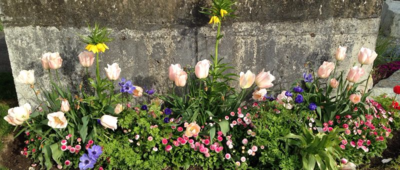
    My trip to Sidney, BC to teach this workshop was my first visit to this beautiful place. Walking along the sea wall was one of the fine pleasures I enjoyed after class was over each day. Here is one of the artful plantings along the path.

    Finally, I will be teaching another map workshop up at the North Cascades Environmental Learning Center (ELC) located in the North Cascades National Park on Diablo Lake (off of Highway 20 east of I-5) on June 24, 25, and 26 (2016). The ELC is an unforgettable place where participants are residents on a beautiful campus at the edge of the wilderness. Yet, it is an easy drive from many points. To read more about the Institute, and to register for this class (academic credit is also available), please click here.


  • Later in her life, my maternal grandmother collected antique china and lace, some of which she gave to me when I was a young woman. Authentic keepsakes from her own childhood were few due to multiple moves she had made leading up to her permanent move to California in the 1960's. But early in the 1970's she gave me a bag filled with small, pieced squares of very old calicoes, chintzes and homespuns. According to Grandma, these quilt pieces were cut and stitched by her mother and her aunt Maida (a beloved family member) on the family farm in Pella, Iowa. Amidst these were a couple of grubby, pieced squares that look as though they may have been stitched by a child. One of these is pictured below.

    IMG_2329

    This little square appears to have been stitched by a child (very likely by my Grandma). A blood spot on the lower right conjures up the possible, tearful scene that could have ended the sewing lesson.


    IMG_2333

    Here is the back of one of the small, striped chintz squares hand-stitched and ready to be pieced.


    IMG_2332

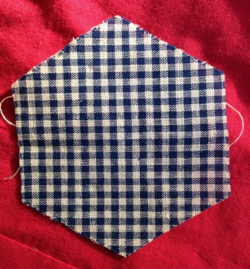
    This hexagon is cut from what was referred to as "homespun." In the late 70's I used the hexagons also in the bag for a set of placemats.


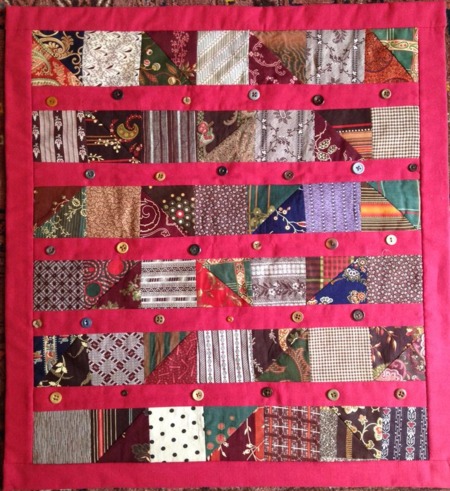
    In the 1970's I didn't like the earthen colors of most of the antique squares Grandma gave me so I put them back in the bag and forgot about them. In February of this year as I was clearing out unwanted fabrics in my own stash, I took a look at all the squares, thinking, "I'll never get around to using these," so I winced, tossed the bag into the giveaway box and reminded myself that I ought not "confuse people with things." A day or two later, I changed my mind and retrieved them. How could I cast away something that my grandmother had kept, that dated from the 1800's, the story of which she herself had told me? The fabrics were all apparently unused and still crisp, dating from the 1850's-1900. Many of the fabrics are classic, collectible and rare Victorian prints. 


    IMG_2388

    I did take a shortcut in sewing the pieces together by machine into rows. The individual squares are a dainty 2.6" square. The whole quilt measures 22" x 24." I used cotton batting between the pieced front and the solid red backing. The three layers are secured with vintage buttons.


    The end of the story: I did get the quilt made! The color palette that I found dreary in earlier years I now find interesting and historic. That these pieces were hand cut and pieced by my great grandmother and my great great aunt moves me. And to think I'd tossed them heartlessly into a pile for the donation truck before I came to my senses!

  • Camion comp final sun sm

    Soon to appear on a Mack truck doing short to medium hauling in Washington and Oregon is this logo I designed for a long-time client. He is a unique man, and the only person I've ever known to have simultaneous careers as a commercial airline pilot and a medical doctor. What was next on his bucket list? To become a truck driver with his own big rig. And, as an appreciator of applied artwork, his intent was to customize his tractor/trailer. Because most of what I've done for him over the years is custom calligraphic work on paper, it did surprise me that he contacted me to see if I would be interested in his next bucket list foray.

    Artwork with the technical qualities that allow it to be reproduced at enormous sizes is best executed as a vector-based image. This I did, using Adobe Illustrator. Still somewhat green in my experience with this software, I did encounter my fair share of learning curves but this was all worthwhile. Originally inspired by a Cuban cigar box graphics, I designed an imaginary tobacco farm on the bay near the Cuban city of Cienfuegos ("one hundred fires"). My client had a lot of say in what is depicted in this image. Everything was drawn within the program except the bottom line of information which is set in a font. The lettering was inspired by the cigar box design from early in the 20th c.

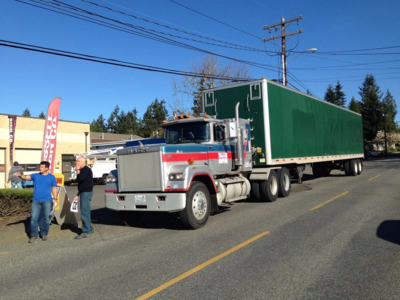
    IMG_2306

    The "before" picture of the truck with its owner and the signage expert. Check back here in a couple of months for the "after" shot. The tractor and trailer will be painted a deep, dark green before the signage is applied.


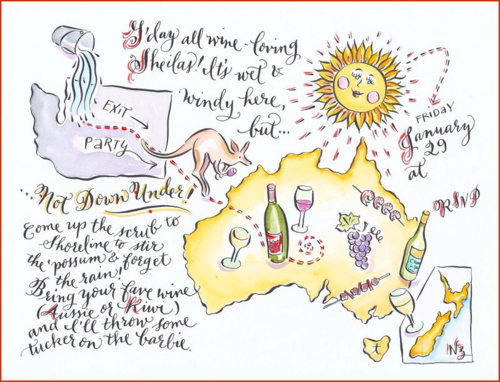
  • We are soggy up here in the NW corner. That's nothing new but we are especially saturated. So for a wine tasting party I decided to design an escapist's invitation to taste wines from Down Under. For this piece I used a pointed dip pen with sumi-e ink and watercolor on HP paper. One person who looked at this said that it appeared I had already started drinking wine when I was doing the artwork. Not true. I was just having some fun:

    Down under invite ed

    Click to enlarge. Personal information has been removed.
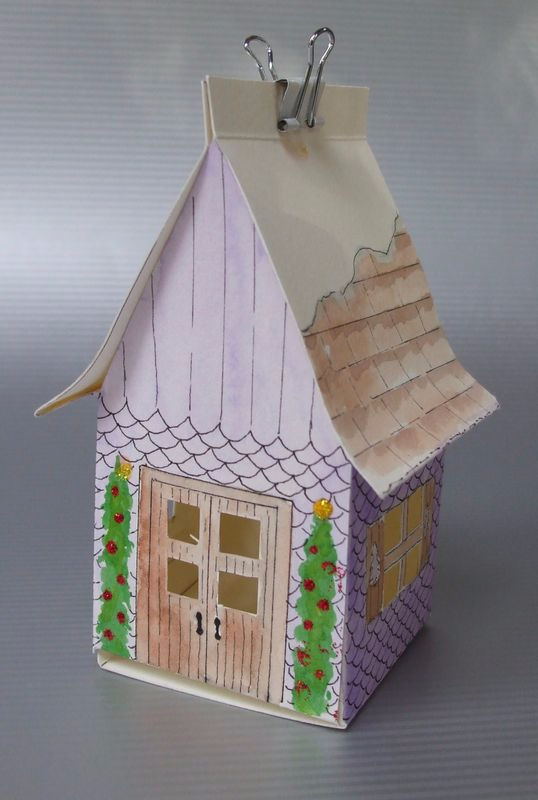
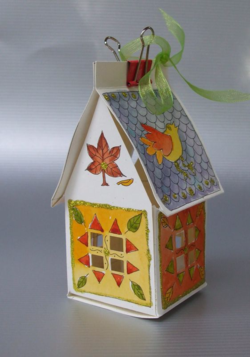
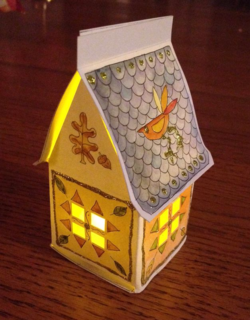
  • For our first architecture project ever, the Drawing Group enjoyed embellishing flat, white cut-outs (precisely pre-done by hand using Arches 90lb hot press paper) that once folded and secured with tape turned into little luminarias. One Tuesday morning in November, one of our members surprised us with this drawing and folding project. It was pure fun. Here are the three autumn and Christmas-inspired houses we completed. This trio was followed by another batch with distinctly Christmas themes, all. Thank you, _____! (Members prefer to remain anonymous.)

    DSCF2987  DSCF2989

    IMG_1973

    My house luminaria with an electronic candle within.

    DSCF2990