Jocelyn Curry

Art & Joie de Vivre


  • Dumas view AM

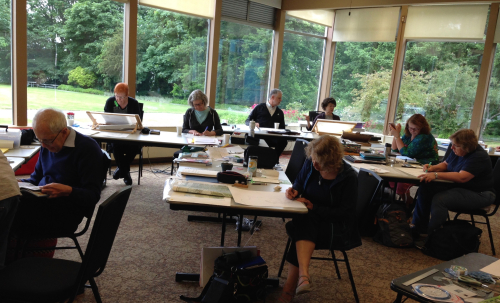
    Dumas Bay Centre in Federal Way was the first-time, urban location for The Art of Drawing Maps by Hand in 2019. The long, Pacific NW daylight hours provided our classroom with ample natural light for the hardworking 13 who took this challenging course. Meals were delivered to our private, adjoining dining room. As is typically the case once the mapmakers become immersed in their design work, many logged dawn to dark hours, making the most of the time set aside for immersion into map drawing. Here is a collection of photos (not all maps are included here) that show some of the work being done during class, and photos of some of the maps completed at home after the workshop. Please click on the photos to enlarge them. Appreciative thanks to Marilyn McGuire for supplying many of the photos shown here!

    IMG_6119

    Full concentration is evident in this photo. We did have our lighter moments and Happy Hours, even.
    IMG_4121

    There's a lot to cover in a relatively short time. The second day of this workshop is chock full of learning techniques.
    IMG_6129

    Marie's preliminary design steps utilize tracing paper images that are ideal for tracing later.
    Birdwood Hand Drawn Map 6.19

    Marie's finished map. Bright, clear and charming, it shows many natural and human-made elements within the 11"x14" map.
    IMG_6114

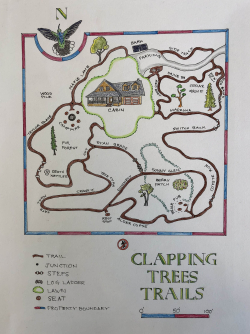
    Above, Tim's tracing setup on his lightpad illustrates a key step in map drawing. His map is of a network of trails and other property landmarks showing visitors the way around his home.
    IMG_4170

    Tim's completed map done in ink and colored pencil. This is the first such project he had ever done.


    IMG_4110

    Yes, sunsets came and went but some soldiered on until closing time at 11 PM.
    IMG_E4164

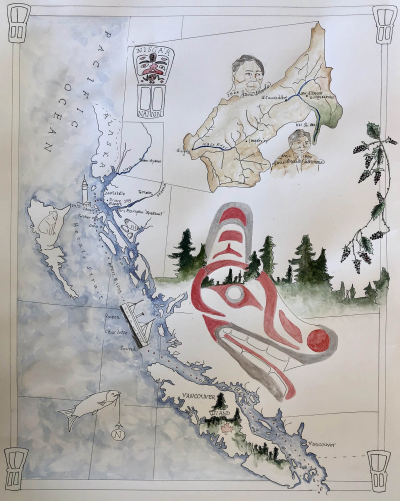
    Sandy's map benefited from her R&D done prior to the workshop weekend. Her map illustrates her grandmother's journey from her small, tribal village in British Columbia by schooner to Seattle in 1923. Symbols of cultural importance add further meaning to this keepsake.
    MJohnson - Finished Map

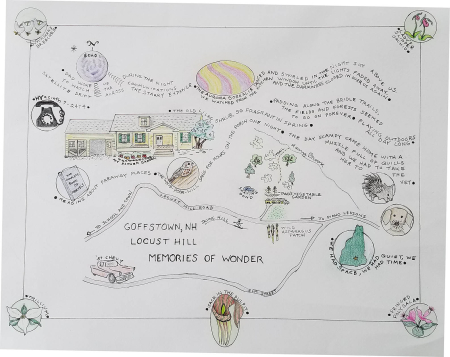
    Mary's map integrates numerous memories from her childhood home. To create a lyrical, dreamlike quality, she lettered her texts in undulating lines.
    IMG_E4166

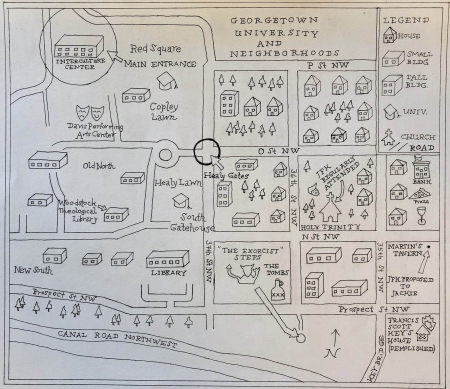
    Shan's map is of a favorite neighborhood in Georgetown, DC. His distinct drawing style evokes the Colonial era.
    IMG_E4161

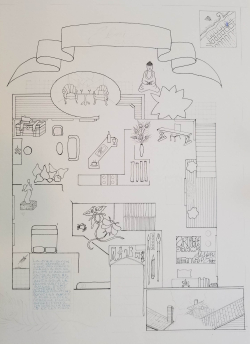
    A map serving as a memoir: Gayle created an architectural-style map of her home, including all the sleeping spots enjoyed by her cat..
    20190705_161741

    In this photo, most of the inking is done. Waterproof ink is used so that paint can be applied.
    IMG_4167

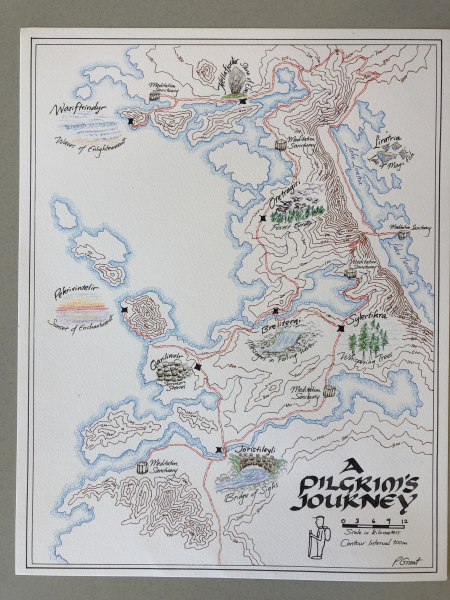
    As an experienced "map drawer of imagined places," Pat branched out by creating many illustrations of alluring destinations on this map. He also added a voyager whose journey is mapped and labeled here.
    IMG_E4135

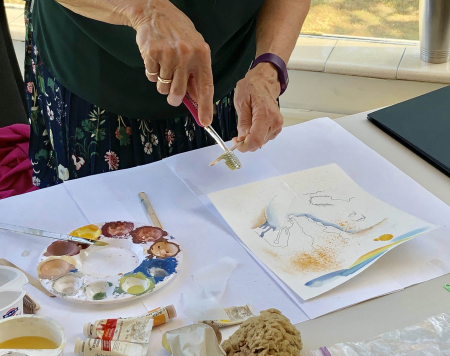
    Various ways of adding color to maps are demonstrated during the workshop.Spattering watercolor serves to add tint and texture to map areas needing accents.
    IMG_6137

    Katy's map depicts her many-year journey through her education as a calligrapher. It folds up, map-style.
    IMG_6138

    A custom cover and closure enclose Katy's map.


    IMG_4163 (1)

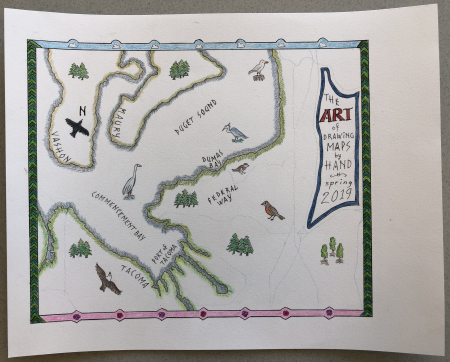
    Anne's map was inspired by the siting of birds in the Dumas Bay vicinity. Her border designs show a solid grasp of ornamental design.
    IMG_4162

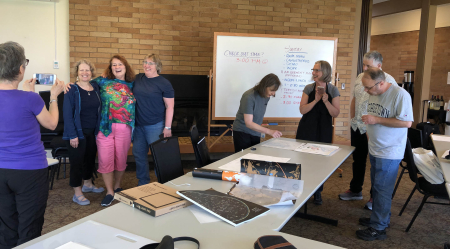
    The final afternoon hours include photo ops, sharing of maps, and general levity. This group included five "grad students" from previous map workshops. My current plan is to schedule a map drawing retreat for any grads who would like to set aside a weekend to work on maps without the repeat of full instruction.
  • In spite of all appearances (here, anyway) the intrepid Drawing Group has continued to meet when the three of us are all able to set aside the same Tuesday mornings. Through all of life's events, whether planned or unplanned in our three lives, we prioritize where necessary so that we can convene. For so many nurturing, affirming reasons, we are approaching year 10 of our friendly practice.

    Some months ago (!) I proposed that we doodle. For two of this, there was family history re: doodling. Our moms doodled regularly while talking on the phone back in the 1950's. For me, this is a distinct memory. It takes no effort to call up the image of Mom holding in one hand the ebony black receiver of our weighty rotary dial phone with its spiral cord, and in the other hand a ball point pen. Her eyes down, her pen creating geometric mazes in the corner of any available paper, she would listen and occasionally utter an uhm hmm, her pen moving to a clear space on the paper when necessary.

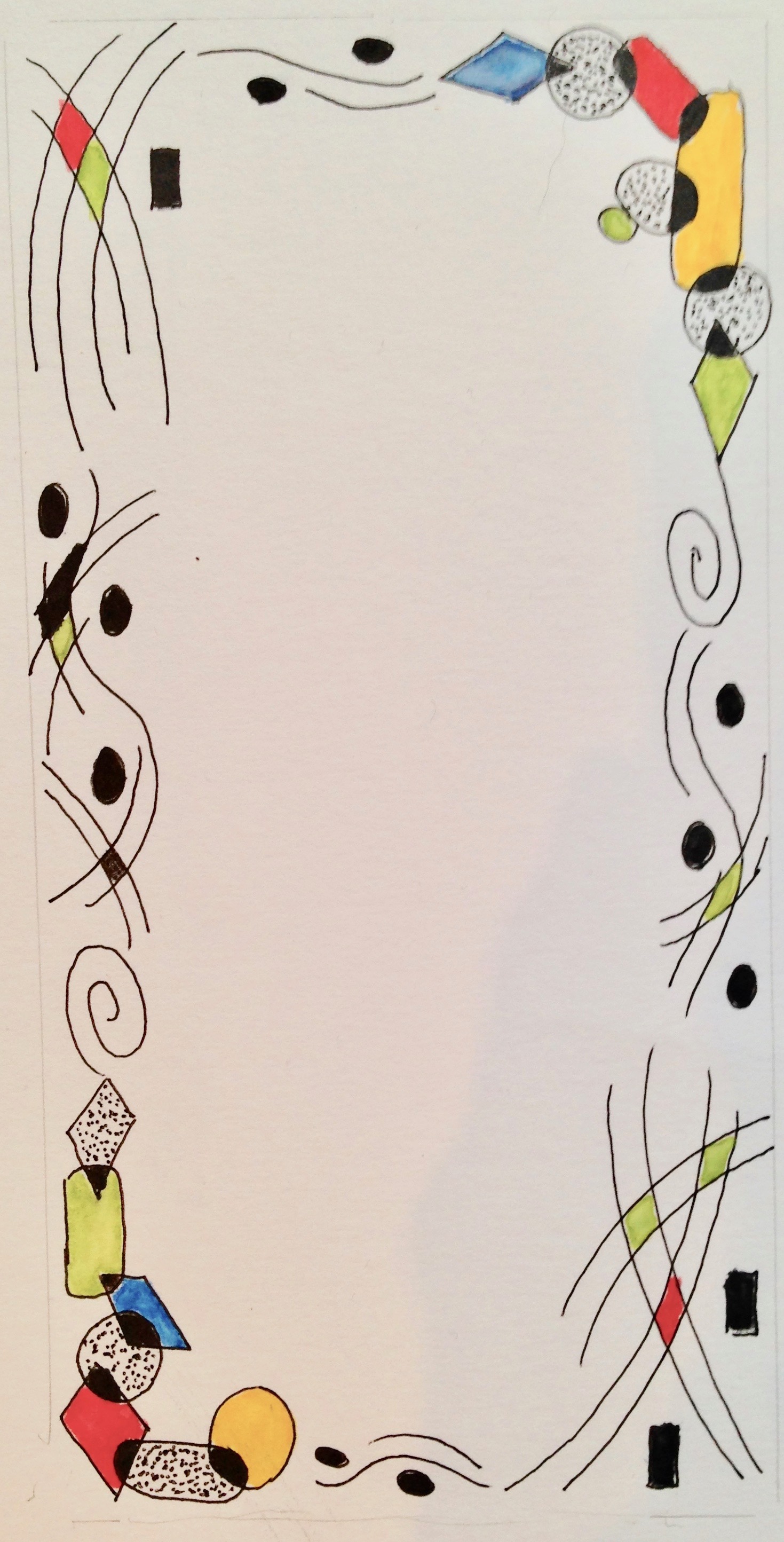
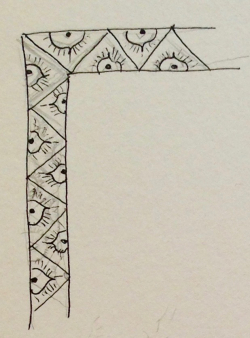
    While sipping our fresh coffee and visiting about our moms and other topics, we three made these doodle borders. Mine is the one with the tribute mazes, and just one of us actually got to some color work!

    IMG_5737

    IMG_5739

    IMG_5738

  • One thing leads to another. I love old fashioned ink and paint, and I also love delving into technology. So here’s the new hybrid in my world of cartology just in time for a New Year. My daughter and her business partner have organized a showcase of musical groups which will be presented on January 7 in Manhattan. I offered to help with publicity by saying to Emily, “Wouldn’t a map be a good idea?” She said, “An animated map?” That’s all I needed to take the plunge into computer animation. Below is the map in its current state so you can see what I’ve been up to. The size I’m posting is a bit larger than my blog’s area, but most of it fits:

  • I took the plunge yesterday and started learning to do animation–applied to a map. Why? My daughter and her business partner are offering a musicians’ showcase concert in Manhattan on January 7. This is for the benefit of attendees of the international APAP conference who are looking for talented bands and groups to hire. Here’s my map, destined to be edited but still fun to view at this stage:

  •  

    HHMapMcKsmobs

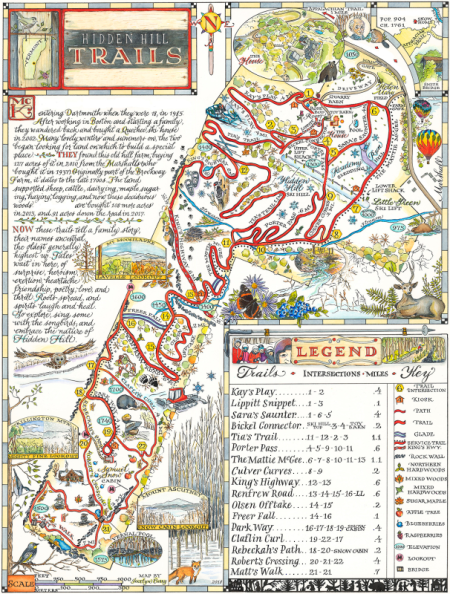
    With personal information removed, here is the finished map. At 20"x26", the map is large enough to allow a greatly reduced image of it to be folded and used as a pocket map while family members and private visitors navigate the property on foot, skis, bicycle or sled.

    It was late October, 2017 when I first received an email from a couple who sought an artist to create a map for their family retreat property in Vermont. After years of thoughtful property development and construction of a home, a cabin, and outbuildings, they wanted it all mapped for practical but artistic wayfinding. Their wish to commemorate family members through naming woodland trails, structures and overlooks after their ancestors and current family members was their hearts' desire. This passion and their overall joy in active family togetherness compelled me to accept the challenge of designing their map. I said yes without having seen photos or existing documentation of the land. Once I began receiving those aids, I quickly realized the awesome task ahead of me! Through the months, we worked closely and harmoniously toward the map's creation. 

    For this post I've compiled a few images to illustrate to readers the design approach I took. A photo of the finished, framed map in place is at the bottom of this column.

    HH vertical thumbnail

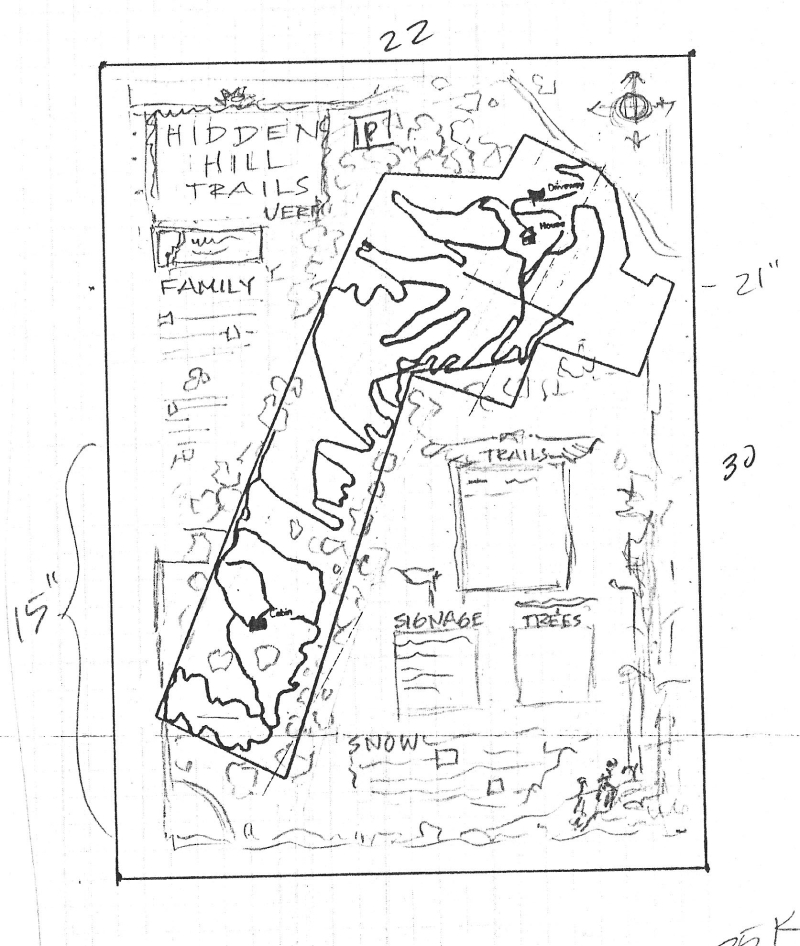
    The first step was to sketch two layouts for the map and the added features around the property boundary. This northerly-oriented layout was selected.


    Map sample overlayobs

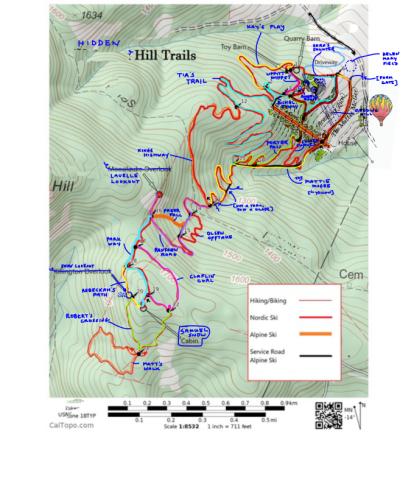
    My clients had thoroughly documented their property with drone photos, GPS trail tracings, and casual photography. Here is one working draft showing their work on naming trails. I also superimposed a few graphics in the top right section to help determine scale.


    Amap

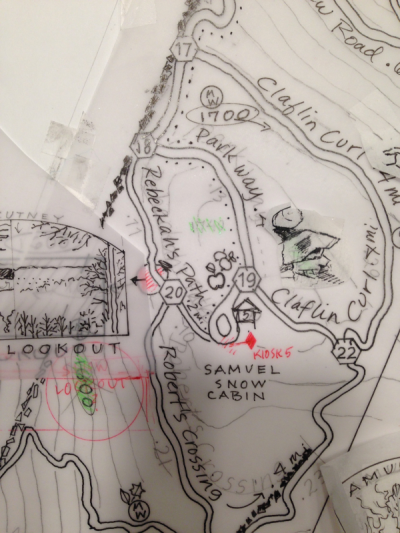
    After penciling in many of the map's features through 3 layers of pre-existing specialized maps, I inked them in on tracing vellum before transferring the whole to the final art paper.

    Ink test  Callig sample 3-300

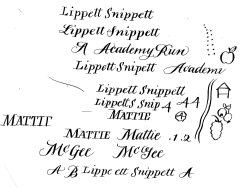
     Samples of lettering, icon drawings, and paint colors were essential in making choices for the final rendering of the complex map. 


    Cmap

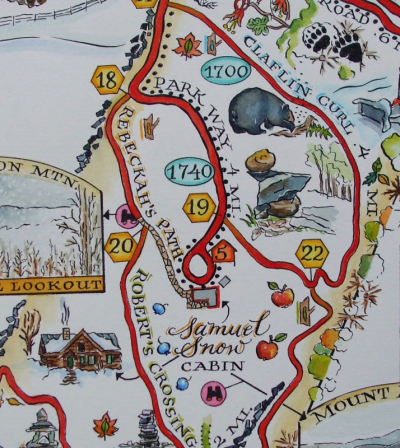
    Here is the inked and painted, finished section shown in the draft sketch above.

    Nine months after the initial phone conversation, the map was completed and shipped to my clients. Starting with their sending an abundance of photographs, images of antique area maps, Colonial signage examples and modern land documents, they were involved in every stage of development of this heirloom piece of artwork. After my pencil draft was developed enough to review with them in person, I traveled with my husband to Vermont to meet them at Hidden Hill. There I, too, fell in love with this land and deeply admired the visionary trail planning and artisan construction work completed throughout it. To be the chosen mapmaker will always feel like an honor.

    Hh obs pic

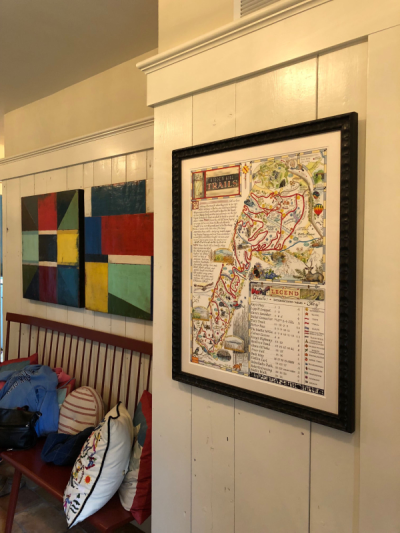
    What a complete delight it was to me to receive this photograph of the map handsomely framed and placed in the primary entry area of the Hidden Hill home. Here, hikers, skiers, bicyclers and all others can refer to the map on their way out the door to explore, walk in contemplation, or have lively recreational time together.


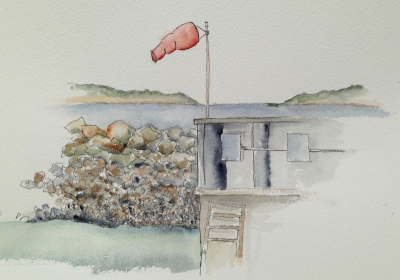
  • The Drawing Group always looks forward to the warming days of summer when we meet up on a driftwood log or picnic table near the beach in Edmonds, WA. This year we perched along the walkway by the marina there, our thermoses and treats spread out within reach as we sketched what was before us. Here's what we did as we sat side-by-side, happy to be outside with pens, paint, and our individual news to share:


    IMG_5018

    Three views: we all enjoy the journaling method of creating small squares for our quick sketches. It's great practice for capturing a lot of information about one's immediate surroundings.
     
    IMG_5017

    My sketch. I think I was chatting a lot and, well, didn't quite get the work done that my chums did.


    IMG_5019

    The foreground, middle ground, and background in this drawing show the whole scene with good success.
  • IMG_4838

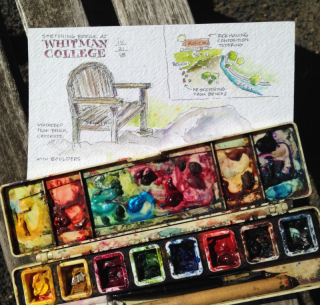
    I sat on a bench just like this one as I sketched this English-style teak bench at Whitman College in Walla Walla last weekend.

    Maybe it was the act of sitting on a bench, relaxed, feeling the spring sunshine warming my shoulders that made me realize that I am working on my last commission as a freelance artist. In 2017 I took a year off from teaching workshops and accepted no commissions or assignments of any consequence. At the end of the year, feeling refreshed, I did accept one large map design job and still have a long way to go toward its completion. When it is done, I will be taking no more. I will edit my bio here on my site to reflect this decision. 

    That said, I’ll be leaving my website as it is because I’ve always enjoyed putting my work and the work of my students out into cyberspace to be enjoyed. But I would like it to be known that if you are searching for an artist to work with, I will no longer be available. 

    Thanks so much for your interest!

    ~Jocelyn


  •  

    IMG_4651

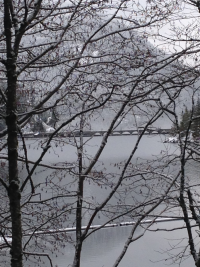
    Diablo Lake appeared cold and colorless compared to the vivid aqua water and verdant trees we are accustomed to seeing during my usual June workshops.

    Late winter snow and cold did not deter 11 participants from heading up the North Cascades Highway at the end of February to take my workshop The Art of Drawing Maps by Hand held at North Cascade Institute's Environmental Learning Center on Diablo Lake. Dramatic, cliff-hanging icicles greeted us all as we approached the dam and drove across.

    The weather report, including the warning we received from our excellent class assistant Hanna Davis that the avalanche danger was high, served to limit our activities outside the classroom. The result was that even more time was spent on maps than usual during this 3-day course, and that says a lot. Maps are very time-consuming to draw by hand. Having extra working time in combination with having inspired students meant that outstanding work was done. Here are some of the working sketches and finished maps done by this group of earnest and good-humored participants (click on the photos to see full-sized versions):
    IMG_4635 2 IMG_0737


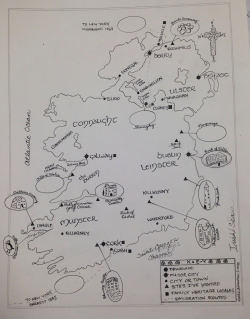
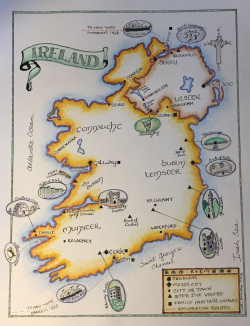
     Above, Kathi Hamilton commemorated family history visits to Ireland in her map. After drafting the country boundaries, she carefully colored it all with colored pencil.
     

    IMG_4639 2 IMG_4652
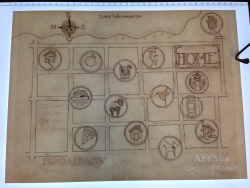
    Cara Anderson created a stylized map of her neighborhood featuring the dog walking route she takes and all of her favorite destinations. On the left you can see a critical step of the map drawing process: transferring a draft to the final watercolor paper with the aid of a light table. The answer to why no one has ever asked for a second piece of paper to re-do a map is that the process is all about eliminating risk by working out most elements of the design before the "good" paper ever receives a drop of ink!


    IMG_4640 IMG_4637

    The two photos above show map designers at work. On the left, the time-saving, erasing-saving tracing process is engaged in by Gayle Waddle Wilkes. On the right, North Cascades Institute (NCI) employee Darcie Lloyd uses a template to create small frames for detailed illustrations or information.
     

    20180318_111351 IMG_8284

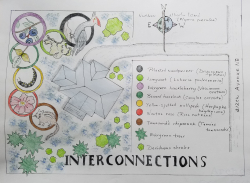
    The maps made by this class varied widely. Mary Johnson's map, above on the left, was inspired by her home property. She wrote, "I decided to overlay the basic outline of my yard with some of the plants and animals that make my yard special in an urban environment. The title 'Interconnections' suggests the biodiversity on the property and the reliance these plants and animals have on each other in an ordinary, residential space." Like most of the people in class, Mary incorporated classic map elements in creative, colorful ways. Sue McNab's map of Antarctica (or Terra Australis) on the right commemorates a three week excursion she took there in 2017.
     

    IMG_4642 IMG_4630

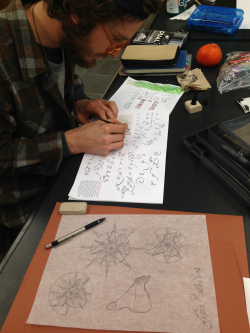
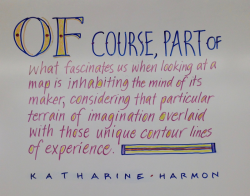
    Here is Anders Rodin, a longtime lover of maps, delving into copying the florid calligraphic letterforms of 16th c. European maps. In the foreground you can see his compass rose designs being worked out on the omnipresent tracing paper. After the class ended, Anders wrote a fine review of his experiences at the ELC and in the workshop. Click HERE to read his review and see the accompanying photos. Quotes about mapmaking help keep us going.


    IMG_4636 2 IMG_9968

    Kirty Morse created a tribute map to the Puget Sound region she calls home. Gratefulness for the abundance of regional foods she and her family have enjoyed for many years inspired her to create a mandala-like map of places and species. She, like several others in the class, completed her map at home and sent me this photo. For those of you who did this, thank you!

     

    IMG_4634 IMG_4653

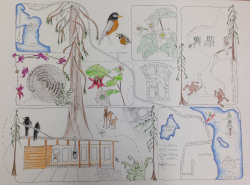
    A puzzle-like pictorial map by Sandy Polzin shows both the route to her cabin and a collection of favorite features of the cabin's deeply natural environment. Sandy is a self-professed "doodler" so she enjoyed filling in her map with thoughtful design and spontaneously done drawings.

    Sunday, February 25 was the last day of the workshop so every map maker was working intensively in the classroom that day once we had had breakfast and moved out of our dorm rooms. The workshop was to conclude, as always, at 3 PM. At around 11 AM we learned that indeed there had been an avalanche that closed SR20, aka the North Cascades Highway, that offered our only route back west toward our various home cities. Having been forewarned, but thinking it unlikely to happen, some of us admittedly hoped that this would happen. Why? Because the ELC and its surrounding natural beauty, is a beautiful place. And, what better excuse to extend this retreat than to have zero possibility of escape other than helicopter evacuation?

    Suffice it to say that the NCI staff, especially Hanna, the kitchen staff, and the resident grad students made our extended stay a pleasure. Gina, one of the grad students, led two yoga classes for any of us who were interested. We were made to feel safe and sound and very well fed! Further, all the class participants worked on happily (as far as I could tell), enjoying the gift of more time with their maps in our comfortable, well-equipped classroom. Then, on Monday at 2 PM we were notified that a channel had been cut through the avalanche and we could pass – ASAP – to make our escapes, our stories about being trapped by an avalanche ready to share with any who would listen. And who wouldn't? 


  • Many years had gone by since I had taken a weekend workshop offered by a regional calligraphy guild. But when I saw the work a friend had done in a class taught by Rebecca Wild of Port Townsend, I eagerly signed up for the next one Rebecca was teaching in our area. It was held in Olympia, WA, in late January and sponsored by Nib 'N Inks calligraphy guild.

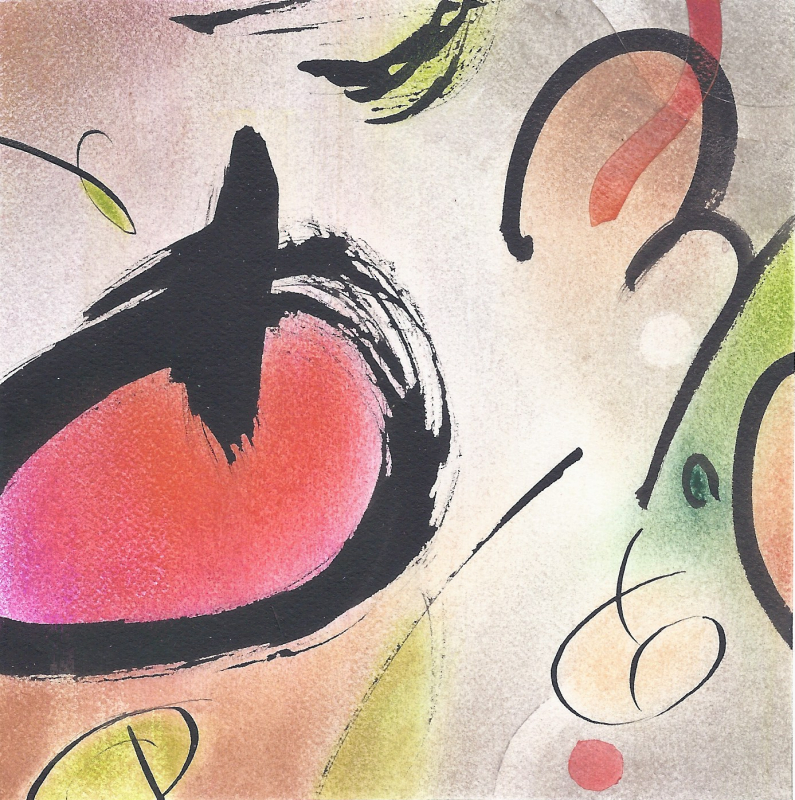
    Rebecca ingeniously devised a series of projects for us based on the artistic imagery and painterly textures of 19th/20th c. painter Paul Klee. As you can see below, we worked in a 5" square format while employing calligraphic marks, layers of powdered pastel and/or liquid acrylic color, debossed texture, and small hand-lettered writing. Layers were sealed with acrylic matte medium before more texture elements were applied. 

    Scan 2

    Bold and finer sumi-e ink strokes taken from our own signature form the anchor elements here. Powdered pastel and stenciled shapes were added next.
    Scan

    After masking off one band of space on the paper, broad strokes of transparent acrylic color went on next. We then debossed fine designs which were then enhanced by smudging pastel into the paper and through hand cut stencils.
    Scan 3 1

    Working boldly with a new material, we applied heavy black oil stick after painting diluted acrylic strokes onto the paper. After tinting cold wax with powdered pastel, we thinly applied it to the paper. The last step was to use a tool to inscribe through the tinted wax for a subtle text.

    For further biographical information about Paul Klée through a comprehensive, interactive web page, please visit https://www.davidzwirner.com/artists/paul-klee.

    It was pure pleasure to spend two days experimenting with new art mediums and design approaches. Rebecca hands out step-by-step instructions for all the techniques she uses; there are so many, with carefully thought-out sequencing, that we were advised to keep the directions on hand when using her techniques at home! She gets my highest recommendation as an instructor.

  • Ink blob faces

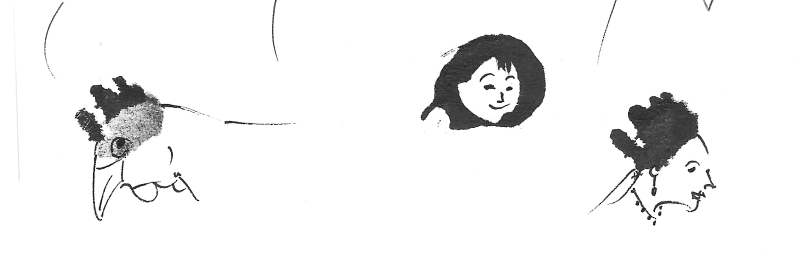
    During the past couple of weeks I have been doing a lot of experimenting with different pens and writing fluids. FYI, this is part of a big map project I'm working on. Jet black India ink tends to get everywhere when one is dipping into little containers of it…some of you are very familiar with this messy phenomenon, I'm sure. Well, yesterday, when I was not working with ink but with harmless pencil, I looked beyond my drawing and saw three random ink blobs (dried and until then unnoticed) left from a previous, inky session. For the sheer fun of it I picked up a regular, commercial ink pen and quickly made faces that incorporated the blobs. I'm liking these three new friends!