Jocelyn Curry

Art & Joie de Vivre

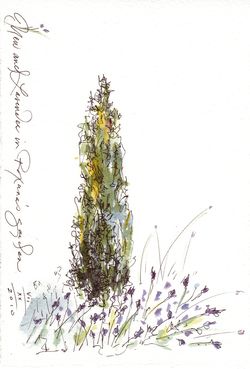
  • Our little drawing group, happily convening again after a hiatus for travel and classes, gathered in one member's garden today. It was a perfect July afternoon for nibbling summer fruit, sipping tea, and savoring home baked muffins. Oh yes, we did also allow time to draw – and there is no shortage of beautiful subjects in this garden. My goal: make four sketches to send as cards to people I wish to thank for various things. I did get three made (we did linger indulgently over our repast!). Here are my garden cards, ready to write in and send:

    Gardensketch3

    Gardensketch1
    Gardensketch2

  • Yesterday morning, I had to bury little Phoenix. In spite of a growing appetite and small improvements in her vitality, the sweet little chicken died during the night. We both gave it our all, but her prior severe illness took too much out of her. She has a quiet resting spot in the newly cleared woods in front.

    The search for a third pullet has now resumed, as it's almost time for Cinnamon and Vita to move into their chicken tractor (photo coming soon). At night they are still in their brooder box, staying warm with a heat lamp. Healthy and rambunctious, they are spending a few hours each afternoon and early evening in their temporary pen in the yard. I took a few photos to show how they are growing into henhood!

    DSCF5565
    DSCF5570 

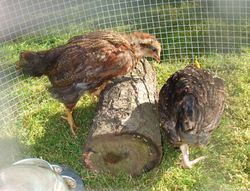
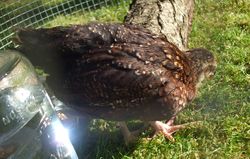
    Cinnamon, seen here climbing on the log, is a Welsummer chick. You can now see her namesake's reddish feathers coming in. Her breed, named after a city in Holland, is known for their excellent foraging abilities. She's a wildchild, and is lightening-fast if an ant should meander into the enclosure. She peeps continually in a variety of melodious tones.Vita Speckville-West is the Speckled Sussex on the right. She's filling out nicely, and is proving true to her breed as a friendly, bright pullet. She stands still to be picked up, and appears to have a "big sister" attitude toward the sparkplug Cinnamon. With good construction luck on my side, the big move into the house will be taking place on Thursday.

    DSCF5568

    Is it a hawk, or is it Cinnamon?

  • In the last chapter of my chicken keeper's journal, I announced that one of my two blond chicks was a cockerel (young rooster). A few days later, it was apparent to me that they both were "little boys", so after having kept them for a month, and watching with intrigue and humor the day-to-day developments in the brooder box, I decided with some sadness to return them to the breeder and select another chick who was clearly a pullet (young hen). Our neighbors are wonderful, but they would not appreciate neighborhood life with roosters for never ending, out-of-control alarm clocks. By the age of six weeks, in the Ameraucana breed, the gender is usually, but not always, clearly defined.

    Below is a sequence of photos with text. In the process of following along, you'll be introduced to Phoenix.

     DSCF5534 To the right you can see the same little "roo" who was nearly crowing as he stood on top of the feeder in the photo in my previous post. Now back in a brooder with many other chicks his age, or younger, he looks as alert and curious as ever. After I took this photo of him, he hopped up onto the Dutch door, jumped down into the chicken yard, and went right up to a huge rooster and stood as tall as he could. Completely unintimidated!

    DSCF5535 On the left, the breeder selected two young pullets who were a few weeks older than my cockerels. The one he gave me (the one in his right hand) was very docile, and showed some signs of being chilled (it was the day after hot weather ended, and cool air had come in). He instructed me to keep heat on in the car, and to let him know how she fared. Naively, I trusted him.

    When I returned home an hour later, it was apparent that this was a very sick chick. She couldn't stand up, and didn't respond to the peeping of Vita and Cinnamon, my two others. A very bad sign. Isolated in a second brooder box, she was carefully watched by me. In retrospect, I should have turned around and returned her immediately. Further, the breeder never should have released her to me. I won't be going back there. I do plan to buy a third healthy young pullet regardless of the outcome of the sick one. It's unlikely she will be fully returned to health, even if she does pull through.

    The following day, I named her Phoenix. Whether she survives another day or not, she is giving it a valiant effort! She peeps greetings to me when I visit her to stroke her or coax her to eat and drink. She likely endured the ravages of a chicken disease called coccidiosis, and is now hovering in a greatly weakened state. There are tiny signs of improvement, but I still have a small box standing by, just in case.

    DSCF5536

    Beautiful little Phoenix

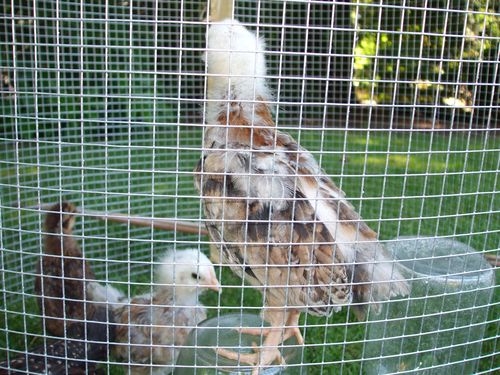
  • Today was a red letter day for the chicks. They experienced being outside on the grass for the first time! Transferred to a temporary aviary out in back, they were clearly excited to have grass to eat, earth to peck, and room to flutter and try out their first perch. I kept an eye on them due to the interest of the passing Stellar's Jays and flickers. They are clearly curious about the growing chicks.

    There's only one problem with this picture: the beautiful, camera-shy chick in the foreground has been confirmed to be, yes, a cockeral, by his breeder. That means he's a young rooster, and therefore he won't be able to live here once he starts a'crowing. I'll take him back to the farm where he came from, and if the other Ameraucana (which is also looking & acting suspiciously masculine) turns out to also be a cockeral, at least they'll still be able to live together and I'll bring home a confirmed female. Its diagnosis is as yet inconclusive! There's still a chance it could be the third pullet (young hen) I'd like to raise, but another week or two will need to pass before he or she is clearly one gender or another. Meanwhile, they are sweet, fun, and spunky.

    DSCF5526

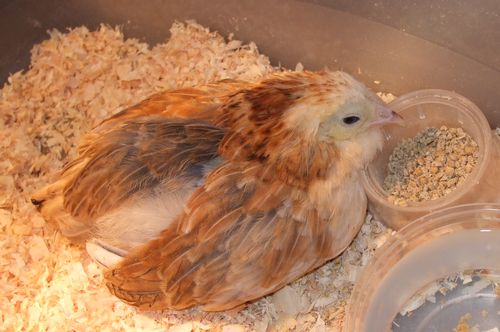
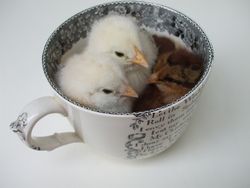
  • Watching an animal develop from a baby is such a marvel. Here is a photo of one of my Ameraucana chicks, evidently a "wheaten" in color according to the breed standard, at the age of one month. She might fit into the teacup alone, but her feathers would be crunched. I'll work on how to take a portrait of the four little ones without their being indignant!

    DSCF5505

  • DSCF5499DSCF5503

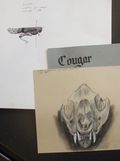
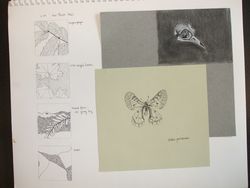
    Students' work. Above left: skull drawing in charcoal on tinted paper with white highlighting. A sketch of Colonial Peak and Diablo Lake is in pencil. Above right: pen and ink exercises are done over quick line drawings done earlier while out on the Deer Creek Trail. The butterfly drawing, done from a classroom bug box specimen, is stippled in ink, and the bird skull is rendered in charcoal.

    To look at a massive stone peak, and with a pencil put the image of it on paper; to see the geometry of a moth, and render it in ink…how remarkable it is to be human, and to be able to draw such huge or minuscule magnificence!  Students began their drawing lessons by looking closely at a Douglas fir
    cone and quickly moved on to sketching an awe-inspiring lake and mountain vista on the first day of
    class. Then came the lichen and moss-covered bark, the skulls, the
    insects, the campus library building (granted, this lesson was a quick
    one), and the drawing with sumi ink using found natural objects. My goal
    for the students in the class at the
    North Cascades Institute Learning Center on Diablo Lake was for them to learn about drawing using
    the local flora, fauna, and landscape as subjects. They did this very
    well, and with notable bravery & great esprit du corps! All students
    considered themselves either beginners, or beginners with some long-ago
    drawing experience. None had done any drawing, to speak of, directly from
    nature. By the end of the three days (June 28-30), each student knew what it felt like to see, to really see, the extraordinary natural world, and to be able to record what they saw with new skills.
    DSCF5488
    DSCF5484


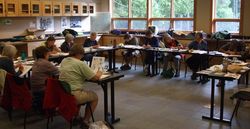
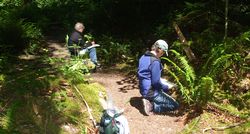
    Focused work was done both in the beautiful Learning Center classroom and out on the trails.


    DSCF5497
    DSCF5501
    DSCF5502 

    Above left: the student who did these drawings had never sketched prior to the class, but bravely gave it her all and did very well, labeling her landscape "My First Sketch."  Above center: these drawings were done by a student who learned to see shadow and proportion by drawing the natural objects. Above right: extensive field notes on the page help students remember how to observe, and what to consider, when drawing en plein aire, or, directly outdoors.
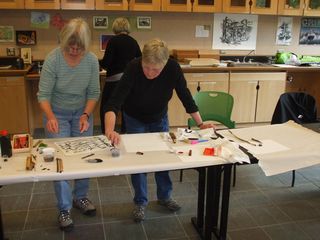

    DSCF5495 The final exercise of the three day course was one that broke from using traditional drawing materials. After collecting a natural item from the ground outside the classroom, students experimented with dipping these into rich, black sumi ink and finding out what kind of marks their "tools" made. More time doing this would have been fun for this hard working group. 

    DSCF5485 

    We were fortunate to have two knowledgeable resident assistants in the drawing class. Katie Roloson helped with classroom logistics and enriched the drawing curriculum with related wildlife legends from the Native American lore. In this photo, naturalist / grad student Justin McWethy (in the cap) is discussing the bear claw scars in the alder tree. He also expertly set up all the specimens for us to draw in the classroom. While on our way up the Sourdough Creek Waterfall Trail (where this photo was taken), we also identified and learned about wildflowers, native ferns and trees. Ultimately, students selected individual spots from which to sketch.

    To learn about other courses held at this spectacular natural location at the edge of the North Cascades National Park, click here.
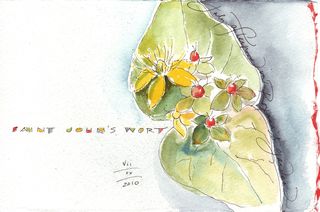
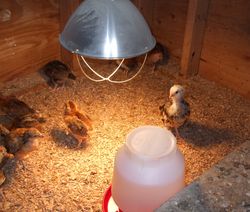
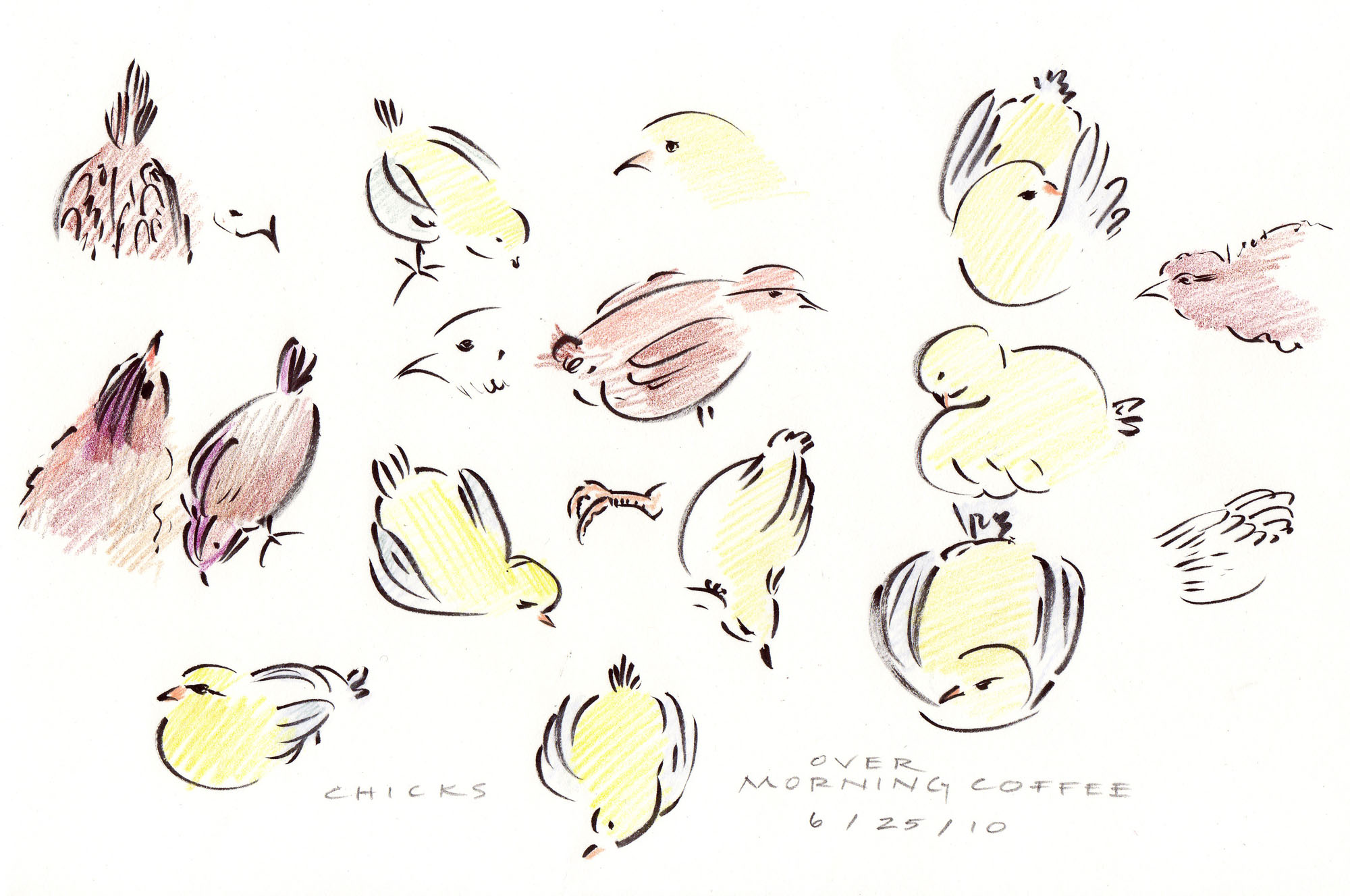
  • I have four lively reasons for not having posted any new artwork for awhile: two Ameraucanas, one Speckled Sussex, and one Welsummer. These are chicken breeds, for those who are not poultry-involved! I've had my chicks for a week; they are as entertaining as four downy clowns can be. This morning I brewed a cup of coffee and sat over the brooder box with a brush marker and managed to wake up enough to capture a few quick (by necessity) sketches of the babies as they pecked, preened, pestered, and collapsed for sudden naps. To see photos of the chicks, please visit my blog.

    Chick sketches

  • DSCF5464
    DSCF5447

  • DSCF5434DSCF5429 DSCF5427

    They're here! Yesterday I ventured out to a breeder's farm in Granite Falls, accompanied by friend Marilyn, and took away two show-quality Ameraucana chicks and one Welsummer chick. There's no guarantee that they will be hens, so time will tell. It's likely that the Welsummer is a female because of her specific eyeline marking and more defined cap of brown feathers. They are currently very happy in their brooder box in the greenhouse. Today I'll be back at work on their coop :-).


  • DSCF5475
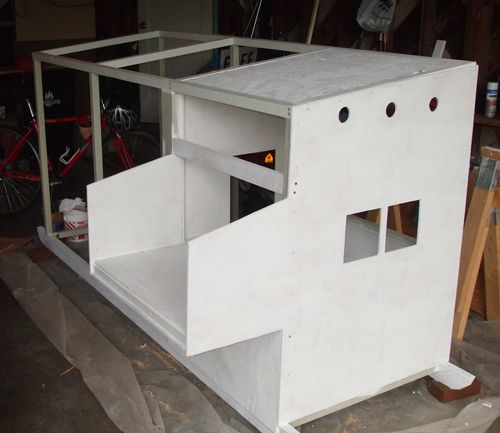
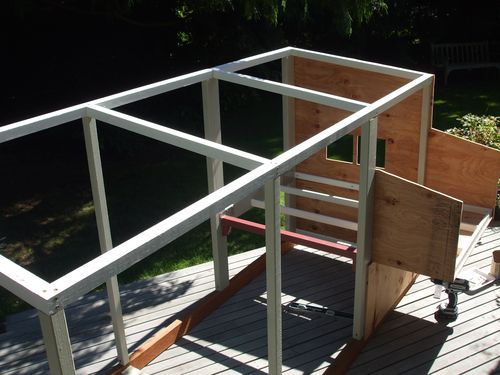
    Progress: a roof, structure fully primed, and ready for the next construction steps. 

    :>

    Now that I'm becoming more familiar with the circle saw, the jigsaw, plywood, the square…and now that I'm drilling less like a girl, the chicken enclosure is taking shape a little more quickly. Here's a photo taken this afternoon:


    DSCF5415

    On Thursday I hope to go chick-shopping!


    If this story
    isn't the most down-home blog topic ever, I don't know what is! But, since curry powder is viewed almost exclusively by friends and family members, there's no need for an upscale, sophisticated publication, right? Let's keep talking chickens…

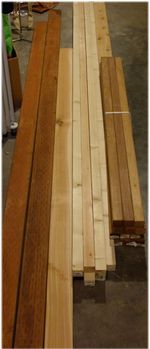
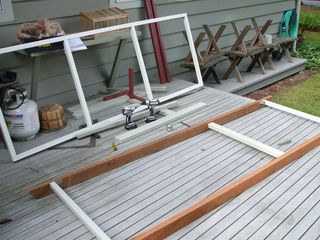
    Before I buy my chicks, their house needs to be nearly ready for them. So here are a couple of photos to follow up on the previous post revealing the sketches for the little chicken enclosure I've designed. I'm now navigating my way through the construction. It's easier on paper! While I'm far from being a skilled carpenter, the structure so far appears that it will be reasonably square and stable. Tomorrow I will bring the plywood home to start cutting the walls of the house portion of the chicken's enclosure. The reasons it's called a "tractor" is that it can be pulled around the yard to provide fresh grass (and bugs & grubs) beneath. Also, larger-scale poultry operations hook up larger enclosures to tractors and move them around the farms. Here are the pics showing the phases:

    Lumber
    DSCF5365


    On the left is the raw lumber which I subsequently cut to size for the framing elements. I primed and painted the cut pieces so that they will be weatherproof on all sides prior to being assembled. Above is a photo I took today. In the foreground is the finished skid frame, and behind it is the top frame for the chicken enclosure. The footprint is 3'x8'. I'm keeping the frame as light as possible so that the unit will be able to be pulled by one human ~ without the need for a tractor!