-
At the age of 16, I learned to do contour drawing while living in southern Spain. Evidently, I liked this practice page of sketches because it's one of the few remaining drawings I have from this time in my life. On the reverse side of the page is a piece of writing by my talented mother. We lived on the Straits of Gibraltar; she was studying the ancient city of Cádiz located across the bay from our cliffside home. In a single two-sided page, an encapsulation of my life in 1967 has been preserved. -
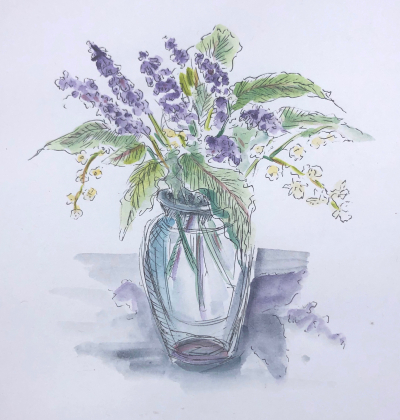
During the past two years, two (R & G, I'll call them) of the three of our little drawing group have moved! It has been over a year since I posted a thing on any of my three blog sites. Let's see if I can remember how to do this… Disruptions of all types have undermined our habits, our outlooks, our every quotidian act to one degree or another. But one thing is ever-returning, and that is springtime. Here in Seattle, that means abundant flowers, humble or flamboyant. We met on R's brand new deck one recent sunny April day, and sketched a dainty collection of muscari (grape hyacinths) and the flowers of epimedium. I love how differently we saw them and drew them! Here you go:
The messy sketch at the bottom is mine, G's elegant botanical study is in the middle, and R's clear, light drawing is at the top.
The warmth of the sun, the sudden zephyr that flipped the table runner, knocking the little vase over, and the bold richness of R's coffee and brownies linger in my memory of that spring morning. How good it was to be together around a table once again.
-
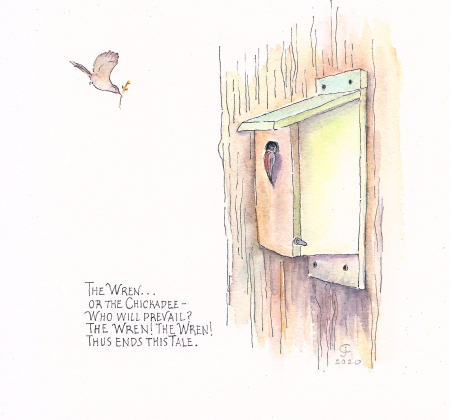
From my studio window I have a direct view of this weathered nest box. For years it hung unused until spring of 2019, and now in 2020 it is the trending piece of real estate on our property. A family of Bewick’s wrens resided there in late March.Some weeks later activities resumed with a nest-building war between a returning wren, seen here in flight, and a stubborn mountain chickadee, seen here blocking the entry. The antics continued for two days when all fell quiet at the house. Shortly thereafter, two black-capped chickadees tried to enter! One of the chickadees and some nesting materials were ejected in a flurry. Then it was quiet again. Two weeks later, the Bewick’s wren emerged, returning with food. Last week, I spotted a very small wren on a cedar branch above the nest box. After several hovering, in-vain attempts to re-enter, the fledged baby finally took to the air and didn’t return, but the singing of the wrens continues every morning in surround sound from our lofty trees.
May, 2020
-
Unfortunately, Letters of Joy has been cancelled due to the threat of the spread of Covid 19. We hope to see you next year
********************************************************************************************
Your opportunity to sing like a monk and write like one too… is BACK for a 2020 repeat performance!
A history-rich, culture-packed, two-hour class will once again be given by me and my dynamic, choir director husband Rick. Write On Calligraphers of Edmonds, WA is presenting their annual conference on May 1 and May 2 at Shoreline Community College in Shoreline, WA. Our class will be one of many varied offerings at Letters of Joy 2020.
Registration will open in March. Please return to this page for updates, or go to WOC’s website by clicking here. When available, the registration form will be found there.
-
For over a year I have been wanting to send a gift to my daughter's friend who recently had her second baby boy. This cherished baby came along after the sudden, heartbreaking death of her first son at the age of two. Not certain how to commemorate this son while greeting the little newcomer, I had to think about what to make. I know that the power of a name can be enhanced by being written by a calligrapher or lettering artist, so I hand lettered both boys' names, added a little portrait of the two golden retrievers the family has included, and put the names into mat openings in multi-opening mats for each boy. Last week I sent the two pre-cut mats with the names to the parents. Here are the names:
-
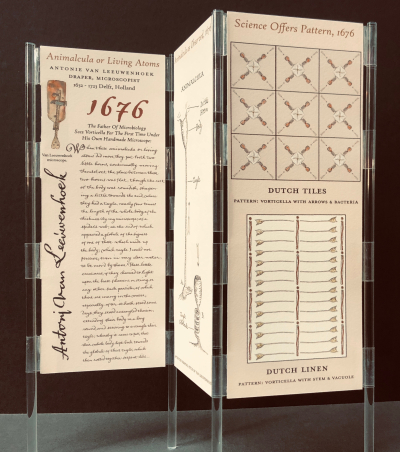
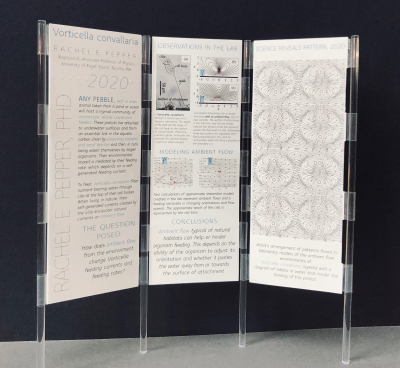
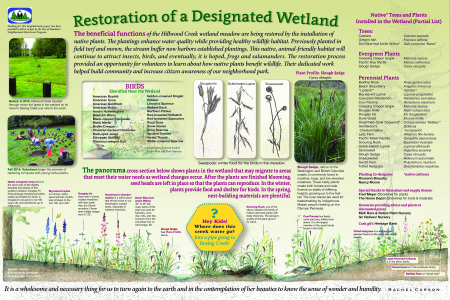
Begun in September, 2018, three interpretive display panels designed by me and illustrated with my watercolors plus photography by Boni Biery, are now in place. Hillwood Park in Shoreline, Washington (my home town) is the location of an ephemeral creek running through a broad wetland meadow. In years gone by, this meadow was an orchard. The central area of this previously cultivated area is now a restored wetland meadow. Who did four years of work on restoring this meadow? Volunteers. I read many requests for assistance on this effort, but the needs of my own home property took what time and energy I had for such digging, planting, and grass removal.
But I did want to contribute something that other volunteers couldn't do, and that was to design display panels for the public to read and enjoy. It took a year for the whole effort, from my first meeting with the unstoppable volunteer coordinator Boni Biery, to the September, 2019 installation of the panels. Here are photos of the panels. Double click on the images to enlarge:
The restored wetland meadow is located in Hillwood Park in the Hillwood neighborhood of Shoreline, Washington.
The address is 3rd NW and NW 190th, Shoreline, WA, 98177.
The park is open until dusk each night. The panels are located along a wood-chipped trail at the edge of the restoration,
just north of the entrance road to the park.
-
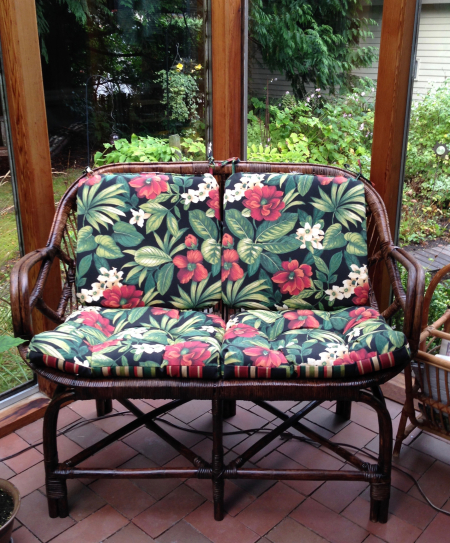
Autumn has officially arrived, and the summer morning reveries back to my childhood years have moved on to current thoughts and goals. Last night I finished another of the items on my summer To Do List: restore the rattan loveseat here in the greenhouse. This seems like a good thing to celebrate now that it is wet and breezy, with the sounds of children playing now coming from the schoolyard playground a few blocks away, and not from the neighborhood cul de sac. Raindrops and cedar leaves are landing softly on the overhead windows here in the greenhouse.
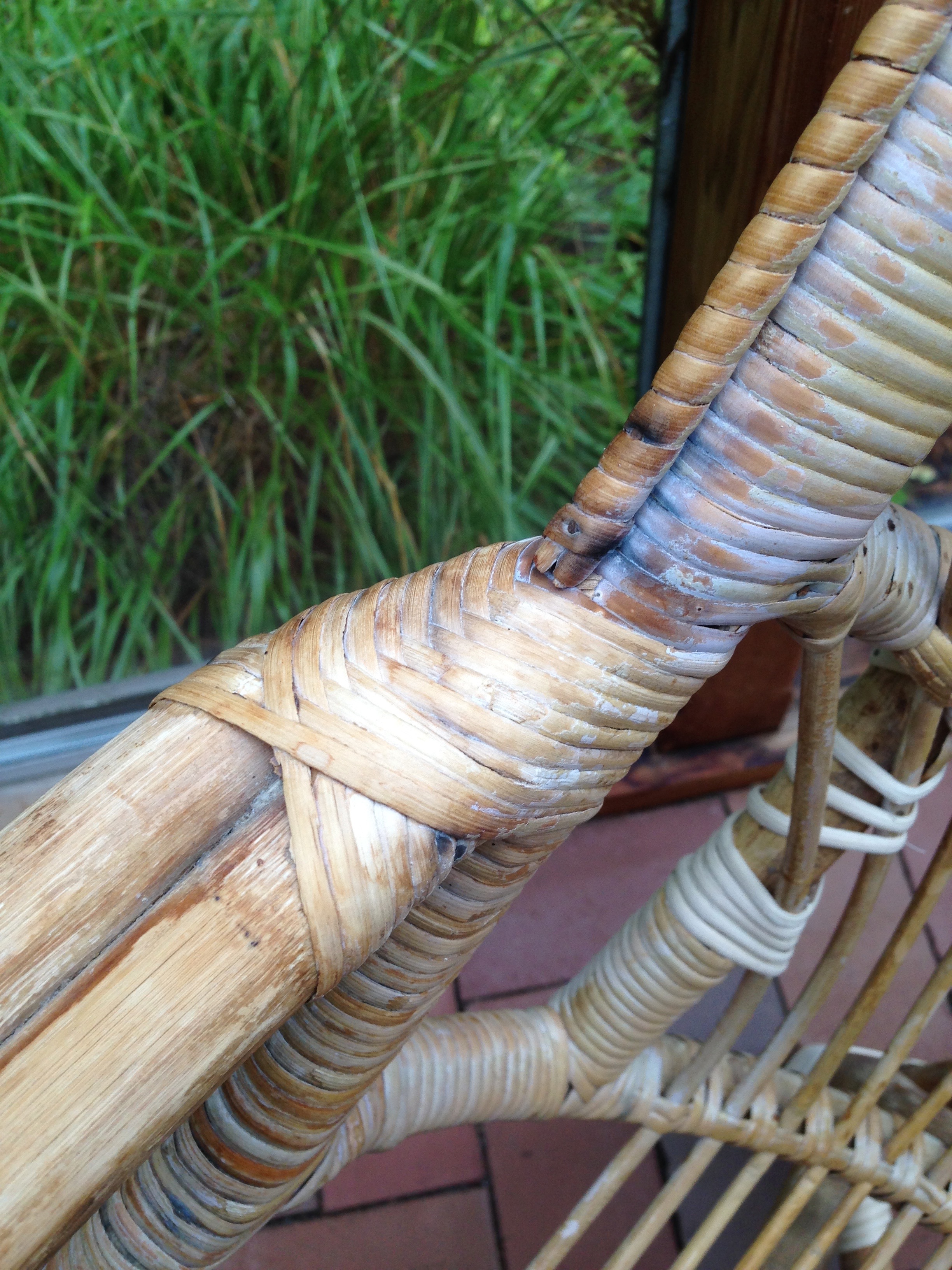
We added this greenhouse in 1982. The story of this construction project, best told by Rick, is now an oft-recounted tale when friends ask about this space. I'll save that fraught story for another time, except to say that once the addition was standing, and standing without the poured concrete foundation having given way to becoming a lake of fresh cement overtaking the back yard, we thought to buy a nice rattan loveseat for it. The glass table came later.Fast forward to 2019 when Rick and I began shopping for a new rattan loveseat. I wish now that I'd taken a true "before" photo at the beginning of the summer, before I opted to restore this one, but I didn't. Imagine the finer rattan wrapping missing from many areas of the frame, especially where 37 years of direct sun hit them. Many dangling ends poked out as the brittle material, originally wound by careful Maylasian craftspeople, had snapped off. Faded and discolored, the still-sturdy loveseat spoke to me: Restore me. I had to respond. Besides, all the potential replacements we found were made of resin, not rattan, and they were too big, too expensive, and, well, just not right.
Last night I put the final touches of polyurethane finish on our little beauty. It is sporting its third set of cushions, by the way. Rick bought these last year prior to a party we held. Today I am celebrating the first day of autumn by checking this project off the summer list! ~~~(P.S., it is now October 5)ReplyForward -
Ada is asleep still at 7:45 on this late summer morning. Now a willowy 8 year-old seeking neighborhood play opportunities (she lives in a rural home with no neighbors), my visiting granddaughter was once the 3 year-old who popped up with the early summer sunlight at 5:30, wanting only my companionship as she chattered while exploring the garden. This morning's greenhouse reminiscence isn't about a grandmother mourning the passing of time, but one of thankfulness for the timeless joy found in summertime play.
When I was 8 I lived near Burien, once a suburb of Seattle and now a city within King County here in Washington state. Our property, with a house built by our father in 1951, was an idyllic place for kids to grow up. Leading to our secluded house at the edge of old-growth forest land was a slightly sloping gravel driveway off of "The Blacktop." The Blacktop was so-called because it was asphalt, I assume, but we never called it the Street, the Road, or the Dead End, which is what it was. In effect, it was our neighborhood playground. At Halloween, it was where we all bumped into each other in the dark in our costumes and compared notes on which houses had the best treats. In the winter it was where the snowball fights occurred and where the igloos and forts were built when the rare snowfall was ample enough. In the spring and summer it was where all of us met up for bike riding, hopscotch, tag, roller skating, hide-and-seek, and whatever made-up games took place. On summer evenings we could be found on The Blacktop. All the parents knew where to look.
Last night, as I listened to the raucous play going on in our neighboring cul de sac, I couldn't differentiate Ada's voice from the five other neighbor girls' shrieks and laughter that blended with dog barks, a toddler's crying, a father's voice. I was thrust back to memories of The Blacktop on summer evenings. There was Bonnie, Janet, Linda, Carol, Claudia, Kath (my sister), Susan, and the occasional invited friend. There were no boys in our age group, it seems. During the long Seattle summer days, we played hard until the gray dusk arrived and that's when Dad would step into our front yard and send a penetrating whistle in the direction of The Blacktop, signaling that it was time to come home and go to bed. Naturally, the whistle was never good news but we did hustle home or risk being grounded. I was grounded often, or so it felt, for a variety of offenses and being grounded was, for me, a kind of torture. Hence, the whistle summons was effective. Barefooted, Kath and I would race down that gravel driveway. By July, our feet were toughened to the rough surface of The Blacktop and to the angular gravel between it and our house.
In June of 1961 my family left Seattle for good. That was not the original plan, but that is what happened. Dad applied for a job as a school administrator with the Dept. of Defense and accepted the job of high school principal in Casablanca, Morocco. Whether Mom suggested to me that I make a photo album of my neighborhood friends or whether I came up with the idea on my own, I methodically took photos of them to take with me. Some day we were to move back to our Burien home which was rented out for that first year, but we never did return and the house was sold in the mid-60's.
In April of this year, Kath (who never came back to Seattle to live, unlike myself) and I visited our old neighborhood where The Blacktop and the houses along it remain unchanged. The same school-bus-yellow fire hydrant is there, right where the asphalt ends and three driveways begin. Next to the hydrant is the weathered boulder where the "it" person stood while others hid. It, too, is still painted yellow. Bonnie's house and Janet's house at the end of the same driveways look the same. Our house, out of sight and down the driveway (now bricked), has had an odd, partial second story added. We left our neighborhood 58 years ago. Three generations of children have called The Blacktop their own since we grew up on it. I can still feel its rough warmth under my feet on those blissful summer evenings of playful abandon. -
We've lived in our home for 40 years, but it is only now, during this mellow August of 2019 that I find myself taking up a studio spot in our greenhouse, feeling reflective as I listen to the birds in the quiet hours of early summer mornings. Rick gave me a tablet for my birthday, and a friend gave me the idea to buy a little bluetooth keyboard for it. No longer having a laptop, I now have this nifty set-up on the circular glass table, my morning desk. Hence, as a seasonal writing project, From the Greenhouse begins with this post.
Two weeks ago I was here at the table writing to a friend when I lapsed into a reflection about my personal history as a transatlantic traveler. Recently, I have surprised some long-known friends when I've off-handedly told them bits about my early life. I assumed that my friends knew my basic life story. Here is what I wrote that day, inspired by the sounds of the morning, with a few pertinent facts and photos added for this first post:
Good morning, K~
I am sitting in the greenhouse now, birds chirping outside but a jet is roaring overhead, too. There's a new flight path that takes more planes over our area. This is not great news for the neighborhood, but when I was a child living near SeaTac, planes overhead were common. So, in a way, the noise is not objectionable to me because it's one of those subliminal comforts associated with childhood and home.
Here is my entire family on board the SS America in 1955. I am deep in strategic thought next to Mom. I recall feeling so grown up; I learned to play cards and shuffleboard on that voyage. And more thrilling to me yet, once familiar with the way to our staterooms, I was allowed to walk about the ship by myself. Independence was encouraged from early on.When we first went to Europe I was 5 years old. We sailed from NYC to Southhampton, England on the SS America. The year was 1955, and Dad had taken a sabbatical leave. Nine months later, we sailed back to the U.S. and I remember seeing the Statue of Liberty from our ship. In 1961, we flew back to Europe from Seattle (via NYC) after Dad was hired by the Dept. of Defense. That time we made the voyage on a propellor plane. That was a looooong flight that groaned all the way across the Atlantic. Later, in the early 60's, the flights back and forth to visit family were via "turbo-props"–a little faster. Finally, in the mid 60's, the planes were sleek jets with designed interiors. What a treat to arrive in England or Germany or NYC without feeling vibrated to the bone and achingly sleep deprived.
When I started this letter to my friend I had no thought of relating this transatlantic travel synopsis to her. In fact, I'd never paused to look back at my own early traveling years as indicative of the rapid changes that swept global travel in the 50's and 60's. "The Greenhouse Affect" has taken on a new meaning for me. Surrounded by geraniums and morning light, it feels as though my mind can travel–without an aircraft.