Jocelyn Curry

Art & Joie de Vivre

  • It's been a while since I posted photos of my little flock of three. They are thriving! They do remain eggless, but they are nonetheless loved. I thought you'd enjoy seeing them as they look today, with some "before" pictures posted for contrast.

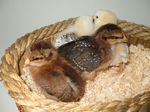
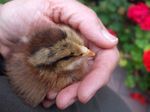
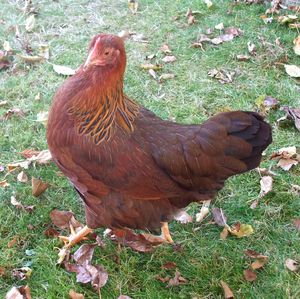
     DSCF5429 DSCF6299Above is Cinnamon at 8 days of age. On the right, she's five months old and very elegant! She's a Welsummer, a Dutch breed, and she continues to be the most shy of the three chickens. At 8 days of age, she hid beneath the other brooder box siblings.

    DSCF5460 In this photo to the left you see Vita snuggled between baby Cinnamon and the two others who ended up being evicted for being boys…


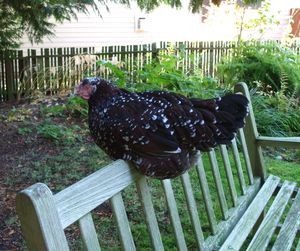
    And here's Vita Speckville West today, below, on her most recent favorite perch: my teak garden bench. She's the most calm and the largest of the three, with heavy plumage.

     DSCF6289


     Bess


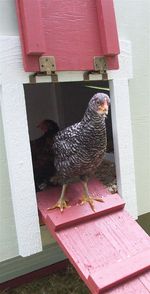
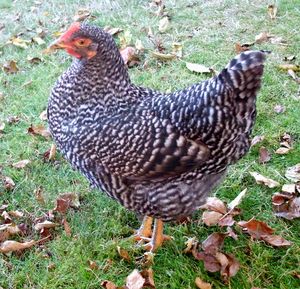
    Here's young Bess, on the left, who was brought home a few days before this photo was taken (she's about 6 weeks old here). She has always been somewhat the boss, and is the "idea chicken" who leads the others into poor decision-making traps, like when she led them through the fence into the neighbors' yard last weekend. DSCF6298 Below you see her as she is today, a lovely example of an American Heritage Breed: a Barred Plymouth Rock.

    On a final note, I have made a couple of hats featuring chicken buttons. The hats are ideal for coop visits in the windy, cold weather of autumn and winter. Check them out on my Etsy site: Soft Shelter Hats, to the left of this column!

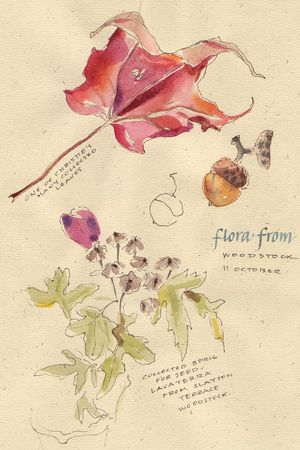
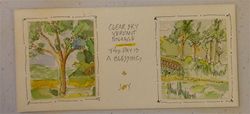
  • To take an autumn trip to Vermont is an all-American must for many of us. To see the spectrum of color on the hillsides, to wind around the country roads, to stop at an apple stand by the Grandma Moses-perfect orchard…one cannot forget the pleasures of a visit. When I went to Vermont with a friend a few years ago, taking my sketchbook was imperative. Here is a group of sketches I did on one page, after taking a walk around Woodstock, my home for a week.

    Woodstock flora

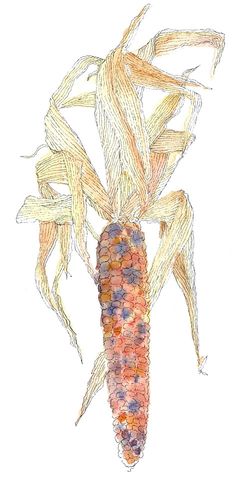
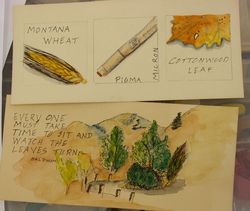
  • Indian Corn small I've always loved the spring, but in recent years I've grown increasingly fond of the autumn. It helps to have Seattle flooded with sunshine this week, so that the unique and subtle colors of the season are illuminated; this, as most people know, is not the norm up here in the northwest corner.

    In honor of the unique beauty of autumn, throughout November I will be posting a series of images I have created during this season. Here you see an ear of Indian corn I drew and painted in 2009 for a card to send to friends and family members. The details: line work was done with a 000 Rapidograph tech pen over the original pencil drawing. The color was done as a separate layer on Arches hot press watercolor paper. They were each scanned, then blended into one image in PhotoShop.


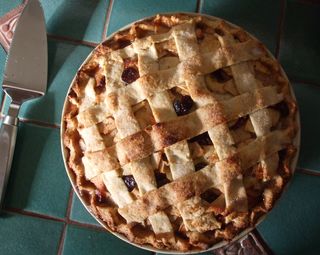
  • Perhaps it was seeing all of the beautiful organic apples available at every turn in our state, or perhaps it was the fine autumn weather here in Seattle that made it an urgent matter to bake apple pies. For lunch guests this week I baked the first one, and then, still obeying the urge to bake and yes, to eat, I baked another this morning to share with two friends who came to meet the chickens.

    Because this blog is called curry powder, I thought it was about time I posted a recipe, even if it doesn't contain curry powder. Are you in the mood for apple pie, too? The pies were made from scratch, but I made mental notes as I tossed things into the bowl.
    DSCF6188

    For a hearty, 10" pie:

    Prepare your choice of pie crust ahead of time, and chill it. I will put my crust recipe (half butter, half oil) after the filling recipe below, but I know that most bakers have their favorite crust and stick with it. If you want to bravely try something new, feel free! Mine is delicious, and reasonably healthy.

    First, roll out the bottom crust, butter the 10" pie plate up to the very rim, place crust in plate, pierce several times with a fork, and set aside.

    Wash 5 large Granny Smith apples and three large Braeburn, Jonagold, or other sweet, crisp apples. Using a peeler/corer/slicer gizmo (highly recommended for sheer speed), process the apples, cutting the slices in half with one cut through each finished apple as it comes off the gizmo.

    Put all slices in a large bowl, and add the minced or grated zest and juice of one lemon. Toss well. Add about 3/4 to 1 cup of sugar (part brown works well), 2 teaspoons of cinnamon, and 1/4 tsp freshly grated nutmeg. Toss and stir well. Sprinkle two tablespoons unbleached flour across apples. You guessed it: toss and stir well. All slices should be coated with the ingredients.

    ~Now pre-heat the oven to 425º.

    Add 1/2 cup dried cranberries (or more if you wish) to the apples. I used Trader Joe's orange-flavored ones, and everyone loved the flavor with the apples. If you don't like cranberries, omit them! After all the ingredients are together, do not let them sit for any longer than necessary, as the sugar will draw out the apple juice from the slices.

    Roll out the remaining dough for the lattice strips.

    Fill the pie shell with the apple mixture, gently arranging and tucking the apple slices so that there are no gaps in the pie. Heap the slices in the center creating a low dome. The thin gizmo-made slices make for a very packed, apple-y goodness. You may have some leftover filling after filling the crust. Put leftovers in a small, oven-proof bowl and bake along with the pie, until it bubbles throughout the bowl (about a half hour).

    Place lattice strips on top of pie. Pinch edge of crust, catching the ends of the strips into the edge.

    Optional: put little dots of butter here and there on top of pie, between lattice strips. Sprinkle granulated sugar across top of pie.

    Put a drip-catching pan or aluminum foil on the rack below the center rack of the oven. Some juice will drip out as the pie nears doneness.

    Bake pie on center rack for 35 minutes at 425. At this time, loosely float a piece of foil over entire pie (do not wrap or tuck foil) to prevent the crust from burning. Lower the temp to 400, bake 15 more minutes, then pierce center of pie with a sharp knife to check for tenderness. If knife resists, bake 10 more minutes. Test again. My pies took a full hour to bake. Remove when done, cool. Eat while slightly warm, with or without vanilla ice cream.

    Invite someone over to feast with you on this all-American autumn pastry!

    ~~~~~~~~~~~~~~~~~~~~~~~~~~~~~~~~~~~~~~~~~~~~~~~~~

    Jocelyn's Butter and Oil Pie Crust (just barely enough for one 10" pie)

    2 cups unbleached flour

    1/4 cup quick-cooking rolled oats (added for apple pie crust only)

    1 tsp. salt

    2 rounded tsp. sugar

    1/3 cup cold safflower oil

    1/3 cup cold, chopped up butter

    1 – 2 T. ice water

    In mixer, place dry ingredients. Mix on slow speed for 2 minutes or so.

    Add oil and butter to dry ingredients, and mix on slow until the particles of butter are split-pea size (the size is not super critical, but they shouldn't be chunky).

    Add just enough water (start with 1 T.) to bring the dough together in a moist ball. The oil will make the dough appear moist–but the dough needs some water to make it stick together. The dough will be soft. Do not over mix. It only takes a few turns of a beater to mix the water in.

    Divide dough into two balls, about 60% (bottom crust) & 40% (lattice strips). Flatten slightly, wrap in waxed paper, chill for at least two hours before rolling out. I make the dough the day before, then take it out of the fridge to soften a little while I mix up the apples.

    This dough is easy to use, but will be softer than shortening crust recipes. Work with it cold. It is easy to "patch" with it because of the oil content. I roll it out between two pieces of waxed paper, then remove one sheet of the paper, and place the rolled-out dough over the pie plate, the second piece of waxed paper still clinging to the top. Ease the crust into the buttered plate, then peel off the waxed paper. Smooth the crust into place, patching if little tears occur. Pierce with fork, fill and bake immediately.


  • DSCF6099

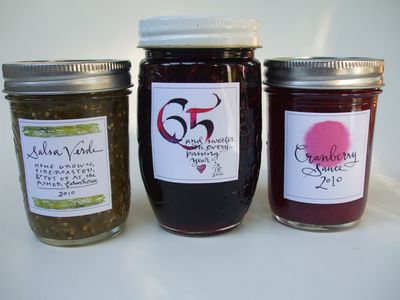
    They are pretty simple, these labels I designed and printed for the family canned goods. It sure was fun sitting at my desk by the window two crisp autumn days ago, looking out at my three chickens, and playing with my pens and inks. (click photo for a close-up view)

    After doing the casual lettering and decorative motifs for each label design, I scanned and placed them into PhotoShop, then ganged them up in InDesign to make a full sheet. Each label is 2"x2", laser printed on Office Max's glossy removeable label stock.
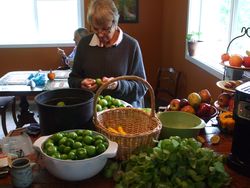
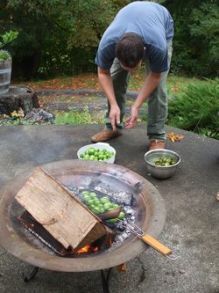
    Below you can see me husking the home grown tomatillos for the salsa verde after they were harvested by my daughter, Emily. My son Eli (he and his wife grow these tomatillos on their small farm) later fire-roasted the vegetables to make this favorite condiment.

    DSCF6073 DSCF6074

    Happy harvest season!


  • SunriseBilliings
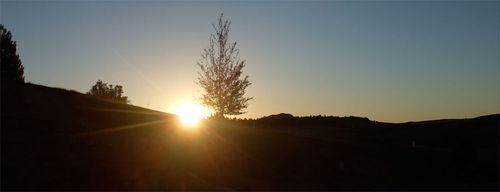
    Above is a snapshot of the September 26, 2010 sunrise in Billings, Montana. My early morning walk readied me for an inspiring second workshop day with 22 students at the ACEC. Below are more luminous pages from the work they completed that day. Please click on the images for a larger view. To see more of this group’s work, please review my previous posts.

    KateArt


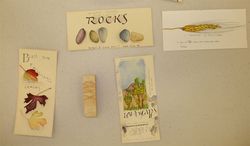
    Kate Stanko’s studies on the left included rocks, which was appropriate because the ACEC site is a former gravel quarry. The site is well represented by her nice collection of varied pages.

    ElizabethArt


    One student (write to me if you did this work, please!) was especially inspired by the flora collected from the grounds (on the right).


    DianaArt1


    On the left, Diana McDonough’s pages and case demonstrate how much a person can complete in two days’ time. She and her 21 classmates fully engaged with the exercises.

    JeanArt


    Jean Fleming-Mazur’s sketches on the right show expressive (and impressive) pen and ink skill while her use of color livened up her 3-square page.


    DebArt Deb Parsons-Menke’s final collection of pages on the left show numerous layouts featuring beautiful sketches of the local flora, a quick sketch and a full-page landscape watercolor. Her reflective writing done on the small prairie was a favorite activity of the weekend.
      
    JudyArt


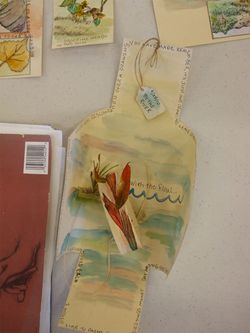
    Judy Swoboda’s softly painted case, on the right, was puncuated by the deep color of a sumac leaf rendered on the band.


    To my students: I was able to photograph quite a few, but not all of your journal pages. If your work is not represented, it is only because my efforts were not fully systematic, not because your artwork wasn’t deserving of being represented. Also, please let me know if I have miscredited any artwork. Thank you.

  • RoseViewfinder DonnaSolo
    Journaling is a solitary activity, usually. Even when in a class, participants manage to find a little solitude. On the left, Rose Toth uses her viewfinder. Donna Shockley, on the right, sketches at the edge of one of the ponds.

    Time dedicated to drawing, design and reflection  will yield work worthy of sharing. Here are more examples from the Montana Prairie Journalers' weekend in Billings, Montana at the ACEC on September 25th and 26th. Click on the images for larger views: 

    MargaretArt SandyArt1
    Above, Margaret Myhre's journal shows a mixed media approach. Numerous field sketches will also be enclosed in her journal case.

    On the right, Sandy Haney's delicate pencil and watercolor sketch attached to the inside of her journal case is complemented by a beautiful, completed journal page. 


    BethArt   MaryAliceArt  


    Both Beth Lee's work, on the  left, and that of Mary Alice Spencer, above, have a neat, graphic appearance. Fitting their own texts to the illustrations was well done by both artists. Shown here are Beth's pretty Italic calligraphy in a burnt sienna, and Mary Alice's "architectural printing" in monoline ink.


    Below on the left, Kathy Hewitt, new to landscape sketching, captured depth, shadow and perspective in her full-page Montana scene with an added bit of writing. All the students utilized the helpful limitations of a 2" square template for their initial drawings.


    MarilynArt  KathyArt   
    On the above right, Marilyn Overby cropped her beautiful pen, ink and watercolor sketches so that her favorite areas were featured in the "final cuts." They are well set off with a bit of text inbetween and a finely drawn border.


    Please click here to see more beautiful pages

    by this group of 22 journal artists.

  •   Prairiejournalers
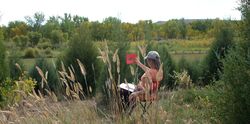
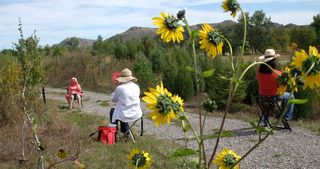
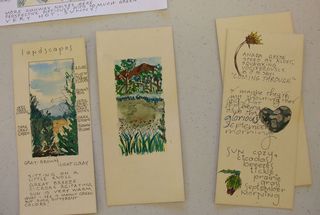
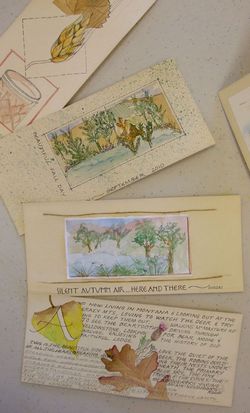
    The spirit of the Montana woman was in evidence last weekend as 22 hard working and talented artists gathered in Billings to study together at my workshop sponsored by Big Sky Scribes, the state calligraphers' guild. Eight of the participants were from Billings; the other 14 drove long distances over the plains and prairies to be there. From a wide range of skill levels came an outpouring of beautiful nature journal work. Working both outside from the paths and on the micro-prairie (shown above, with 4 workshop students) of ACEC (Audubon Community Education Center), studious work was also done in the classroom. Each participant completed several small journal pages plus a decorated case for those pages. The paper had been pre-dyed with tea, giving it a warm color that enhances watercolors with an autumnal undertone. Each student also did numerous contour drawings and landscape sketches on ordinary paper.

    Photos from the weekend, with captions, are below. I took more photos than I usually do when teaching, so another post will include additional images of the journal pages:

    Viewfinders
    For some, landscape sketching was a new and slightly terrifying skill to learn. Small viewfinders isolated sections of the softly-hued surroundings, helping keep the scale of the sketches suitable for journal work. In this photo, all of the viewfinders are a noticeable red.


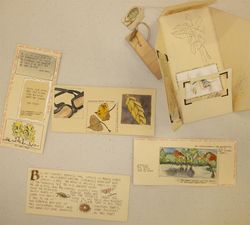
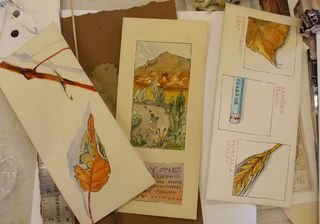
    BeckyArt To the right are three pages created by Becky Smith. Students varied their page layouts, practiced pen and ink shading techniques, worked to enhance color, and incorporated handwriting, lettering, and decorative capital letters into their compositions.

    SandyArt
     On the left are Cyndy Aten's pages showing field notes, various monoline lettering styles, and a bold palette of colors. A unique heart-shaped stone is featured on the page of Cyndy's own reflective writings.


      EdieWork

    Edie Owen's pages to the right show a variety of layouts, careful landscape studies, and the addition of spatters and freely painted lines.

    Please come back to see more examples from the workshop. I'll be posting another collection tomorrow. Thank you!

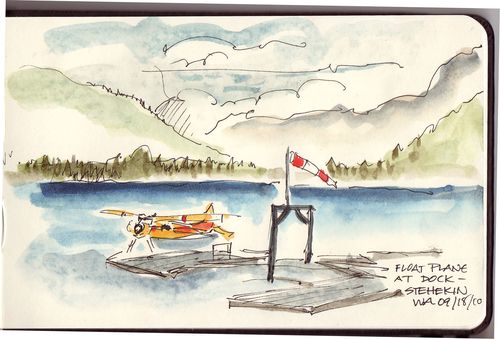
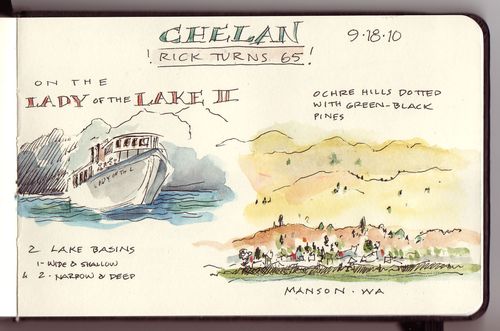
  • Legendary and evocative, the tiny community of Stehekin, Washington, is tucked in between peaks of the North Cascades at the north end of deep, glacially carved Lake Chelan. There are three ways to get there, none of which are by car. One can hike in (14 miles) on mountain trails, fly in by float plane from the town of Chelan at the opposite end of the lake, or, do as most of us do: take the Lady of the Lake II for a day-long cruise "uplake" and then "downlake," stopping here and there along the steep shoreline to pick up travelers. I took my tiny sketchbook with me and captured a few scenes:

    Chelansketch 

    The trip uplake is narrated just enough. One learns of the geology, the communities that have taken hold along the shores, the camping locations, and various historic events. As the ship is under way, fishermen proudly hold up their morning catches to show the Lady passengers. Good, stout coffee is sold at the concessions stand on board. Passengers move in and out from the bow or stern, catching the fresh air and perfect views of the mountain-surrounded lake. The strong engines of the vessel smoothly move the Edmonds, WA-built vessel along; she can take an impressive 285 passengers.

    Chelansketch 1
    When the ship docks in Stehekin, the Landing comes to life. According to the ship's captain, as soon as the Lady departs, the Landing (residents consider Stehekin to be a nine mile long community that includes the Landing, rather than a "town") once again becomes still and quiet. Moored at the end of a dock was a sunny, golden yellow and orange float plane, looking like an oversized, cheerful mosquito against the Prussian blue of the lake waters. We took the 45 minute-long tour on a cherry red bus that took us to several features found within a few miles of the Landing. The layover in Stehekin is a brief 90 minutes – not long enough to satisfy us – but long enough to give us an idea of what life would be like for the fewer than 100 year 'round residents there. A highlight: the Stehekin Pastry Company! Blackberry pie and a luscious brownie fueled us for the tranquil cruise downlake.