 At the start of almost every drawing class I teach, the participants are force-fed a little contour drawing to warm up their eyes and hands to seeing and recording shapes. I think I'll always love the look of these drawings, especially if the hand is allowed to meander freely about the page as the eye stays essentially fixed upon the subject. In this drawing of my own, a collection of small vases (only one is visible here) hold stems of hellebores. The uppermost blossom cried out to be tinted with colored pencil, so that's what I did.
-
-
 Drawing and photo by Libby Mills
On March 17th and 18th*, a group of twelve artists gathered with me at the Padilla Bay National Estuarine Research Reserve in Bay View, Washington. It's hard to imagine a place better suited to a weekend dedicated to drawing, painting and writing about the surroundings. The Bay, the softly-hued landscape, and the soaring evergreens against a dramatic sky provided plenty of drawing and painting challenge to the participants. The beautiful, on-site aquarium provided contrasting subject matter for our second afternoon. Broad variety in the shifting weather gave us everything from intensely cobalt blue skies to a full spectrum of grays as we captured on paper what we were seeing.
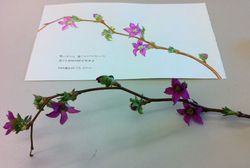
Being at the Reserve on the brink of spring's arrival allowed us to begin our work by drawing the delicate but vibrantly colored salmonberry sprigs (Rubus spectabilis) collected Saturday morning and brought in by Mary Heath.
 Morning's work by Mary Heath
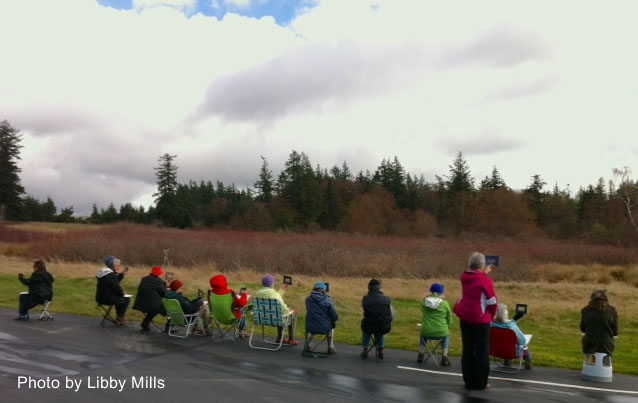
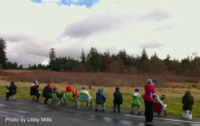 Throughout the workshop, page design was emphasized. To aid in designing, a 2"x4" viewfinder (we are all using them in the photo above) doubled as a template to create either vertical or horizontal rectangular spaces on the 6"x9" pre-cut pages. At the end of the workshop on Sunday, the pages were to be stitched together.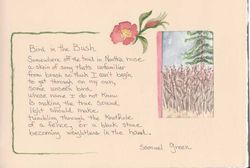
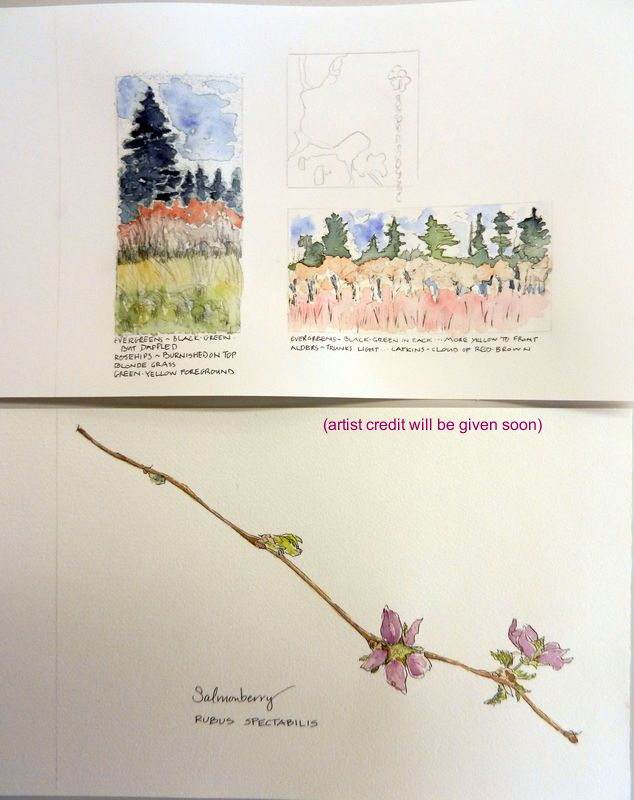
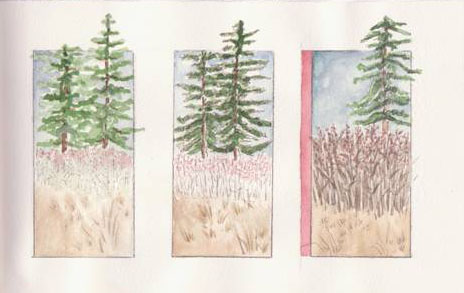
One of the techniques employed as a design feature for either a book cover or inside pages was fenestration, or the cutting of windows in the paper. In this example of careful design (right, and below), Nancy Liggett utilized a detailed painting of a salmonberry blossom, a handwritten poem, and a window revealing a watercolor sketch of the wild roses and a fir tree. Turn the page, and you see this trio of pen and watercolor sketches:
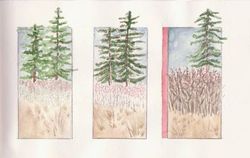 Nancy completed this pair of pages after the workshop was over. Reports are that several workshop members have continued working on their books and have planned sketching outings. One must continue to draw often in order to build skills. This cannot be emphasized enough. I am overjoyed to hear that the energy and rewards from the workshop have taken hold!
The object of doing the three vertical sketches was to do five-minute drawings of the same section of landscape. Repeating a subject will often lead to increased perception of it, the elimination of unnecessary detail, and confidence in being able to record something quickly. This was an optional exercise on day two.
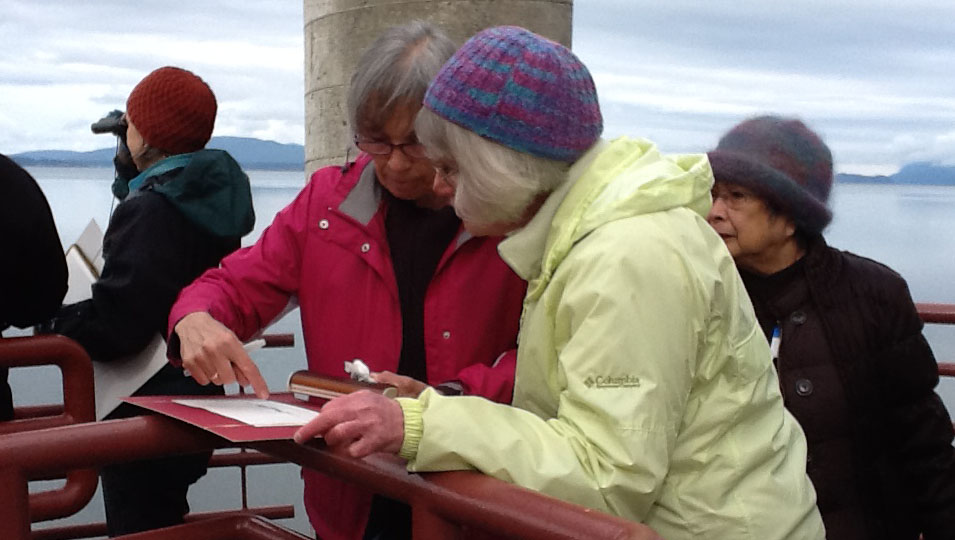
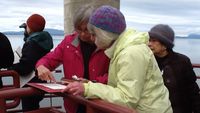 At the Reserve overlook, I give tips on quick waterscape painting.
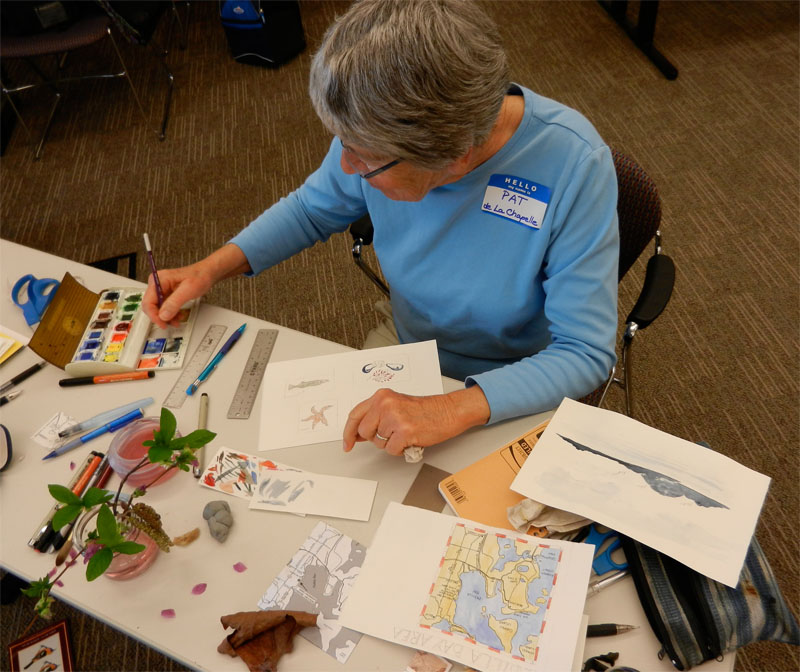
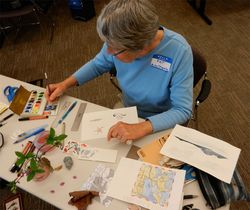 Pat de la Chappelle is surrounded by her pages as she approaches the time to stitch them into a book.
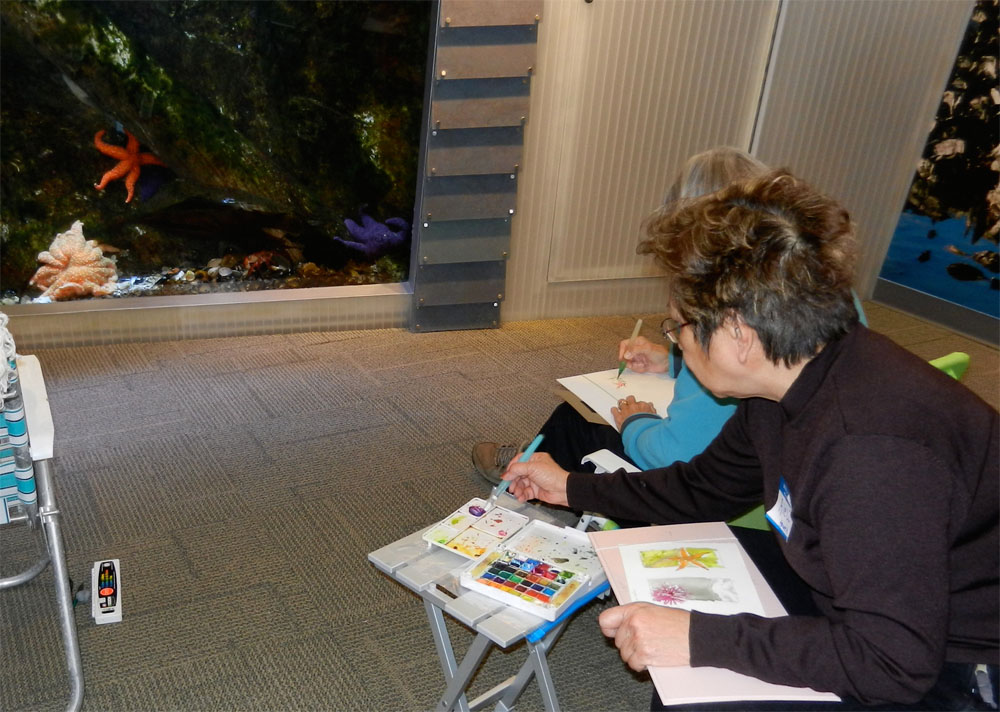
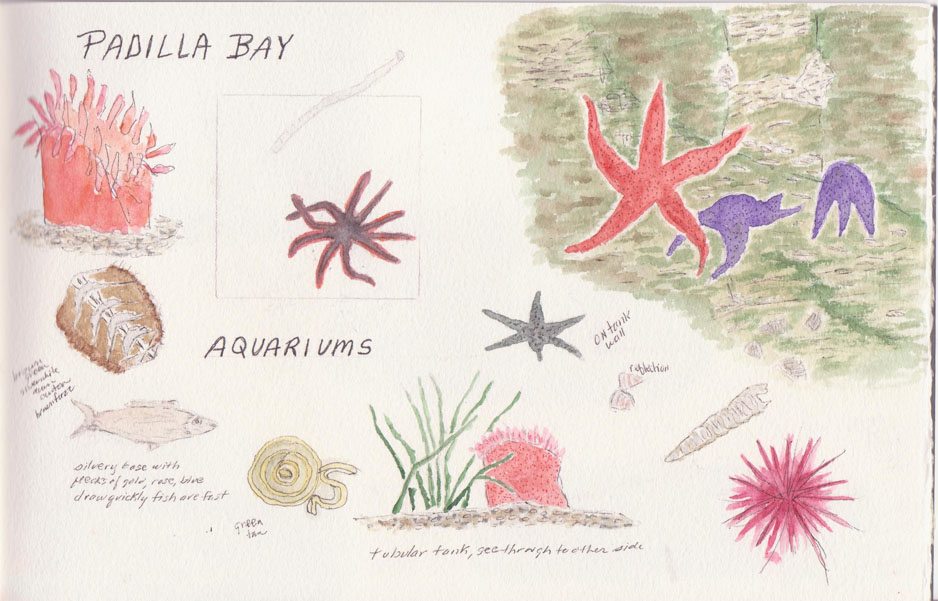
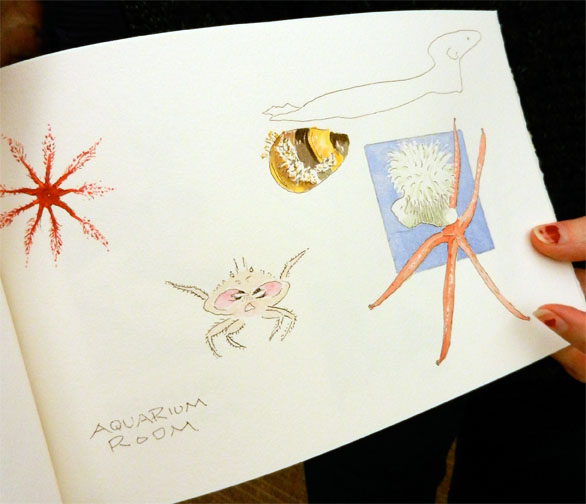
After gamely drawing while out in the weather, the group cheerfully walked through the breezeway from the spacious classroom to the aquarium. Open to the public, this room features new tanks for the intriguing creatures found in Padilla Bay. After sketching the breadth and depth of the outdoor vistas, the participants easily took to drawing the defined, colorful creatures in the pristine tanks. After I assigned two different page design approaches for these timed sketches, the artists filled their pages with drawings, then proceeded to paint them. Some continued the painting while in the aquarium, others worked in the classroom.
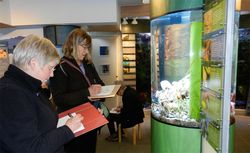 Mary Heath and Libby Mills sketch in the aquarium room.
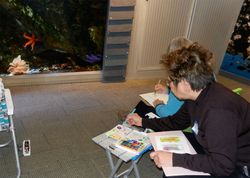 Aleli Howell and others sketch creatures living in the largest tank.
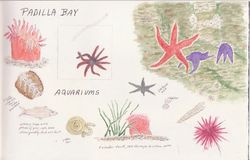 Elle Romick rendered a fine journal page by including multiple sketches and notes, and by using a pleasing color scheme.Kay Reinhardt's delicate style was well suited to drawing and painting the Bay creatures.
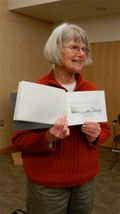 Nancy Liggett shows her Bay sketch.
Rather hastily, because we had used all of our time, and after the books were stitched together and embellished with a few beads, each workshop participant showed her book to the group. In two days' time, an impressive amount of work had been completed by this dedicated, upbeat class of keen learners.
~~~~~~~~
A special thanks to Mary Heath, Kay Reinhardt and the Padilla Bay Foundation, Anne Middleton. and Barbara Rozema for the use of her marvelous cabin!
*This workshop was entitled A Book of Days; Pages from Padilla Bay.
-
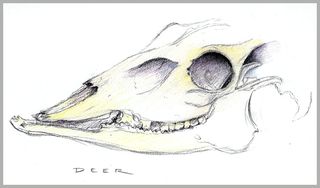
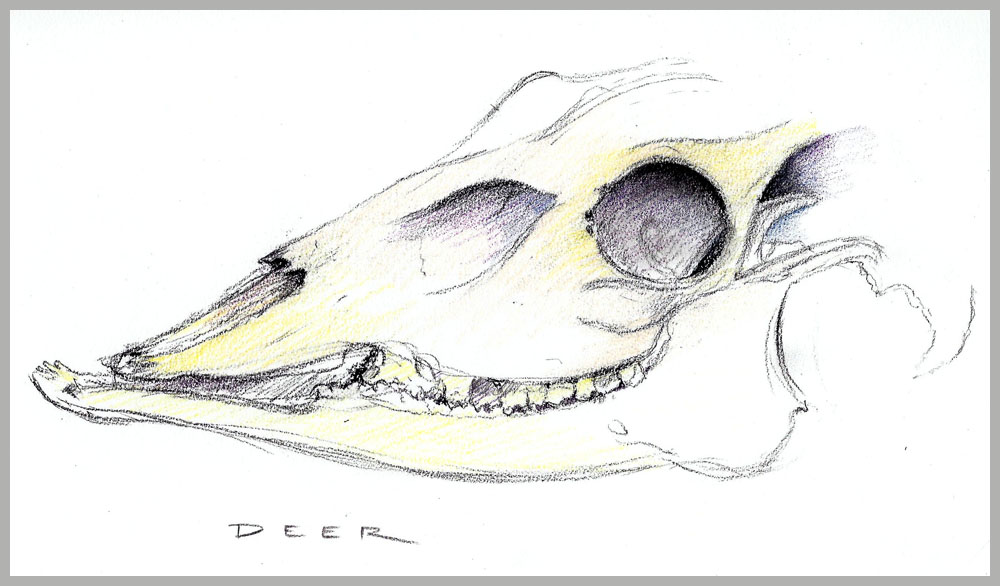
As one of the spring classes offered by the North Cascades Institute, Specimen Drawing at the Burke Museum: Feather and Bone is now open for registration. Class will be held on Sunday, April 22, 2012, from 10 am – 5 pm. This is an opportunity for those especially interested in natural objects to practice drawing with me as your instructor. We'll be using the elegant forms of animal bones and bird feathers and wings as subjects. A naturalist will also be in the classroom to offer insights into the forms and functions of the objects we'll be working from. We'll pack in as much instruction and practice as we can in one day. Some art supply items will be provided so that beginners don't have to invest too much time or money in them for this short course. The central location of the museum, its inspiring collections and the one-day format will provide a novel retreat for the participants. To visit the Burke Museum online, click here.
To register, click on the title above or the link below. Email me with questions!
http://ncascades.org/signup/programs/specimen-drawing-at-the-burke-museum-feather-and-bone
-
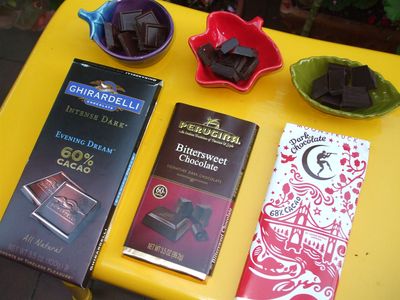
One evening last summer, inspired by the chocolate bar display at PCC in Edmonds, WA, I decided to create a tasting of three of the bars for my husband and myself. I arranged the bite-sized pieces and bars as you see in the photo. Then, we started in (this was dessert on a warm evening after dinner). As we analytically let the morsals melt in our mouths, I made a few notes about the qualities of these three bars with similar cacao content. Thinking that I had long ago tossed out my notes, I never posted our amateur findings. My notes showed up in a kitchen drawer a couple of weeks ago, so here you have them:
Ghirardelli Intense Dark Evening Dream 60% Cacao
The most aromatic; rich, but not a very complex flavor (no artificial flavors); thinner bar breaks nicely; most economical
Perugina Bittersweet Chocolate 60% Cacao
Inferior, dirt-like aftertaste; artificial vanilla (vanillin); added milkfat detracts from cacao richness; classic European packaging is handsome
Moonstruck Dark Chocolate 68% Cacao First Place Award
Complex flavor with coconut and blackberry notes; no artificial flavors; fun graphics on the package; the 68% cacao content probably plays a big part in this bar being the top choice in this limited tasting event
Once we had eaten our fill, the bars were put away, to be nibbled at now and then during that week. My husband commented that when he ate the chocolate without being in critic mode, even the Perugina bar tasted just fine, thank you.
-
After Christmas, aren't there always a few nuts-in-the-shell still sitting around in wooden bowls? There certainly were in my childhood home. And so there were at one of my drawing group member's homes when we gathered there recently. Here are three little still lives using our petite subjects:
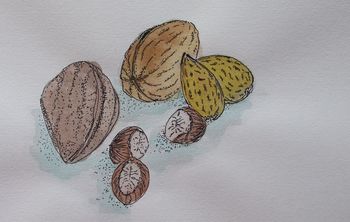 Above: tech pen and watercolor
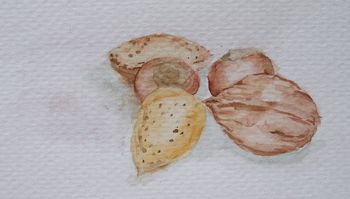 Above: watercolor
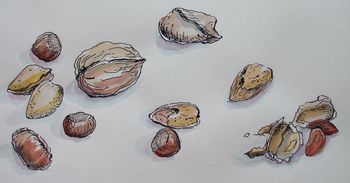 Black gel pen and watercolor
 -
What happened?? I haven't posted since November 11. Must have been the holidays or something…Happy New Year to you! May it be healthy and prosperous.
While bustling about with festive activities and family gatherings in our home, I also had some assignments to complete. One was a Valentine card design that entailed a false start before I landed on the style that fit. Because we will be celebrating Valentine's Day in about a month, this seems like a good time to put forth a few of the composite roughs I created during the first stage of designing:


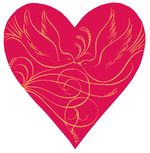
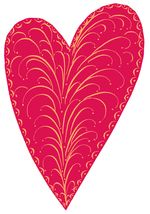

The design specifications for this card were that the heart motif and the band motif were to be flocked in red with gold foil stamping on them. To achieve this mock-up effect, I employed PhotoShop to convert the black and white ornamentation to the color gold in order to emulate gold foil. Each band was created to coordinate with the designs within the hearts. The final design chosen was significantly different than any of these! I'll post it later on this year, as it will be a Valentine for 2013.
-
Not to ignore the artistic potential of holiday baking, our little drawing group opted to convene with a seasonably appropriate drawing activity: decorating gingerbread cookies. No one argued that it would be OK to put away our pens and pencils for a week! So, during two hours of light-hearted practice, with coffee, cookies, and satsumas on the side, we drew in icing. Here is a little collection for you to see. This group represents two cookies from each of our sticky drawing boards:

-
One of the fun aspects of being a chickenkeeper is that of chicken educator. For instance, I have answered this question many times over the past 18 months: Will the hens lay eggs without a rooster being involved? (The answer: yes)
My own teacher in matters of chickenkeeping is the author of my excellent book, Gail Damerow. The book is Storey's Guide to Raising Chickens. It was when Vita, my Speckled Sussex hen, began to lose a lot of feathers that I consulted Gail's chapter on molting. I quickly determined that Vita was, indeed, molting. It's pretty dramatic what happens to hens when they molt. Below is a photo of one night's feather loss when Cinnamon, my Welsummer hen, began to molt about 10 days ago:
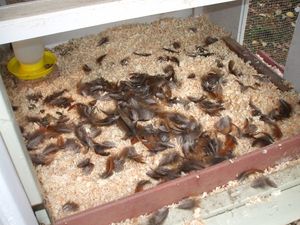 Shocking, isn't it? It looked like a fox slipped in and murdered a chicken. When Vita was at the height of her molt, she had no tail, and a fully bare bottom that looked like she was plucked for roasting. Other feathers were thin and she looked about half her usual size. I didn't have the heart to take a photo of her! She was quite miserable, embarrassed, and somewhat self-isolated. Very unlike the sassy Vita I know! And, there are no eggs laid when a hen is molting. It's not a great time for a hen.
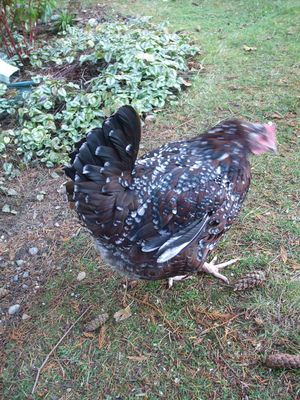
In the second photo, you see Vita sporting her new plumage, which is beautiful. She's strutting her stuff, but still not laying.
 In the third photo, you see Cinnamon with no tail, and Vita in the foreground. This photo was taken 3 days ago. So far, my faithful, plucky Bess, the best layer of the three, hasn't begun the molt yet. This is an annual event for chickens, and a matter of serious management for egg farmers, as one might imagine.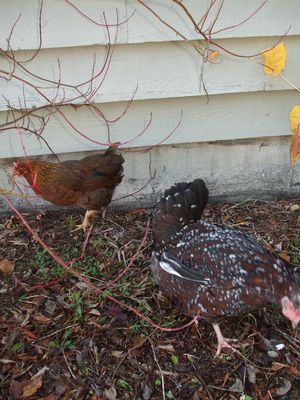
That's our chicken lesson du jour :-).
-
A trip to the produce department in the autumn is a feast for the artist's eyes, isn't it? Among the predominantly purple veggies I bought a couple of weeks ago was a gorgeous savoy cabbage. I decided to render it in two layers: a fine line contour drawing and a loose watercolor layer. Here are both the parts, and then, the combined image.
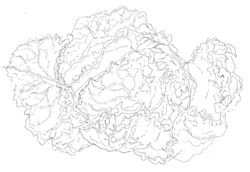
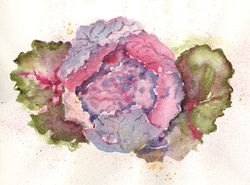
For the line drawing I used a 000 tech pen. After placing the line drawing on my light table, I put a piece of 90 lb. watercolor paper over the drawing and loosely painted the cabbage which was perched nearby. I scanned both renderings and combined them into one image in PhotoShop.

To see a photo of the purple vegetable collection, including this Savoy cabbage, please click here. -
A friend told me about "Mother's Milk Cookies" when I was chatting with her about my new granddaughter Ada and her beautiful mom, my daughter-in-law Amy. No, the cookies do not have mother's milk in them. They have ingredients that enhance milk production for busy new moms. And all new moms are busy.
There are commercial mother's milk cookies, but I wanted to make some so that I could put the best possible ingredients in them myself. After finding numerous recipes online, I selected one. Whole grains, brewer's yeast, and ground flax seed mingle with the organic butter and free trade chocolate chips in these tasty treats. Of course, I had to design a label, too:

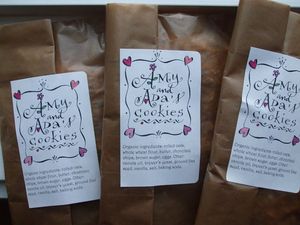
For the artwork, I used a pointed pen for the lettering and little border. After scanning it in as a TIFF file in PhotoShop, I colored the motifs digitally. In InDesign I incorporated the list of ingredients, printed the finished label out on laser labels and wrapped each cookie in a natural waxed paper baggie. Frozen, these pop into a professional mom's briefcase and nourish both mom and baby when snacktime arises!
 Jocelyn Curry