As a retired lettering artist and illustrator, I still create a lot of visuals and have fun doing it. My website is a place I can post and share them from my Shoreline, Washington studio in my home.
Have you ever noticed how many pear paintings the world's artists seem to be producing? A friend recently commented, "It's because pears are so voluptuous." Ah, this could very well be. But they also offer a manageable challenge for beginning oil painters like moi-même. These pears sat on the kitchen counter, in front of the more popular bunch of bananas, for about a week before I had to paint them. For me, all aspects of painting with viscous oil paint are challenging: color mixing, working from dark to light (the opposite of watercolor), and trying to achieve a 3-D appearance. One of my workshop teachers said, "Painting with oils is just like doing any other artwork." Oh. Why does it feel like traveling in a foreign country, then?
Soon I'll be going to the ocean for our annual family vacation. My paints are packed up and ready. During my next painting session, I may just have to contribute to the world's huge output of sunset-over-the-water paintings.
An unanticipated low tide and ideal drawing conditions met us at the Edmonds, WA beach. We were treated to freshly baked cookies, pre-heated travel mugs for steamy, aromatic coffee, and a perfect log on which to perch.
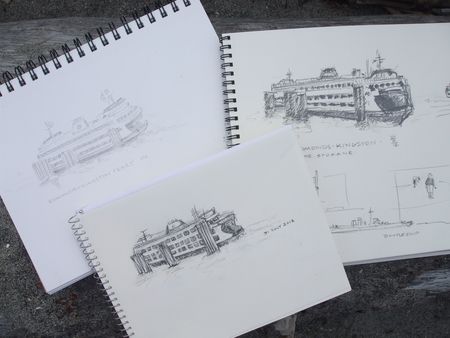
It's awfully nice when an outing ends up being even more fun than anticipated, isn't it? Such was the case for the little drawing group this week. After convening to draw seagulls on the Edmonds beach two years ago, we decided to take the plunge, meet up at the beach again, and sketch the ferry. You can imagine the challenges with this: perspective, scale, and hundreds of little windows to indicate. Oh yes–and there's the matter of time. Ferries only sit there for a little while before pulling out and heading across Puget Sound.
In the sketches seen below, you can see how we each caught the image in pencil. To draw (quickly) the end of the boat, we took advantage of the view as the ferry pulled away from the pier. When the next ferry approached, we did some touch-up work on our sketches, then settled back to enjoy conversation in the mild, salty air. Here's to summertime in the Pacific Northwest!
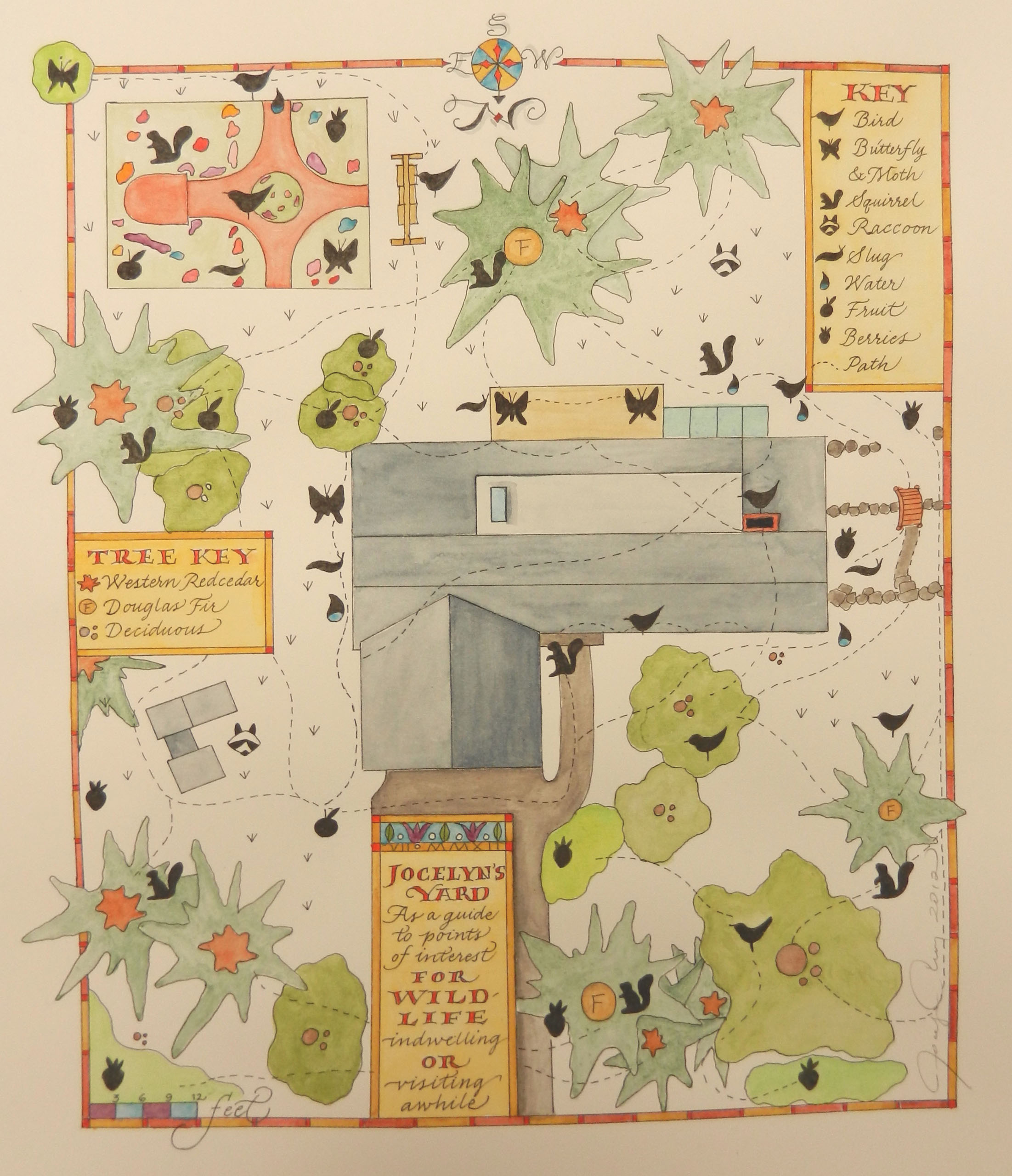
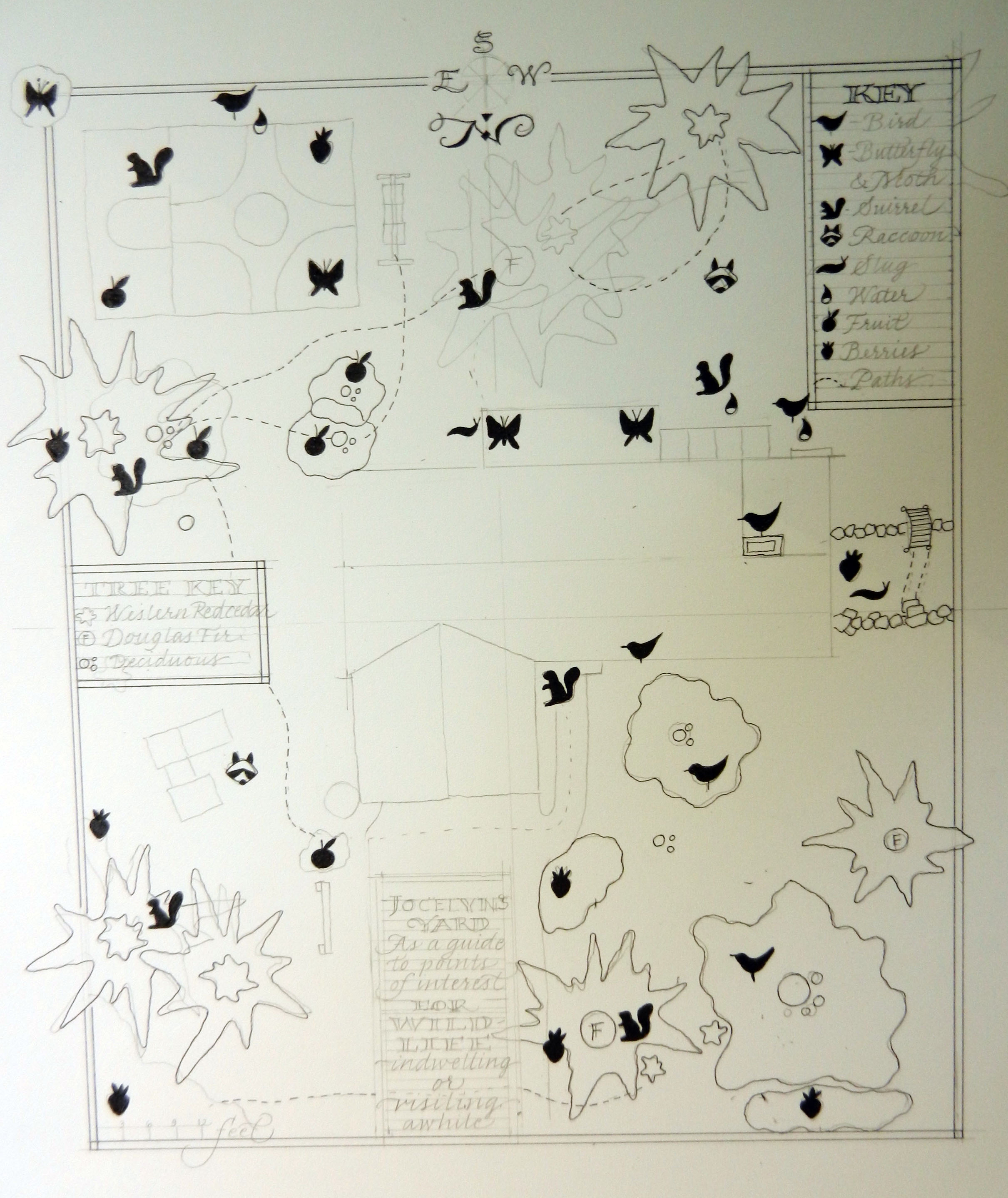
The dominant graphic element of this map is the black icon. Representing different species and various desirable food and water locations, the icons would help animals quickly determine where to go in my yard. It pained me to tip off the raccoons as to the location of my chicken coop, but I had to be the creatures' advocate in this case. For the occasional human map reader, I have included some verbage. Click on the map for a larger view.
We all use maps, but how many of us have ever drawn one? Consider setting aside four days in September to explore the art of mapmaking while being in the embrace of the peaks and lakes of the North Cascades.
From September 6-9, 2012, I will be teaching the course The Artful Map, A One-Page Journal at the North Cascades Institute Environmental Learning Center (ELC). This will be one of three courses (participants register for just one of the three classes) offered at the annual artists' retreat held in this spectacular location on Diablo Lake, less than 3 hours from Seattle. I taught a shorter version of this course last year, and will return to teach it again with an additional day this year.
When it comes to designing maps, there are no limitations. Just about anything can be mapped, whether it be a geographic location, a voyage taken, or even a series of life events. Up among the massive, stony peaks and forests surrounding the ELC, we will have no shortage of inspirational material to work with for experiential maps that can double as journal pages.
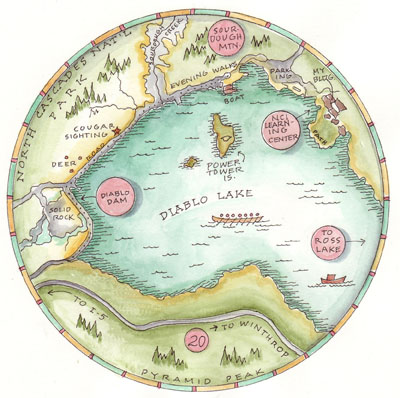
The circular map of Diablo Lake and the ELC area shown here was one I made last year prior to the class.
Click on the map for a larger view.
Today I completed the map above that exemplifies a different approach. Ostensibly designed to help wildlife navigate my yard and find food and water there, I had a good time marking off my property with paces while making notes and sketches on site rather than relying on Google Earth, which I used to assist in rendering the geographical elements on the circular map. For artful maps, exact measurements are not needed. For more abstract approaches to making maps, traditional cartographic features may even be omitted in favor of individuality. When designing your own map, you may employ your imagination to any degree you wish.
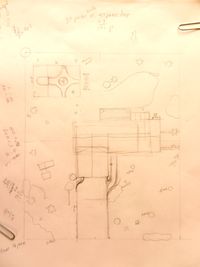
Below are two in-progress images of the map. I started with transferring a basic sketch to hot press watercolor paper (one of the ones we'll use in class) using a light box. Then, I inked in with a Rapidograph 00 all the features and icons, borders, paths and keys. After the ink was dry, I painted the map with watercolor, selecting colors as I went along. Incorporating both warm and cool colors, and keeping them fairly light, I tried to keep the icons strongly visible.
Pencil sketch made while pacing off the property and marking tree locations.
On hot press watercolor paper, inking of icons and outlines takes place.
Please contact me with questions you may have about the class or the venue. Visit the informative website for the North Cascades Institute by clicking here. View the work of last year's students here. Register for the class by clicking here. I'd be very happy to see you and work with you up in the mountains, at the edge of turquoise Diablo Lake as the summer draws to a close.
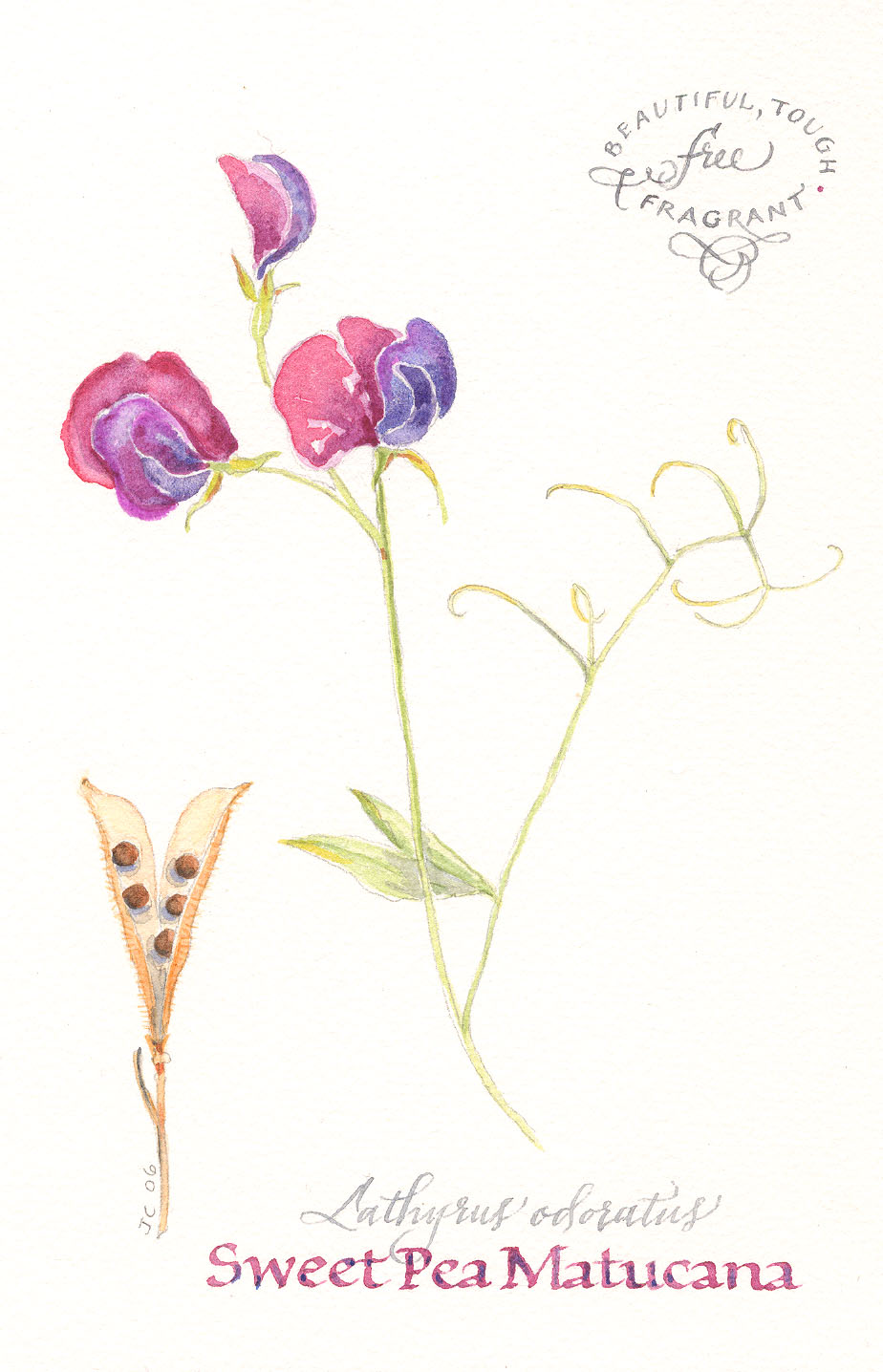
One of the simple pleasures of summer in my garden is the dependable blooming of Lathyrus odoratus, the sweet pea Matucana. On the left is a seed packet I designed to share the Matucana seeds with friends and family members.
Everything about this plant, fabled to have been first cultivated by monks in Italy in 1699, is desirable. The plants volunteer if previous year's seeds are allowed to drop to the soil. Requiring no watering beyond the natural rainfall (granted, this is Seattle), they are hardier than most weeds. The color and the fragrance are exquisite. Blooming early and continuing through July, they are a source of pure summer delight.
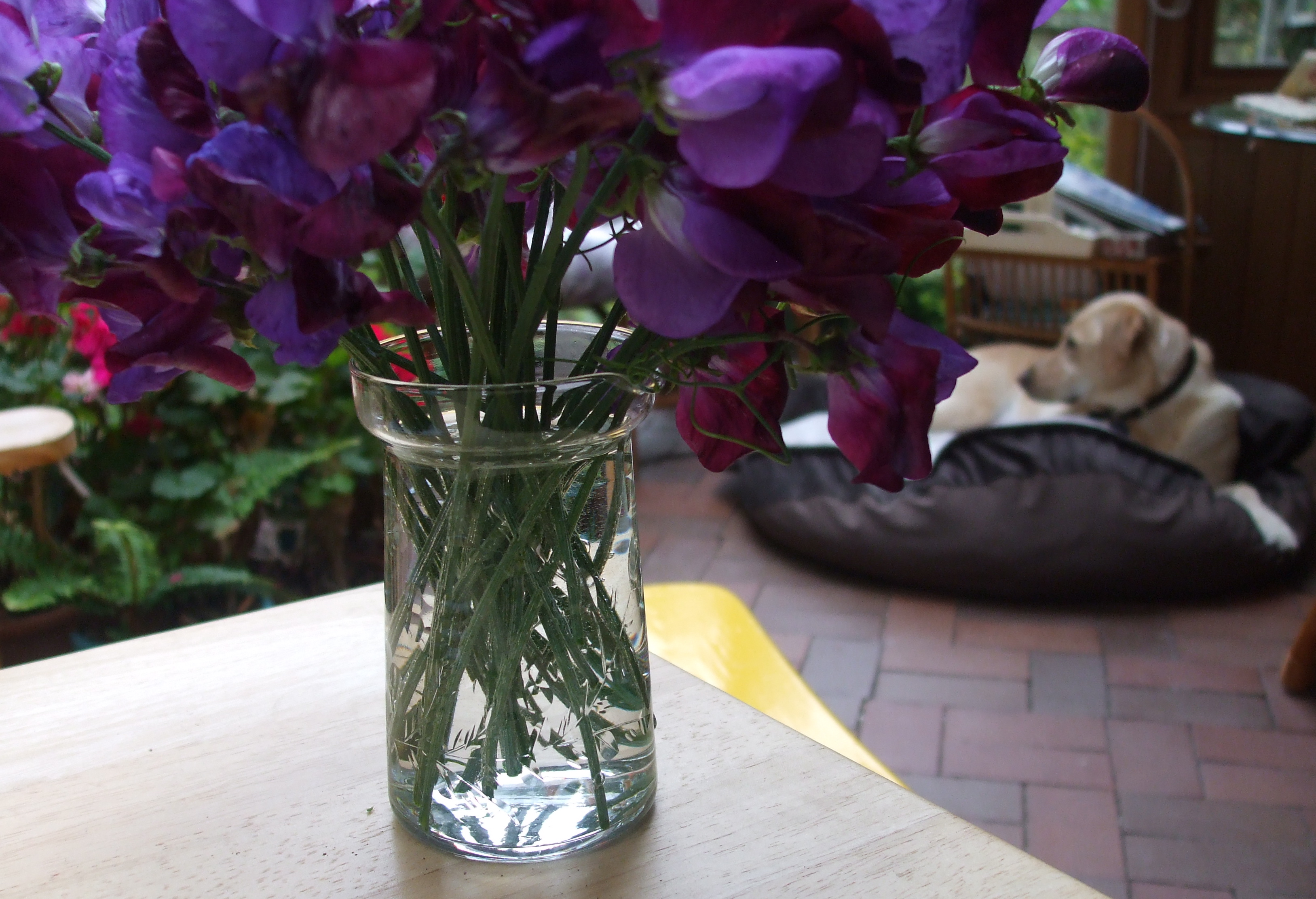
Two weeks ago, while on a weekend excursion with friends, I found a small, cut glass pitcher at a garage sale. What could be more perfect for a bouquet of Matacanas? (Click on either image for a large view)
Lots of food, water, and Cinnamon's warmth yielded vigorous duckling growth.
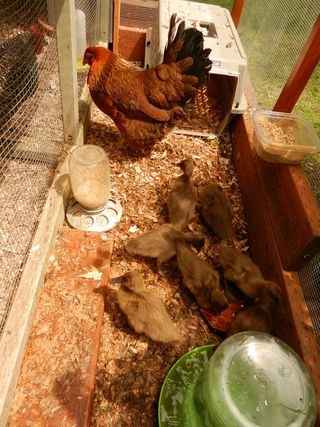
After one week, it became important to move the chucklings (friends have had fun coming up with hybrid names) outdoors. So I built a brooder coop for the family. By the time the youngsters were two weeks old, they were consuming over three gallons of water a day. No kidding. I could hardly keep the waterer full! Between eager drinking and bill-smacking splashiness, the water disappeared. Here you see the brooder coop placed adjacent to the large coop, where Bess looks on and Cinnamon stands guard.
When the chucklings were two weeks old, a new owner for the babies was found, and one by one I collected the plump, warm little siblings and put them in a box. Cinnamon protested, trying to protect them, but never pecked me. Yesterday, I allowed her to jump out of the brooder coop for her first foraging jaunt around our property in many weeks. Re-integration with Bess and Vita is a little rough, but getting better today. Cinnamon has had her brood, and is resuming life as a free agent hen.
The babies will be kept warm by a heat lamp, and by each other.
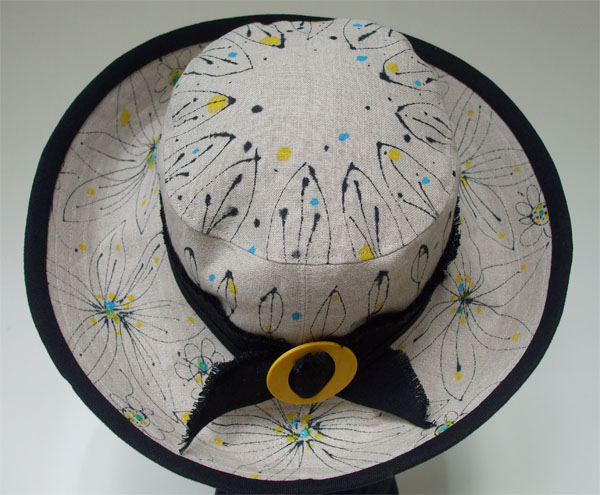
There's something potentially scary about freehand drawing when it's done in acrylic on something other than a sheet of paper. My years of doing loose hand lettering by squirting sumi-e ink out of an eyedropper have given me confidence, I guess, even though a disaster is never out of the realm of possibility. Last week I took the cut-out pieces of a linen sun hat and went at them with a needle-nosed bottle filled with black acrylic paint, and acrylic ink accent colors applied with eyedroppers. I then heat-set the artwork, sewed the hat, and trimmed it in black linen.
This hat is one of a series I have made this spring for my small online hat shop, Soft Shelter Hats (on Etsy). In the cold months, I make embellished fleece hats. Year 'round, you can find the cotton sun hats of my shop partner, Christine Smith. She elaborately hand dyes fabrics and makes sun hats out of these textiles. Take a look when you have a minute!
June 14 UPDATE: Please scroll down to see the video~
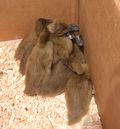
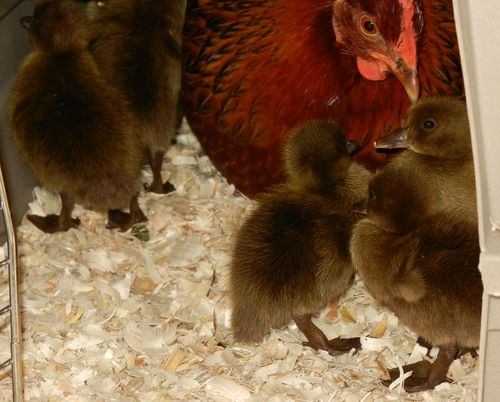
Unaccustomed to a human hovering over their box, the babies scamper into the carrier and under their mama when I approach, so I'm not certain of the final duckling count. So far, I've counted six at one time. They all look perfectly fluffy and highly mobile!
All seven babies are alive and well, and living in their box as well as on YouTube. Here's a new video taken when they were four days old, June 14, 2012:
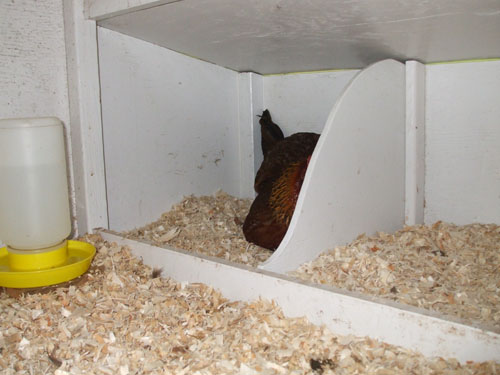
Yesterday, Cinnamon stayed nestled in her preferred corner of the nest box.
As I type this, Cinnamon's life as a surrogate mama chicken has begun. The Khaki Campbell eggs are hatching today! As a routine check on the broody little hen, I opened the nest box cover to peek in. The sight of a broken shell prompted me to lift Cinnamon up. Had an atrophied egg been broken? No! I saw a wriggling mass of damp, downy ducklings! I also saw an egg in the process of being pecked open. I quickly replaced Cinnamon, who was distressed of course. Later today, I will move mama and babies to the brooder box I have set up for them in our greenhouse.
I called Amy and Eli and announced the hatch, which is coming a day ahead of the estimated 28 days. Eli warned me (as I am now warning my readers) that there may be deformities as a chicken hen may not have the perfect hatching technique for ducklings.
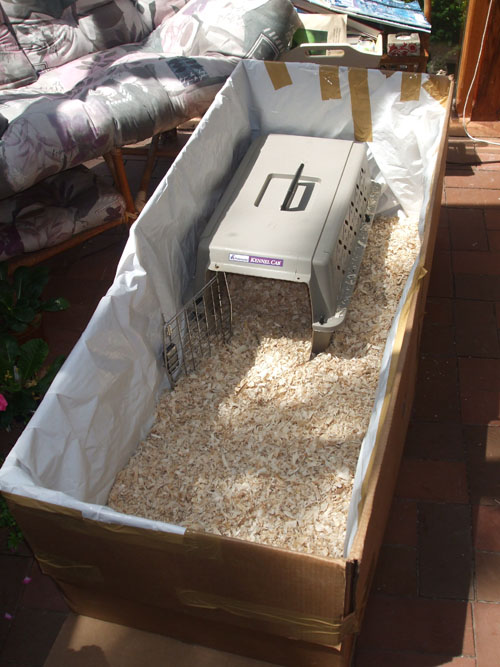
Two large boxes with a cat carrier and lots of fresh wood shavings will be the temporary home for the new family.
The one duckling that rolled out from under Cinnamon's wing when I checked the progress a second time looked hearty indeed. I'm keeping my chicken-and-duck-keeper's fingers crossed! Photos will soon follow..
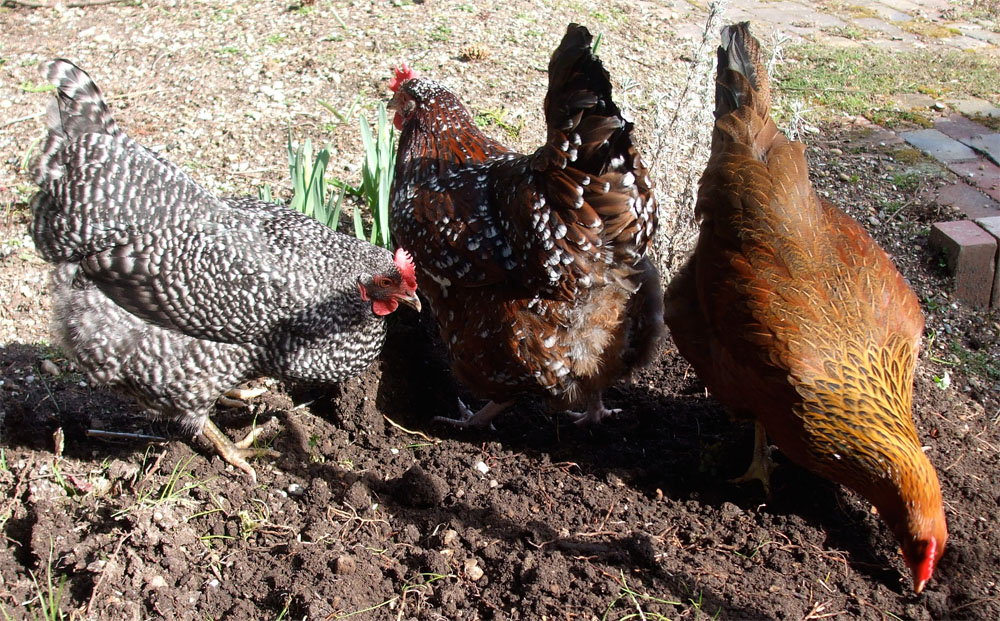
Bess, Vita and Cinnamon helping out with the rototilling.
Not everyone is enamored with my chickens, or any chickens, so I'll try to keep this update as compact as an egg. I've already recounted, to family and friends, the tale of how Bess, my Barred Plymouth Rock, got us all in trouble in March, so I believe I can stick to the condensed version:
Early March: Cinnamon and Vita resumed laying eggs after taking the winter off (not unusual for the wintertime, but I didn't expect them to take three months' vacation after molting). Bess, who didn't molt and didn't take time off, announced impending egg arrivals loudly each time the other two went up the ramp to the nest box to lay. Granted, Bess can be vociferous, but the announcements generally do not last long.
Mid-March: A neighbor living behind our house, someone I don't know well, called to complain about the chicken racket. Eek. No one has ever complained about the girls! Quite the contrary. In response I promised to move the coop and do what I could to simmer Bess down. He mentioned chicken stew, thinking I would laugh. So I knew he was serious. He stated that the chickens had awakened him that day at 7 a.m. I doubted this, because I had been up at 7:10 and the chix were silent. I started keeping a record, just in case I was reported to the city of Shoreline:
March 20 chicken journal entry:
6:45 AM: Vita up. 6:50 AM: Cinnamon up, pecking moss. 7:50 AM: 3 up, all eating. 7:10 AM: all three on perch. 7:27 AM: one hen clucks softly. 7:40 AM: all eating. 7:50 AM: pecking on ground. 8:00 AM: Vita clucks at seeing me in the window. 8:30 AM: I take morning snack to chickens. 8:30 AM: Bess goes up the ramp to lay. 8:41 AM: 10 second egg announcement from Bess. I release chix to help quiet Bess down. 9:05 AM: Vita goes up ramp to lay. Bess announces loudly for 15 sec. I toss lettuce out the window to distract her. Etc. [On this day, therefore, there were exactly 25 seconds of Bess vocalizations. The rest of the day, they were essentially quiet. This was the noisiest day of the two week period of recording morning chicken activity.]
Fast forward: Neighbor called a couple of weeks ago to say that it helped a lot that I moved the coop away from his property. I knew that the main problem was actually Bess' temporary excitement that I knew would wane with time, and it has. Nonetheless, peace in the 'hood was the goal. By the way, this blog has a new banner (above). The banner, an oil painting, features a portrait of plucky Bess.
Chapter Two: Cinnamon and the Duck Eggs
I placed 7 duck eggs around the broody Cinnamon, then tucked them under her.
You may ask: Why not give an "olive branch" of fresh eggs to our neighbor? Well, the reason is we simply don't have extras right now. Cinnamon went broody shortly after Bess' egg production finally dropped (coincidental, I hope) after the neighbor episode. Being broody means that Cinnamon only wants to sit on eggs – any eggs – and she stops laying her own. This happened twice last summer. This spring, my son has been working at hatching his fertile Khaki Campbell duck eggs in an incubator at his small farm in Castle Rock, WA. He has plenty of fertile duck eggs, so I thought: why not see if Cinnamon would hatch some ducklings?
She has been on the eggs for two weeks. She is thoroughly dedicated to her work. The incubation period for ducks is 28 days. For chicks: 21 days. So this is a long haul for little Cinnamon. If you think, as we did, that this is a far-fetched task for a Welsummer hen, view this YouTube video:
If Cinnamon succeeds, I will have my own YouTube clip to share. And then, the ducklings will be sold from our "farm" here in Shoreline, or taken to Eli's farm in Castle Rock. By all means, stay tuned!
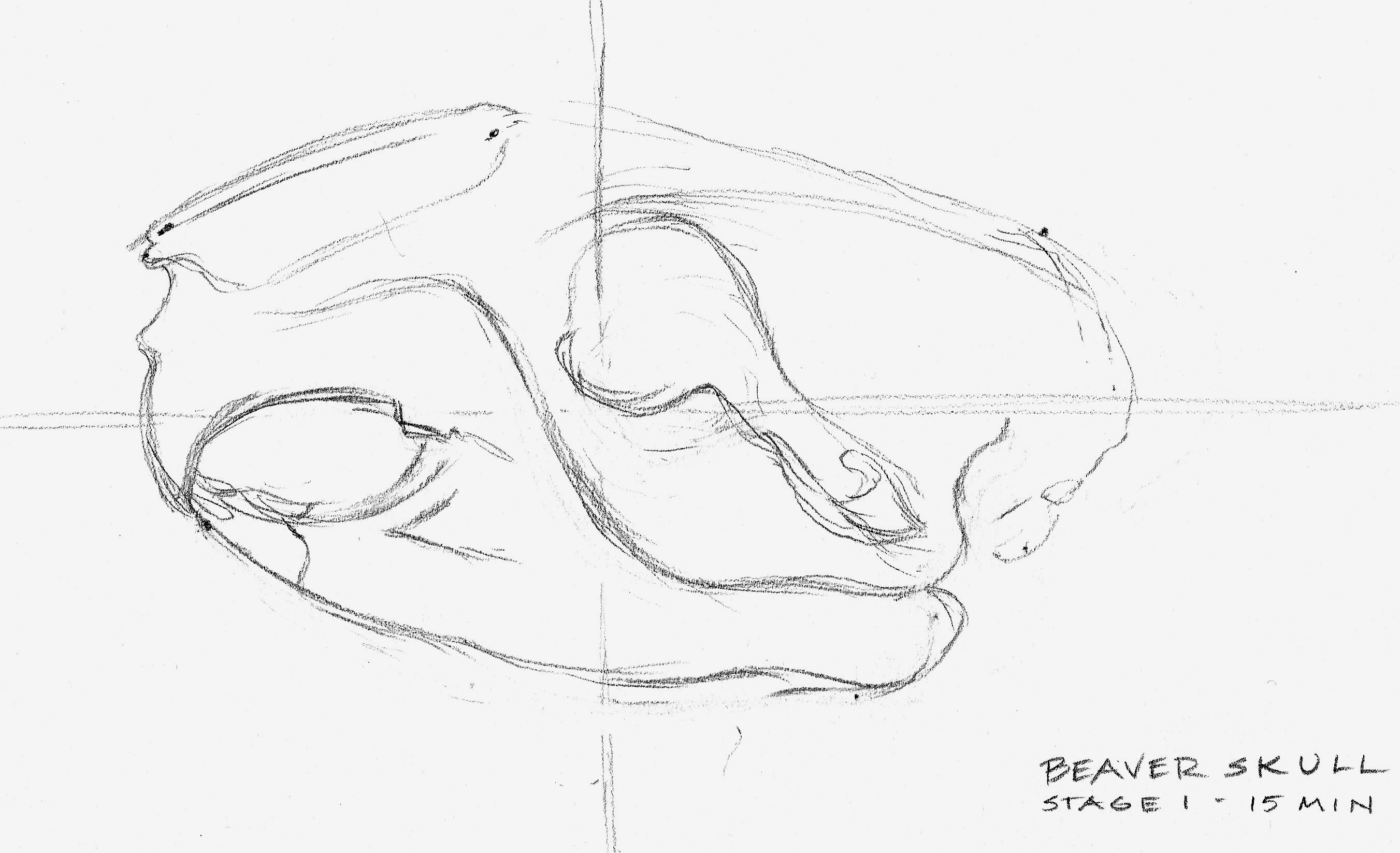
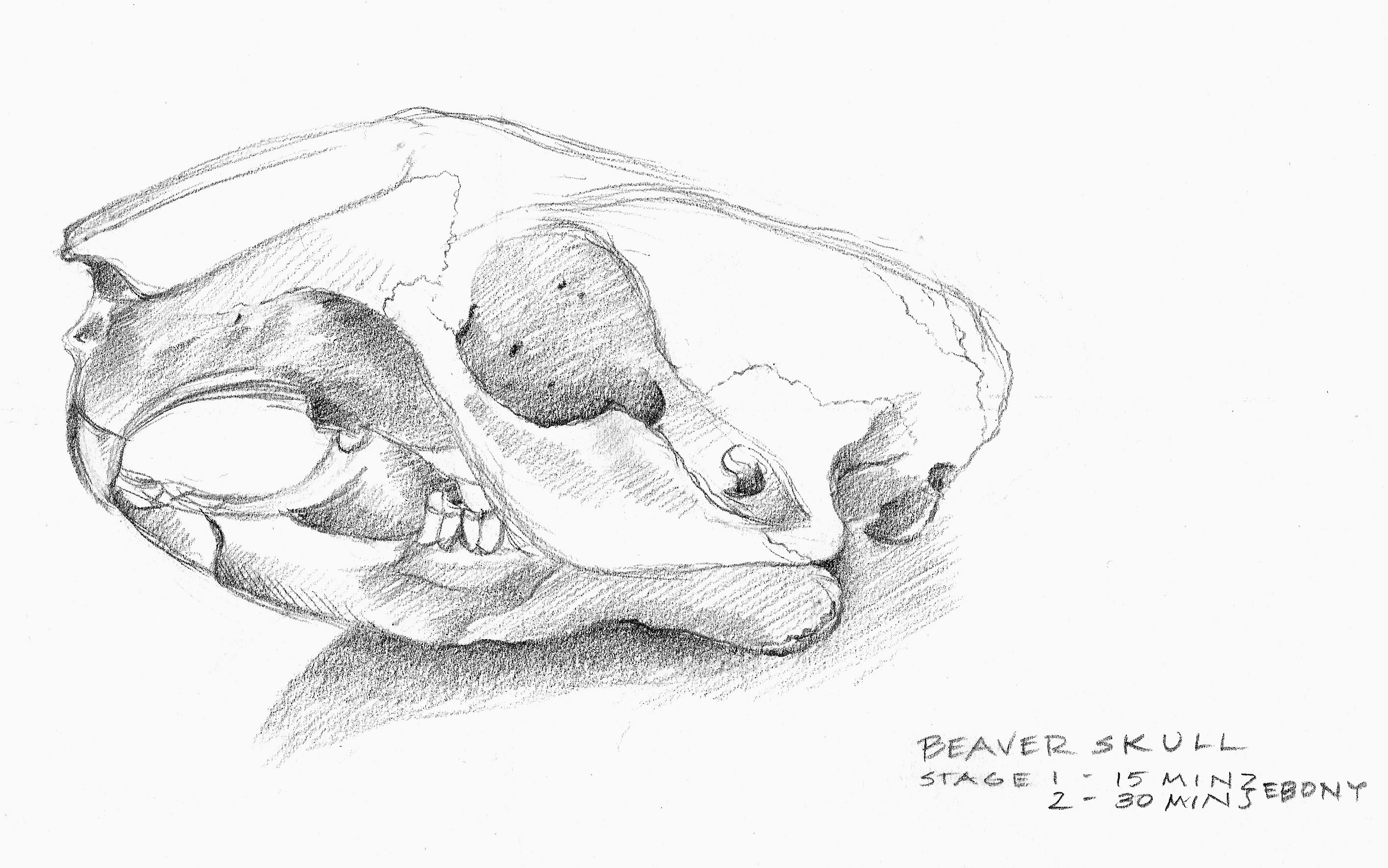
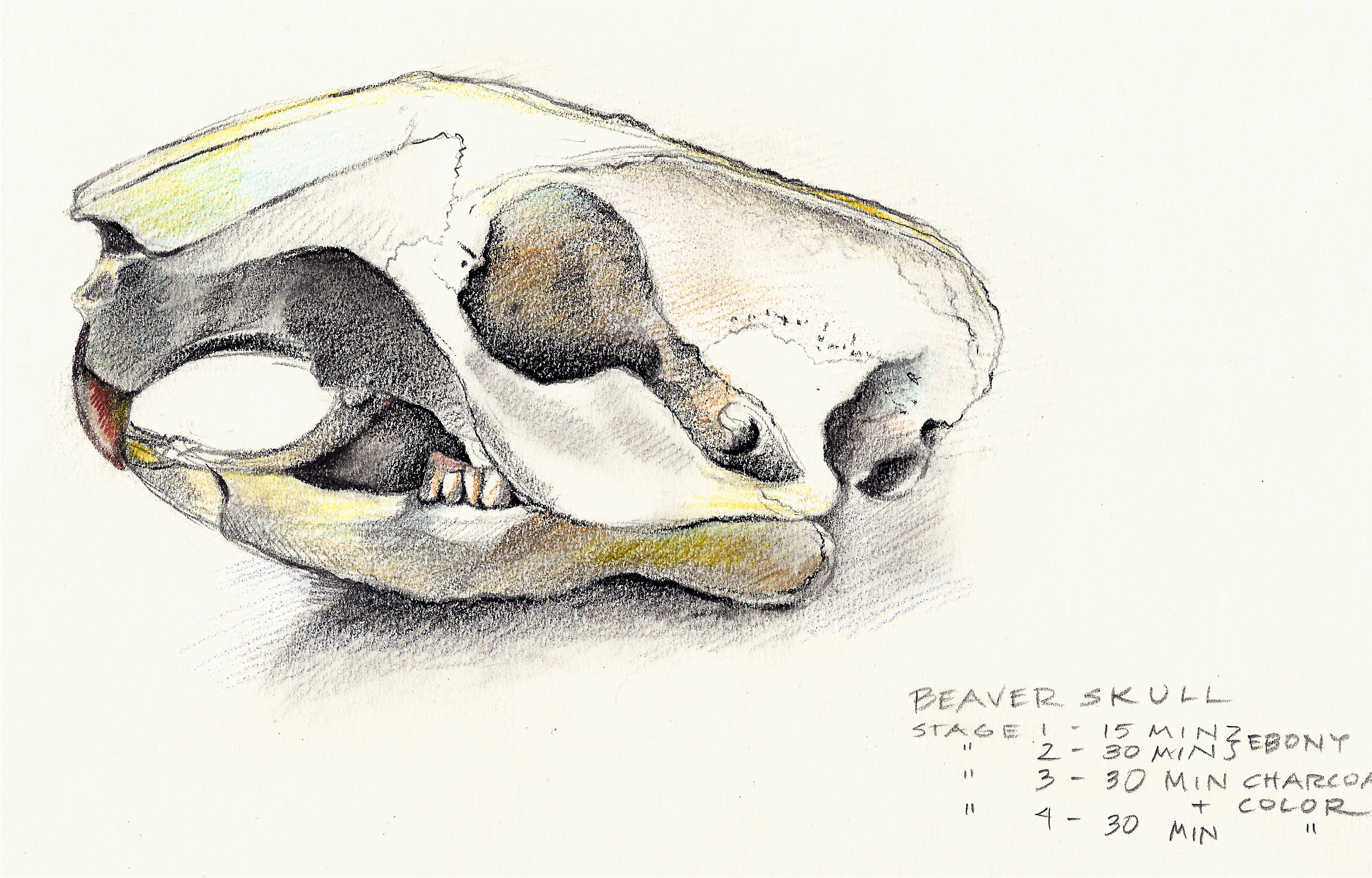
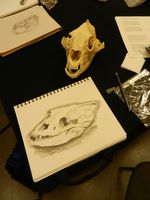
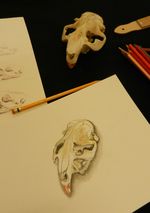
Beginning with a challenging subject, a mammal skull, each student in this North Cascades Institute-sponsored class began the day with warm-up contour drawings. Shading with graphite and charcoal was practiced, and then a more developed drawing was made during the morning hours of this one-day class held in the classroom at the Burke Museum on the University of Washington campus. Above, a visual step-by-step tutorial I created for this class features how to sketch and shade a beaver skull.
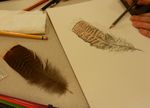
Above: a few examples of class work. Accuracy of form was emphasized, but so was the addition of some color, even where color was not blatantly evident. Once the skull renderings were developed, I distributed wild turkey tail feathers for a contrasting subject. In these, the zig-zag pattern of color gave the drawers a chance to blend colored pencil pigments to achieve the colors and feather textures.
Above: students successfully rendered the soft, downy part of the feather, the graceful curve of the rib, and the woven look of the banding.
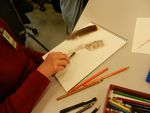
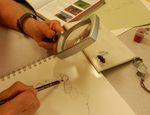
My original plan was for the turkey feather sketches to be warm-ups to drawing a portion of a spread bird wing as shown in the photo above on the right. Naturalist Katie Roloson, from the NCI, gave a brief talk on feathers and wings. She is seen holding the wing of a red-tailed hawk, and I am holding an owl wing. Katie had brought "bug boxes" as alternative subjects for drawing. Most students opted to draw moths, butterflies, dragonflies or beetles as their final specimens, most without the aid of a magnifying glass, but one student came prepared and drew a beetle using a glass as seen in the photo above on the left.
Thank you to the Burke staff members Carl Sander and Diane Quinn for assisting and supporting NCI's educational programming outside the organization's Learning Center at Diablo Lake.
 Have you ever noticed how many pear paintings the world's artists seem to be producing? A friend recently commented, "It's because pears are so voluptuous." Ah, this could very well be. But they also offer a manageable challenge for beginning oil painters like moi-même. These pears sat on the kitchen counter, in front of the more popular bunch of bananas, for about a week before I had to paint them. For me, all aspects of painting with viscous oil paint are challenging: color mixing, working from dark to light (the opposite of watercolor), and trying to achieve a 3-D appearance. One of my workshop teachers said, "Painting with oils is just like doing any other artwork." Oh. Why does it feel like traveling in a foreign country, then?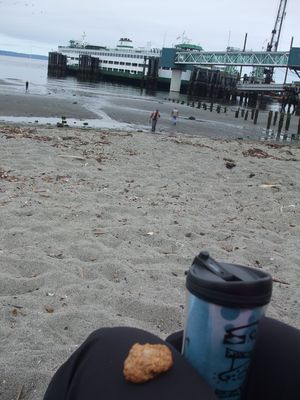




 Jocelyn Curry