Jocelyn Curry

Art & Joie de Vivre

  • All I have to do is look at the date of my last post to confirm what I knew already: it's been a very full 6 weeks since I have posted anything new! Summer activities are coming to an end, signaling a return to the studio. There are design projects coming up, workshops being discussed, and new technology to learn here.

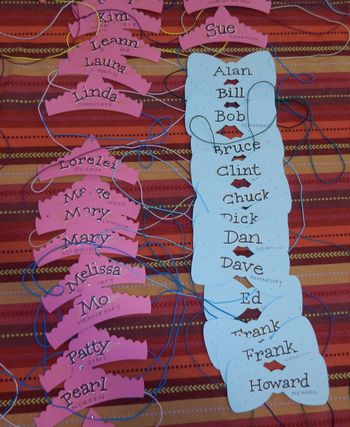
    While I rarely do the bread and butter calligraphy projects that once kept me busy, I do still love to do them for special events for friends or family members. Below you can see some of the namebadges I made for a birthday party held on August 25. The guests were such good sports; all but one of the 105 wore either a bow tie or tiara!


    DSCN1037

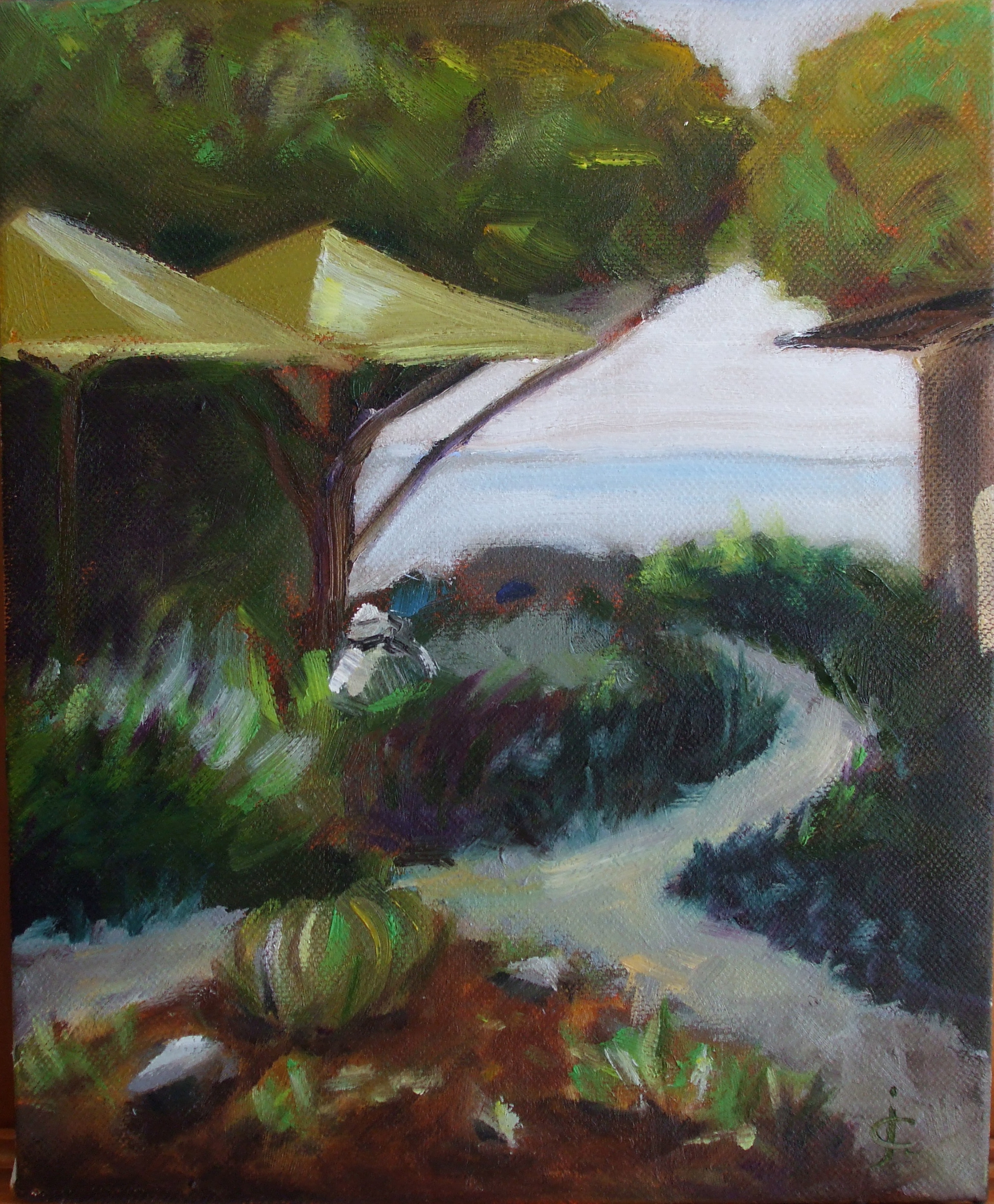
  • Today,  I reserved time to finish a painting I began in early July. That day was spent in my friend Claire's garden, with her painting lilies in watercolor while I painted a garden scape in oil that included her as she sat under one of her chartreuse patio umbrellas. If the day sounds idyllic, it was. We spent some six hours painting, primarily, with the occasional check-in on one another. I even took a nap in my chair at one point, lulled by the radiant sun that day. Here is the finished painting which I'm giving to Claire in recognition for the years of her life spent weeding that glorious garden:


    DSCF0763

    Claire's Garden, oil on canvas, 8"x10"


  • …there is always the garden. Minnie Aumonier
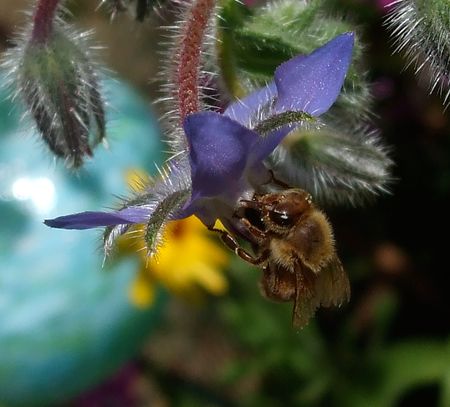
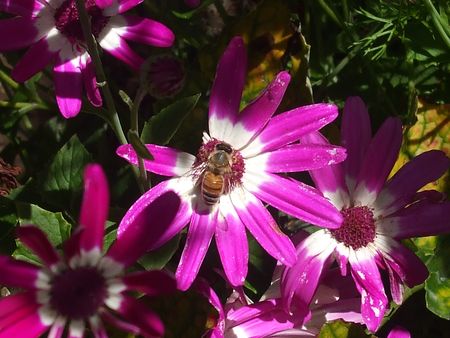
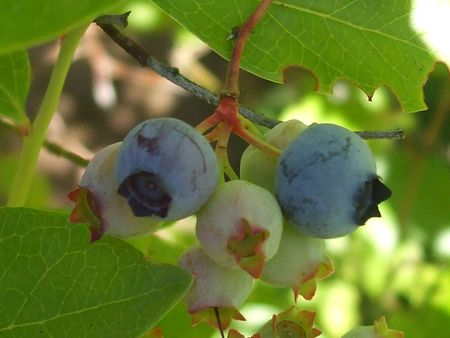
    This brief quote means a lot to me and has since 1985 when I first bought a card with these words engraved on it. When a little solace and comfort are needed, I always have a place to go. I celebrated today's idyllic, birdsong-accented morning by taking my camera out to the Early Garden:

    Bee to borage
    DSCF0705

    Blueberries
    DSCF0707

    Juncos

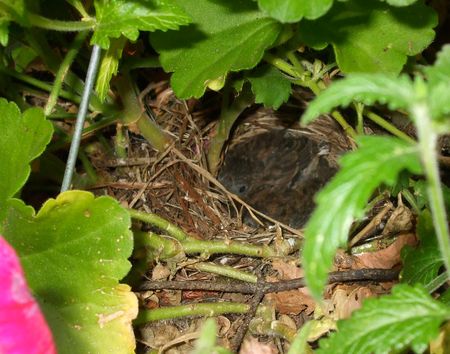
    Three baby Dark-eyed Juncos hatched in my hanging basket. Both parents work full time to feed them. We are used to one another now, with the parents carrying on with their nurturing even during a birthday party going on next to the basket! [postscript: they fledged two days later.]


  •  

    DSCF0631

    After arriving at the Bay, I took a walk through the uplands of the Reserve to design specific journaling exercises for the following day.

    Nothing is rich but the inexhaustible wealth of nature. She shows us only surfaces, but she is a million fathoms deep.
    EMERSON

    This quote is especially appropriate for the tranquil location of the National Estuarine Research Reserve, of my July 13-14 workshop in quiet Bay View, Washington. 16 students and I gathered there to spend two days recording on journal pages some of the natural features surrounding us. Perfect summer weather, a fine classroom facility, earnest learners and plenty of delicious food (the Skagit Valley, where the Reserve is located, is Berry Central right now) combined to make a successful weekend.


    DSCF0644

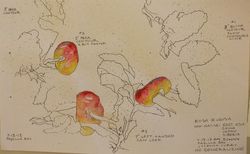
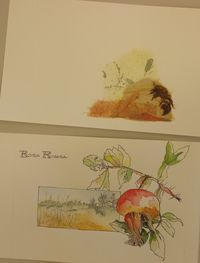
    Creating a beautiful pattern of inklines across the page, these drawings by Jude Middleton are good examples of contour drawings. Color added only to the hips, with a final spatter of watercolor overall, add richness. Journal notes finish the job; this is a perfect nature journal page!

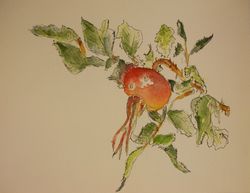
    Saturday's warm-up exercises began with a page of drawings. Blind contour drawings of the hips of Rosa rugosa (collected from a mound of them on the property) were followed by left-handed drawings of the same on the same page. Following these, the students then moved right onto fine watercolor paper with a detailed drawing of a rose hip and its clusters of leaves.


    DSCF0658

    Brooke Randall's delicate pen work is enhanced by her way of applying watercolor. Using a variety of greens and yellow in foliage makes it come alive on the page. Journal pages are 6"x10" of Fabriano Artistico cold press watercolor paper.
    DSCF0648

    Elle Romick's composition shows the landscape where the mound of Rosa rugosa lives. Careful placement on the page allows each design element to have significance and to enhance the others. Above the rose hip page is Jude's collage. Many of the students made these to decorate the cover of their finished journals.

    After a brief lunch break, the group walked up the path to a point where we were allowed a landscape overview that included the mound of roses from which came our specimens. The rest of the day was spent developing both the hip painting and the small landscape study that joined it on the page. Lettering skills were practiced, too, with emphasis placed on overall page design.

    On Sunday, the assignment for the day's work was given early on: five specific journal items were to be added to the journal on one or two pages. The examples below show the variety of choices: something from the aquarium, a detail drawing of a chosen specimen, a decorated versal letter, a small landscape, and a small map. But prior to starting our artwork for the day, most of us moved through the plentiful array of breakfast foods (shouldn't all serious work days begin with such a repast?) arranged on the buffet table:


    DSCN0911

    Berries, nuts, home-baked items and deviled eggs courtesy of Anne's hens were among the generous spread.
    DSCF0639

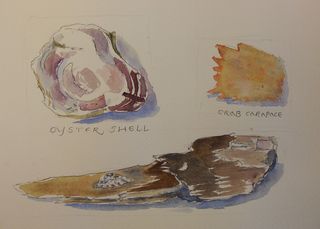
    Claire Russell selected beach specimens for her detail studies. Adding shadows consistently to each item enhances this collection.


    DSCF0649

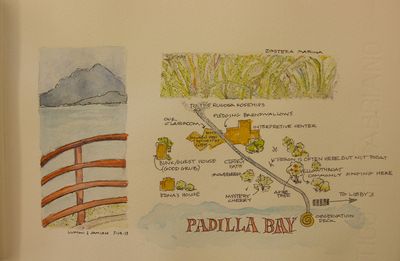
    Mary Heath rose to the challenge of designing a map that tells the story of our unique location. On the left side of the page is a view of the Bay overlook, and the eel grass rendering above the map creates the ideal top border for the map while honoring this important Padilla Bay aquatic plant.


    DSCF0659

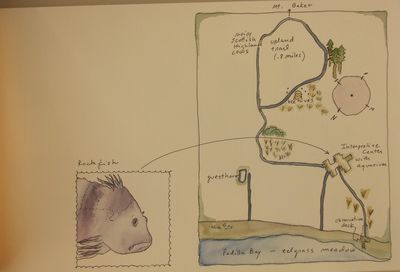
    Mary Siple also created a map of the Reserve and Bay, opting to feature a rockfish from the aquarium in the outstanding Brazeale Interpretive Center.


    DSCF0661

    Mary's lugubrious rockfish becomes the humorous fellow featured in the fenestration on the cover of her journal. We all laughed!
    DSCF0650

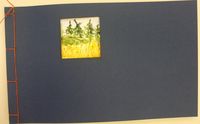
    Brenda Boardman's lively watercolor landscape was ideal for framing with a fenestration on her cover. Students chose between four colors of paper for their journal covers.


    DSCF0651

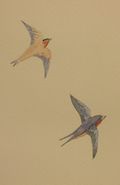
    Kay Reinhardt rendered Barn Swallows in flight as a nod to the nesting swallows in the outdoor corridor of the Center.
    DSCF0662

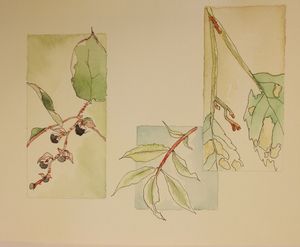
    Anne Middleton's delicate watercolor and fine ink lines are used here to depict studies of native plants. L to R: Salal, Elderberry, and Red Alder.


    DSCN0908

    Our group used viewfinders to help isolate a section of the landscape that featured the distant mound of Rosa rugosa.

    To all who participated in this weekend of learning, sharing, and the expanding of perception, I thank you for the chance to spend two days together and I applaud the excellent work you did. Continue to practice, practice. Special thanks go to the Padilla Bay Foundation administrator Kay Reinhardt. Thank you Libby, Anne, Mary, Nancy and Marilyn for your positive support and help in set-up, take-down, and seeing that all of our needs were met.

  •  


    DSCF0565The Artful Map workshop
    I taught last weekend at the North Cascades Institute's Environmental Learning Center began simply enough. Each participant received a packet of papers and reference materials plus two different pens to use. Many of the 14 did not consider themselves to be artists or designers, which made all the more bold their trust in the focused creative process into which they were entering. (Please click on an images for larger views.)

    A few of the students arrived with an idea of a place of personal significance they wanted to map and brought some materials to refer to. All the students needed to arrive at a starting place for their maps after just 4 hours in the classroom. Then, the designing began. With most maps carrying a lot of detail including images and text, icons and roadways and paths, time was of the essence in the design and execution process. When you look at the work that was done in this class (and during evening hours for some), It's hard to believe that some of the map designers literally had never made anything like this before. Below you can see the early stages of two maps that illustrate the design process, and the finished pieces are below those.

    To all of my students: You went above and beyond, and it was a pleasure to join you on your mapmaking journeys.

    DSCF0574

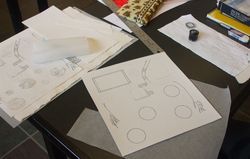
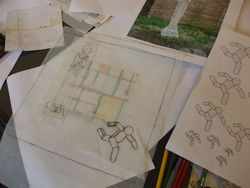
    Regina Wandler's desk displays pencil work-ups assembled on a trial sheet, tracing paper, and the first phase of inking in of basic map elements.
    DSCF0573

    Patricia Resseguie had an idea for a map, so she collected materials at home to use in class. Even with this forethought, the actual design process brought surprises. Her map turned into a stained glass window (Frank Lloyd Wright-inspired)on her final map.


    DSCF0609

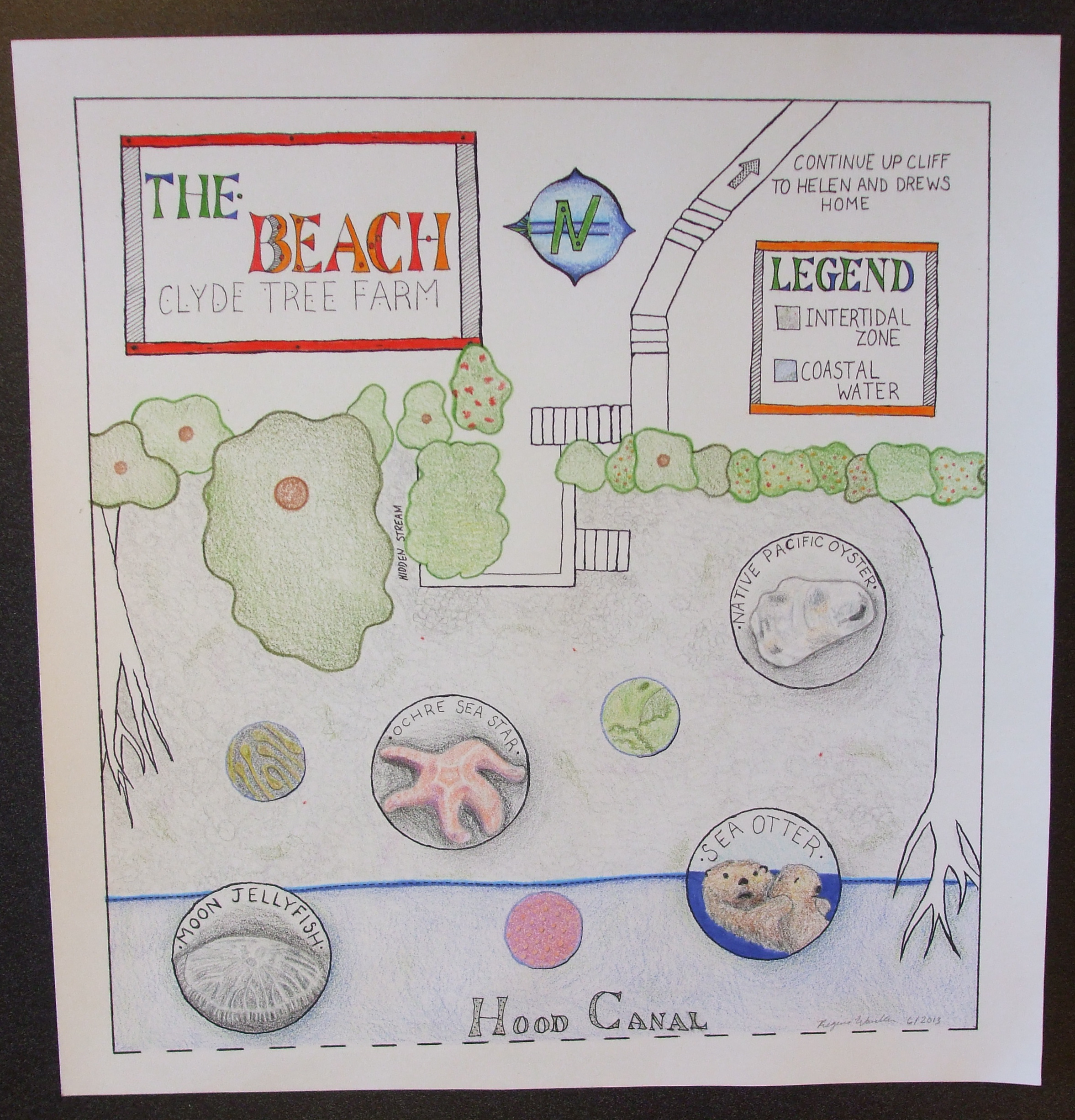
    Regina's completed map. She used graphite, colored pencil, and ink.


    DSCF0608

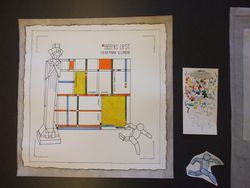
    Patricia's map. She may eventually color the figure on the right. Ink and watercolor were used in the image, with the trompe l-oeuil effect in the border done with graphite.


    DSCF0605

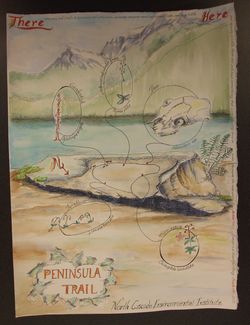
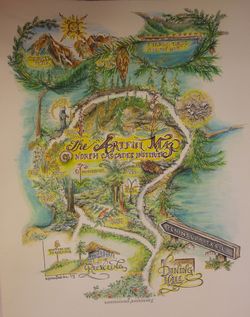
    Kathy Brackett was inspired by the views and the natural objects seen from the Peninsula Trail on campus. Her unique approach of floating detailed images over her background painting worked well.
    DSCF0606

    Karen Bakke's richly illustrated map of the Peninsula Trail includes a breathtaking wealth of detail and full color. The drawing was done in ink, followed by water-soluble colored pencils.


    DSCF0590

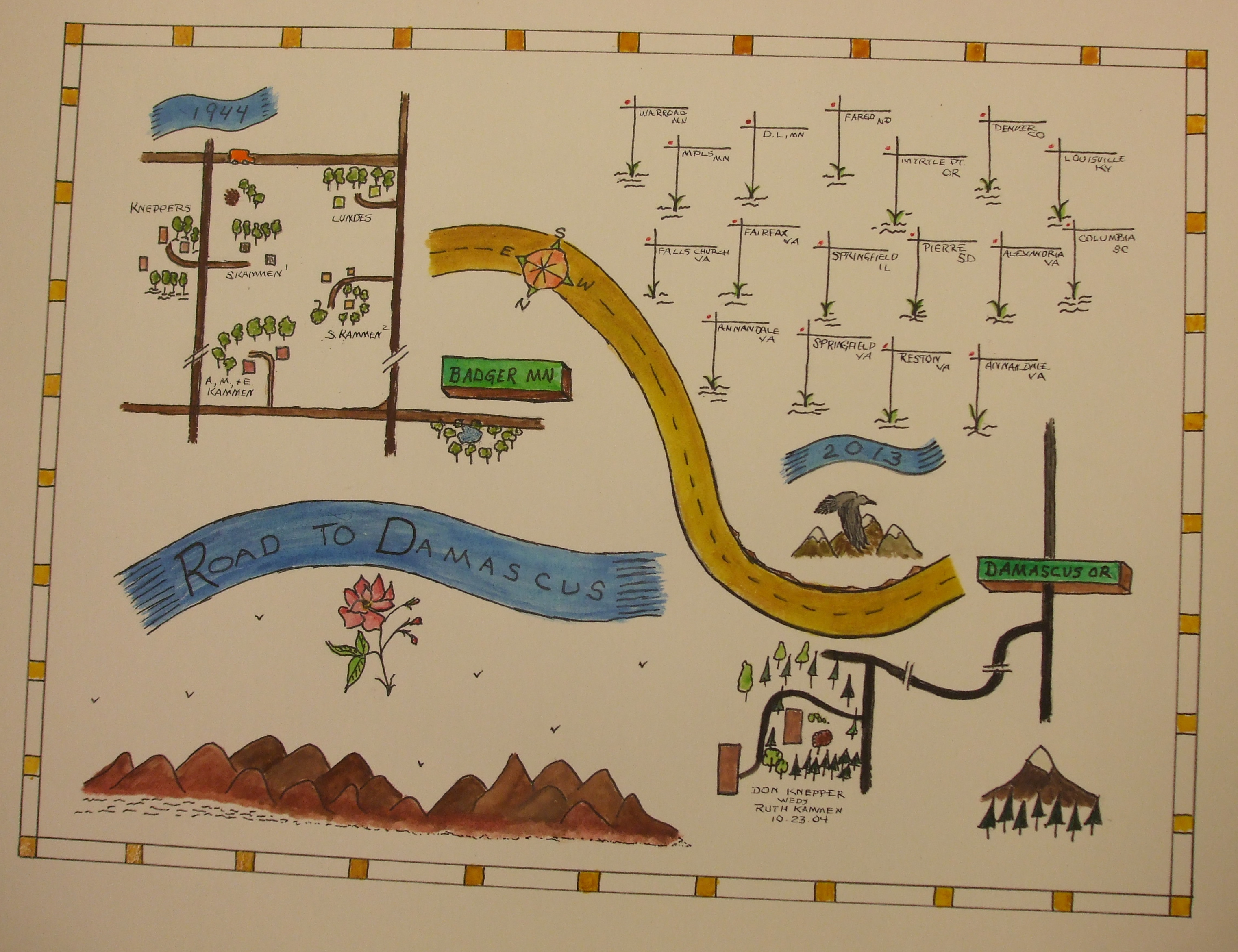
    Ruth Knepper created a "map of my life" depicting her birthplace, the 17 moves she has made, and her current home. A lifetime, on one page! Ink and watercolor were used.


    DSCF0592

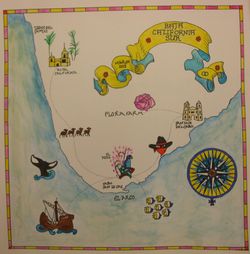
    Rebecca Demaree commemorated her honeymoon trip to Baja California in this colorful map. Stylistic unity and a storytelling feel make this a fun map to look at.


    DSCF0603

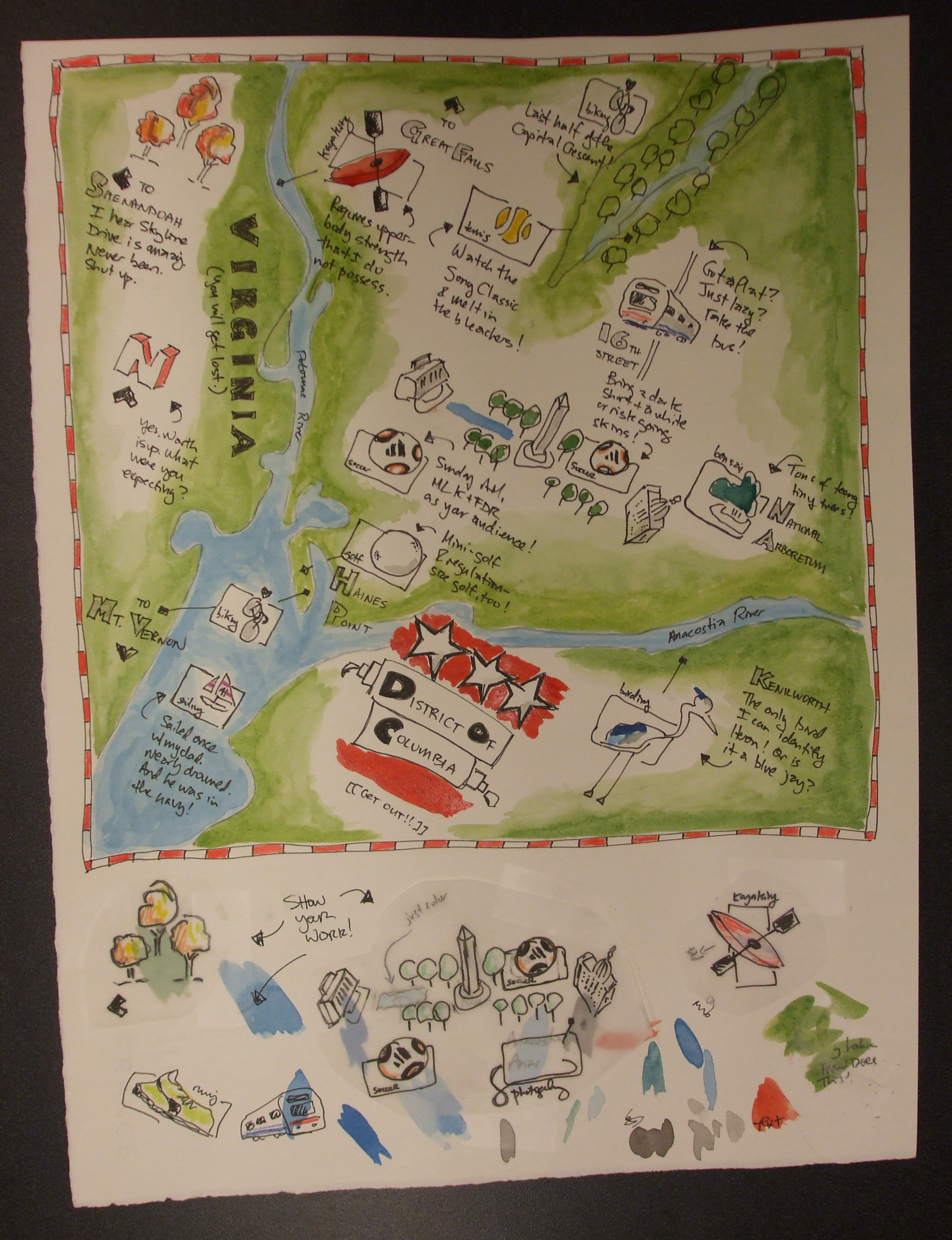
    Scott Kirkwood drew a map of the section of Washington, DC where he lives, works, and plays. A sense of humor comes through with Scott's drawing style and his witty captions.
    DSCF0607

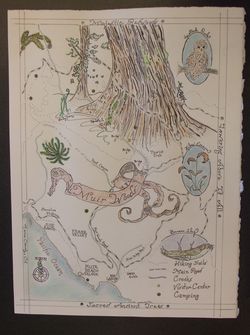
    Linda Chauvin merged two layers by superimposing her illustrations of Muir Woods, CA, over a map of the area. The result, one classmate said, was "like a fairy tale." Linda burned a lot of midnight oil doing her final map.


    DSCF0612

    Marian Jones created a life's journey map based on her birth, schooling, marriages, and her ongoing quest for knowledge. Humor and Marian's joie de vivre permeate her map.
    DSCF0610

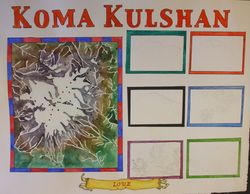
    Stephanie Bennett honors one of her favorite peaks with a watercolor and the routes she has hiked to the summit. In the boxes she will ink in various views of the mountain.

    DSCF0611

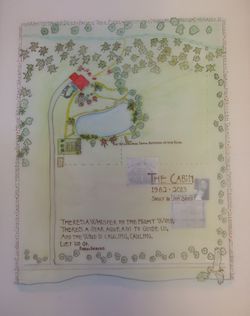
    Sally Soest used a watercolor wash on paper as the bottom layer to a translucent mylar map. Graphite, watercolor, and careful lettering tell the story of the cabin.


    DSCF0604

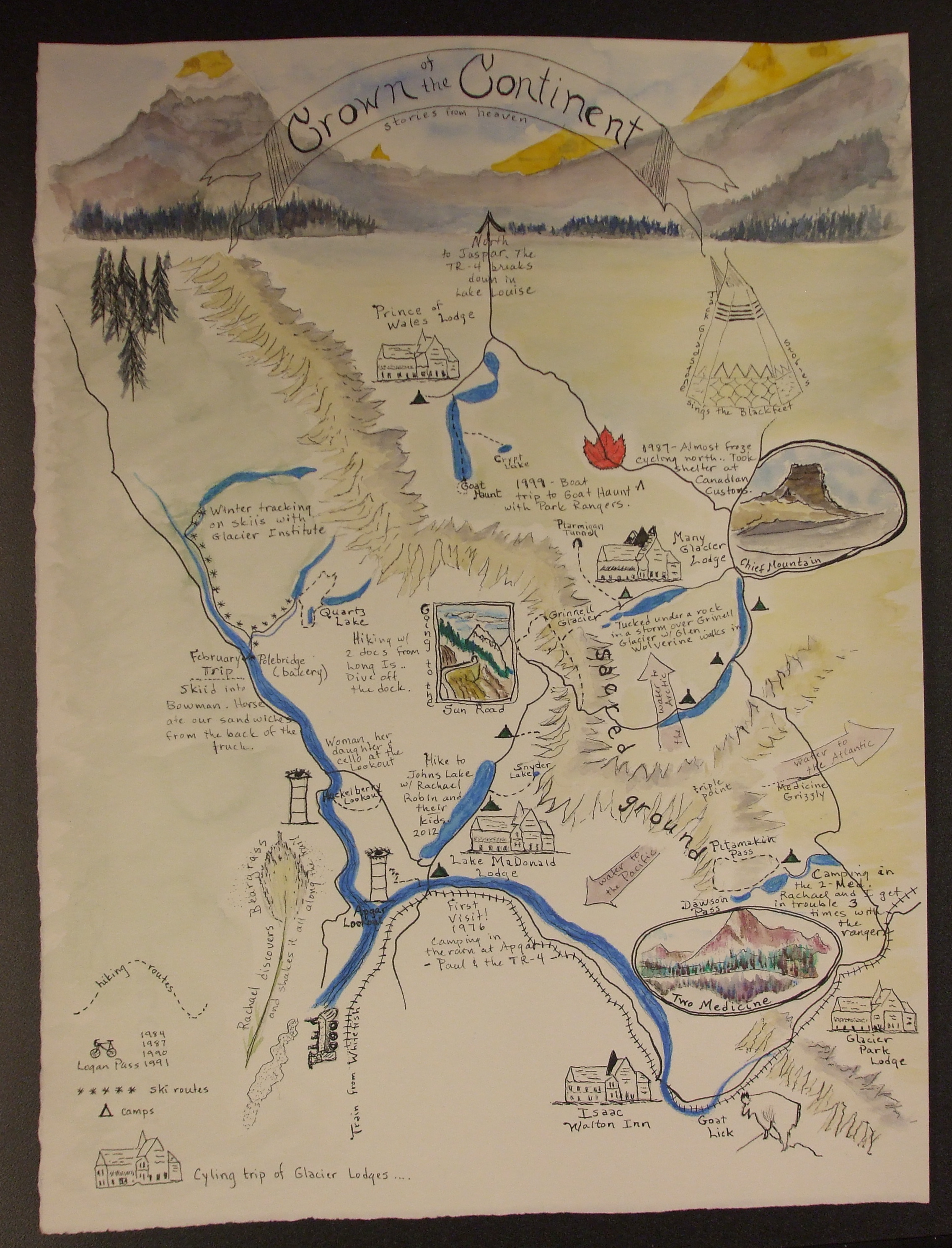
    Renee Fredrickson commemorated many adventures within one geographical region: The Continental Divide. Trips dating from 1976 are recorded in drawings, insets, and notes.

    DSCF0578Shelley Spalding worked intensively on her map, the inked beginnings of which you see on the left. Shelley had to leave before class on the last day, so I didn't have a chance to take a photo of her nearly-finished map. I hope to receive a photo of it from her.

    Thank you for your interest!

  • Dear Reader,

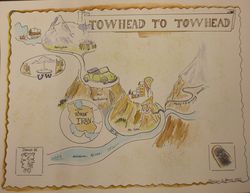
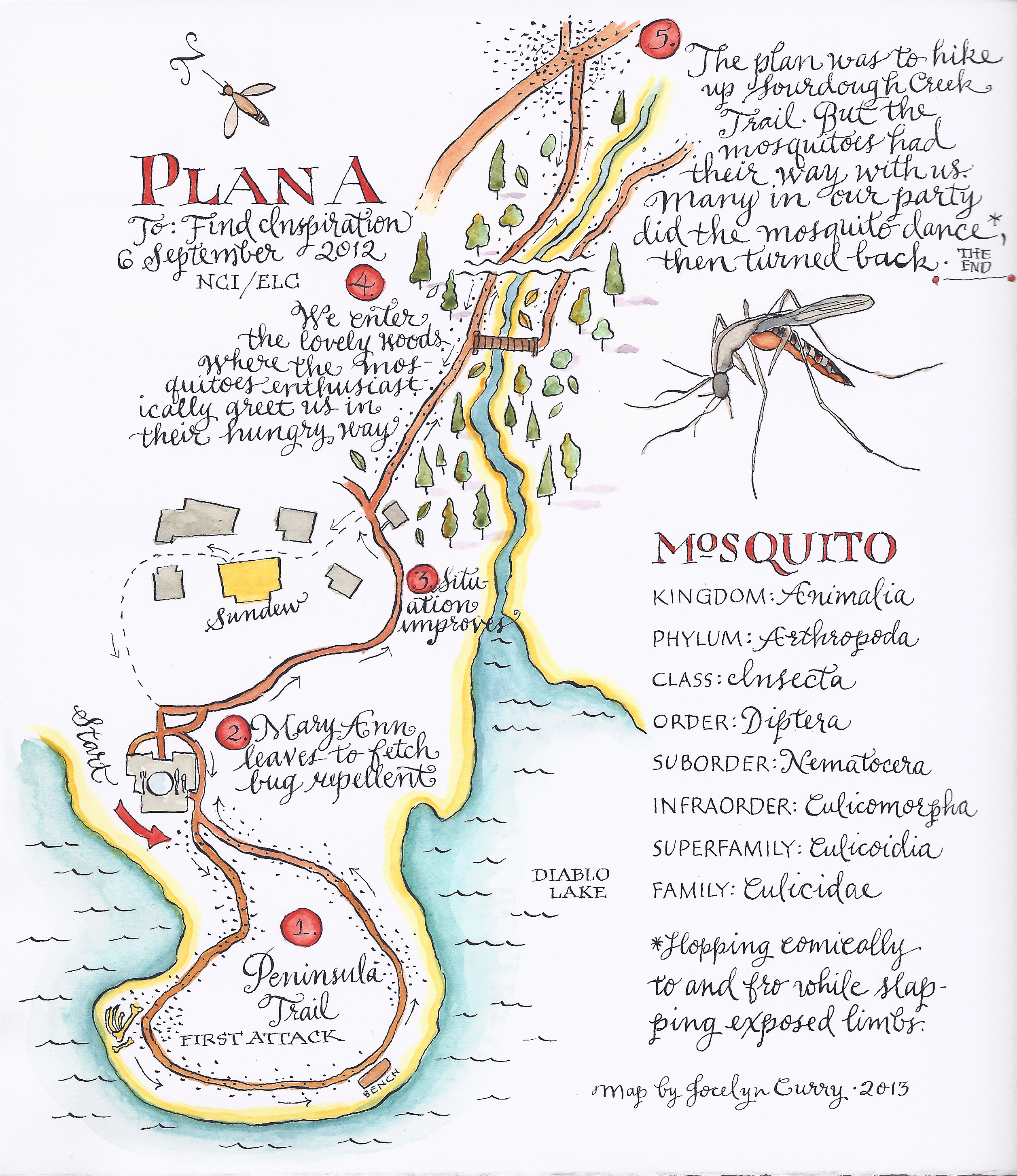
    Perhaps you have arrived here by searching for The North Cascades Institute, or it's superb Environmental Learning Center up at Diablo Lake in the North Cascades mountains of Washington State. Before deciding never to go there because of the story told in the map below, I hasten to assure you that in all the years I've taught at that magnificent place, I've never received a single mosquito bite. Further, I was told that it's highly unusual for there to be mosquitos there at all in September (the winds through the gorge sweep them away), so the incident commemmorated in my map is not likely to happen again in September, at least. Insect repellent is always on the list of things to pack because the ELC is, after all, at the edge of a thriving wilderness, and those are places that serve all manner of living beings. On that note:


    Mosquito map

    An ill-fated walking tour intended to give an inspiring overview of the natural features of the area ended in well-tolerated failure. For this map, a crowquill pen with India ink was used for the line work. Watercolor was added after the ink work was done. This map is intended to be humorous, so I used a casual script with no guidelines for the text. Just for fun and a bit of real science, I profiled our dubious friend the mosquito.


  • Perhaps all rights-of-passage come unexpectedly. I have never given the matter much thought. But 51 years ago to the week, I began my experience of one when I, as a homesick-prone child of 12, left my own family home in Casablanca, Morocco, to travel with our French neighbors to their summer home in southern France.

    The trip lasted a full month. My travel journal documents the four-day road trip preceeding the four weeks spent in the tranquil, verdant village of Les Cammazes, 35 km from the historic city of Carcasonne. The population of Les Cammazes in 1962 was 164. The population in 2006: 290. Astonishingly, the town was established in 1384 AD. It was a classic, rural village consisting of one main narrow road tightly lined with stucco and stone buildings. Surrounding the village were farms. There was a broad stream (technically it was a flume) running across the main road, creating an X from an aerial view, a stream which played an important part in my time spent in the village.

    I alluded to the tiny, lined notebook that became my travel journal in a post to my professional site. The week after doing so, I found the journal itself, tucked away in a scrapbook recently excavated from an old steamer trunk in our basement. When had I last seen my little book? Perhaps 40 years ago. Reading it has launched me into deep memory recall of a pivotal time. I left my parents and sister as a child that June, and returned to Casablanca at the end of July as a person with a greater awareness of herself in the world.

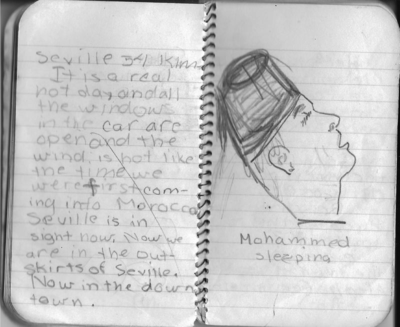
    The road trip was arduous. Extreme heat, a crowded car, a rough ship passage across the Straits of Gibraltar and car trouble while crossing the Pyrenees made it an endurance test. In great detail, I recorded all of this in my journal. Here is a spread, one of the few that includes a sketch:
    Mohammed sleeping

    In French Morocco in the 1960's, it was common to have live-in household help. The men were referred to as "houseboys." Mohammed, sketched here while sleeping in the car, was the family's houseboy who traveled with us to be in service during the summer stay. His passage on the ship taking us from the African coast to southern Spain was his first boat ride. He was seasick, according to my journal.

    Almost exclusively, we spoke French. This contributed to my homesickness because communication was difficult; I had only picked up a little conversational French from our ten months of living in French-speaking Morocco.  One of the daughters was close to my age, so she was my adventuresome daily companion in Les Cammazes. At the end of the month with the family, I spoke informal French with considerable facility and a convincing accent.
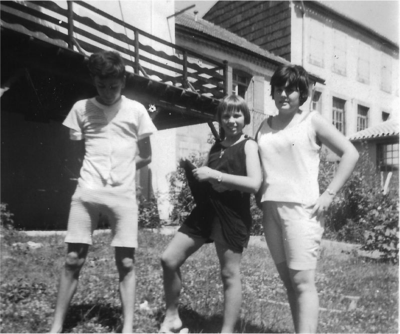
     

    Three of us

    Here you see me between two of the siblings. While digging around in an old trunk of clothing, we found some vintage woollen swimsuits.

    During my four weeks in the village, I wrote letters to my parents who were in Italy during part of that period. The letters, describing daily activities such as "fishing in the creek with a burlap bag," always ended with, "I miss you so much. Please write to me." The letters mailed to the American Express office in Naples never reached them, but were returned to Les Cammazes. 
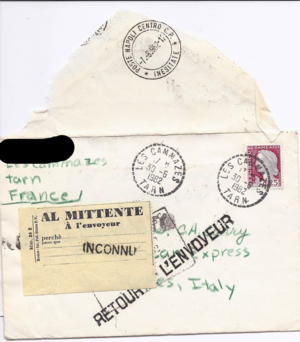
     

    Inconnu

    "Unknown. Return to Sender."

    So penetrating was my homesickness one time that after an upsetting incident with my companion, I had to go to bed because I appeared to be physically ill. Alone in a large bed in an airy upstairs room (a special place, as there was some resentment that I got to rest in it), I recall studying the vintage toile wallpaper at close range. The repeat-pattern images of happy groupings of full-skirted, parasoled ladies in the countryside with romantic little villages in the distance made me all the more aware of how far away from home I was.

    The two returned letters I have described our fishing activities more than anything else. Madame saw our obsession with fishing (and catching crayfish), so she bought us some tackle which immediately yielded fish that were big enough to cook for the family meal. With our growing success at fishing, we spent more and more time at the creek. One episode has always stayed with me, and that was the time we found a villager's hat snagged at the end of a stream culvert where rushing water emerged from a fairly narrow passageway. We found out from a village shopkeeper that the fisherman whose hat we saw had evidently lost his balance while fishing the day before, had been swept into the pipe, became lodged, and drowned. It was darkly sobering, especially after hearing a graphic description of the victim's appearance.

    The photo below, also found in my scrapbook, immediately evoked other, more pleasurable memories of my stay:
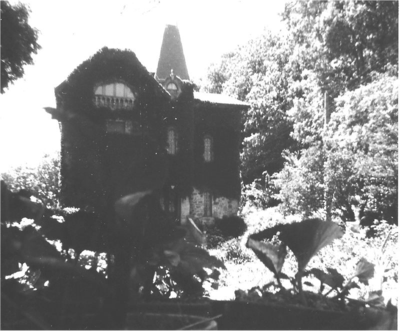
    French house

    Until I saw this photo in my scrapbook, I had forgotten our visit to this ivy-covered stately home near the entrance to the village. I recall the sun flooding into the parlor on the west side of the house, where a friend of the family welcomed us three girls. I don't remember the reason for the visit, but the romance of the place comes back to me.

    Built of stone and surrounded by lush gardens, the house pictured above was just downstream ( I think) from the village laundry facility. This consisted of three massive stone basins with built-in stone washboards. Diverted water from the stream ran directly through the tubs. Women doing their washing began at the first tub, punishing the garments against the stone washboards with muscular arms using brick-sized bars of olive oil soap. I can still see them in my mind's eye. There was a method and rhythm to the work that left a lasting impression on me. The second basin was for the initial rinse. The third, for the final rinse in fresh creek water. I have to wonder: are the stone basins still in use today?

    It came as a surprise to me when a friend of the family, a French teenaged boy who was also in Les Cammazes for the summer, developed a crush on me. This was a big contributor to the right-of-passage factor, as I was entirely unprepared for something like this. I look at the photos of my childish, flat-chested body, my bangs and my bob haircut, my toothy grin, and I still wonder to this day what intangible forces may have come into play. Of course, I was flattered, if taken aback. I became self-conscious when he suggested to me that it was time for me to start shaving my legs (French women never shaved theirs in those days!).

    We had a dance one night in the cool, rustic stone wine cellar beneath my French neighbors' villa. We strung a bare lightbulb up, on extension cords, as there was no electricity in the cellar. I believe that the teenaged boy's name was Joe–but I'm not sure. We all had glasses of wine, which, in spite of my having been drinking diluted wine, French-style, with our dinners, was much too strong for me. I didn't know what to do with it. I was dancing with "Joe," awkwardly I'm sure, and something inexplicably compelled me to pour my wine on the lightbulb dangling against the stone wall. The lightbulb, predictably, exploded. Everything went dark, and there was animated chaos in the wine cellar as the music continued from the record player. I think I may have claimed culpability, because I vaguely recall a lecture on the physics of pouring cold liquid on a very hot object.

    As I read through my little journal a few days ago, I was puzzled by the last entries. Once we had finally arrived in Les Cammazes, I officially ended my journal (THE END). There are numerous blank pages following THE END. But on the last page, and on the inside of the back cover, were these entries:
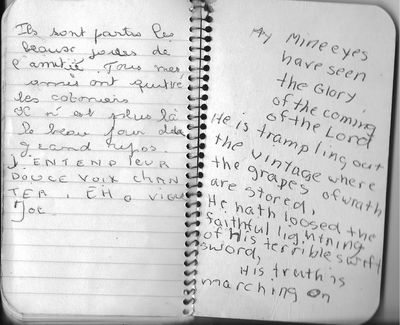
    Poem and song
    On the left is a poem written down, I believe, by "Joe." Here is my translation of the poem:

    They have departed, the beautiful days of friendship-

    All my friends have left the cotton plants-

    It is no longer here, the beautiful day of the grand repose-

    I UNDERSTAND THEIR SWEET SINGING VOICE.

    [I don't know what the last, partially written line means. And, the name "Joe" could actually be the beginning of "Jocelyn." There may have been an interruption.]

    Now, I have no explanation for why I would have written (and why so crookedly) the words to The Battle Hymn of the Republic on the facing page. I always liked singing this strong hymn when I was young, but why would I have written it as almost a reply to Joe's lyrical, parting poem? Why the juxtaposition? I'll never know.

    I returned to Casablanca on an Air France jet, by myself. I have the telegram that Madame sent to my parents letting them know when I would be arriving. The stewardesses seemed to treat me like a grown-up, with sweet graciousness and respect: la jeune fille Américaine. This is a keen memory because I realized at that moment that I had grown, and changed. It almost seemed magical, that flight back. I could be apart from my parents, cope with a host of situations I had never faced before, and even fly alone on a jet.

    Joe wrote to me after my return home. I was slightly embarassed by his letters, and I don't remember replying because I really was not ready for his amorous focus upon me. Mom asked me about the letters, of course. I couldn't bring myself to keep them, evidently, because they are not in my scrapbook. I couldn't quite explain what had transpired with Joe, or perhaps I didn't really want to, because Joe's attention to me was part of my private awakening, my right-of-passage to an expanded world. 


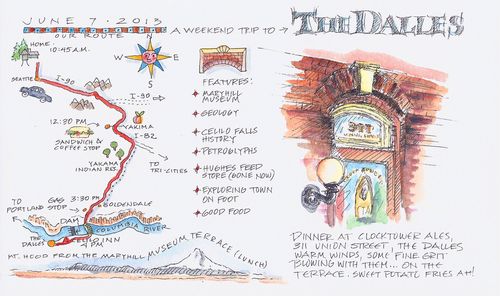
  • When I was 12 years old and living in Casablanca, Morocco, I was invited to go to our French neighbors' summer home near Carcasonne, France. Prone to homesickness to begin with, I soon turned to a small, lined notebook* I had brought to make notes about the long drive as a way to keep my mind off my trepidation about leaving home.Thus began a lifelong habit of creating travel journals. Here is my most recent page from a fun weekend exploration of an historic area just a few hours from Seattle:

    The DallesSm

    Every aspect of this trip was a pleasure. The drive, the historic buildings in The Dalles, the stunning presence of Mt. Hood against the blue sky, and the wealth of cultural significance of the area. I tried to include them all. The page is 6"x10".

    *Since I posted this piece on The Dalles, I have written a memoir of the trip I took when I was twelve. To read it, please click here.


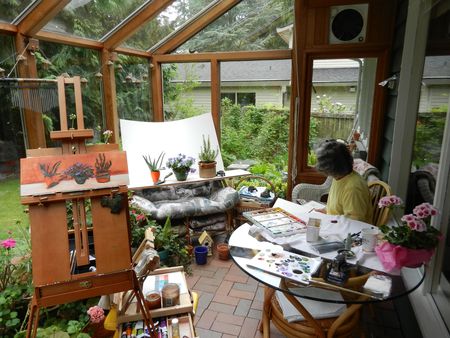
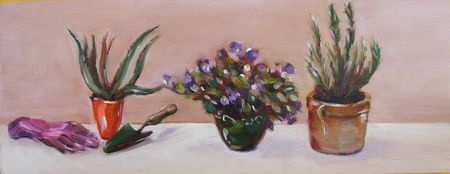
  • Daily life responsibilities tend to sweep us along and we often never get around to doing things that nurture our creative selves. To remedy this tendency, my friend Claire and I set up our second date to paint together last week. She paints with watercolor, I with oils (these days). We commit to a 10 AM-4 PM span of time, which includes a potluck lunch. Here are a few photos documenting our seasonally-themed still life painting day in my greenhouse:

    DSCF0482

    Early in the day, we both launch into preliminary work. My small painting is seen on the left as an underpainting done in burnt sienna. Claire works on watercolor studies on the right. Our still life glows in the distance.
    DSCF0485

    Claire's first work: on top, the rosemary pot is studied on a single page. Below was Claire's first take of the left side of the still life. Although Claire wasn't happy with this painting, the colors are beautiful.
    DSCF0488

    As a final painting, Claire isolated the rosemary pot and added a turtle!

    DSCN0718

    Here you can see that my painting now has color added as I work from dark to light values. Claire is seen studying her rosemary pot as she paints it.

    DSCF0512

    My finished painting. After Claire left the "studio" I added a pair of soiled fuchsia gardening gloves to the still life. It just looked like it needed something more. Eventually I'll sign the painting on the right, and then maybe it will be balanced. I hope.


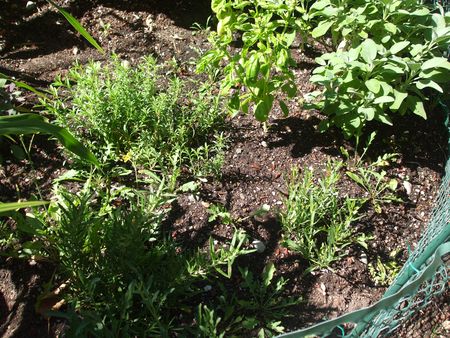
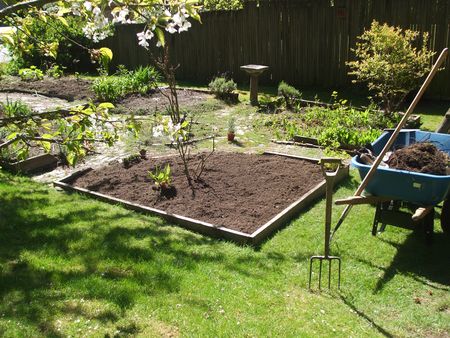
  • It's been over 25 years since I first designed and constructed my "Early Garden." It was thus named because it was the first part of our property that receives the morning sun. Over the years, I've wearied of weeding and maintaining it all. Know what I mean, fellow gardeners? But this spring has brought a renewed interest in beautifying the Early Garden, so last week I began with the NW quadrant to create a designated herb garden. It's the closest to the kitchen, so it's really the "kitchen garden" as it were. Here are a few pix with captions:


    DSCF0468

    My digging up of flora from the past begins. Bess is on hand to pluck worms as I unearth them.

    DSCF0469

    Gone are the rampant lemon balm volunteers, the feverfews, the love-in-a-mists, the past-blooming iris leaves, the old straggly calendulas from the 1980's. Time to plant anew.

    DSCF0480

    The first new residents: a rosemary plant, a sage plant and a thyme from friend Jennifer, some parsley babies from friend Tom, dug up from the old garden, two pericallises (violet flowers; garden gifts from Rick), and a couple of new pansies for more color. The sorrel plant from friend Patty was kept, as was the heritage rose from my mother-in-law.The vinyl chicken fencing is to keep you-know-who from excavating in the soft earth. There is plenty of room for other herbal newcomers, so I'll post more photos as I make progress on the planting.